Task Force Created for Cannabis Forest Crimes Reports Human Trafficking Arrest in Navarro; When Denied Basic Facts, We Investigated What’s Going On
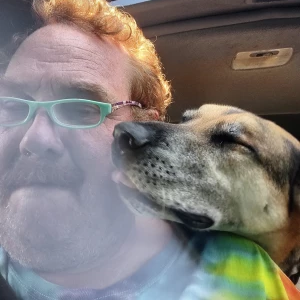
Jesse Upton has likely been falsely labeled a human trafficker by Northern California news outlets. The media was given a press release missing most of the basic facts and published the charge anyway. Predictably, most outlets repeated the raw release about “the human trafficker in Navarro” without making phone calls or addressing obvious inconsistencies. (The full press release appears at the end of this story.)
“I can’t believe the entire media here didn’t look into this at all — and that even the Santa Rosa Press Democrat would pass along a story that really doesn’t make sense,” said a well‑known local man we’ll call Paul. Paul is someone you would respect if you heard his name, but like many people with common sense, he doesn’t want to appear critical of either the media or law enforcement, as that can come back to bite you.
It’s kind of our job — and a lonely one, given the state of the media in 2026 — to restore the narrative to demanding certain facts, not just running with anything and everything simply because it arrives in their inbox. It’s terrifying to think of our friends, neighbors or ourselves getting devoured by a news media that serves no purpose but to amplify press releases and never looks back when they have ruined lives, and we know of many that have been hurt badly by this somewhat new approach to journalism.
We spent a lot of time talking to people, only one of whom would go on the record with his name: Mel Upton, Jesse’s brother, who lives out of state. Mel said he had often spoken to both Jesse and the alleged victim on the phone together, had seen them together, and never saw anything that looked even remotely like human trafficking in his view. It was a HUGE mess that greeted the investigators. An ugly, nasty mess that included the refuse of used chemical bottles outside, with an indoor grow operation.
Neither “Paul” nor Mel said they had the desire or the information to discuss any charges related to an illegal marijuana operation. Pretty much everyone in the area knew that Jesse Upton started more than a decade ago as an illegal marijuana grower and then, when it became legal, was one of the first in line to do it legally at his Boonville operation on Anderson Valley Way. We all know what a disaster legal cannabis turned out to be for small farmers. And so he appears to have had an illegal indoor operation in Rancho Navarro for quite some time. This is Mendocino, so that’s not a big shock — but there are still boundaries. Did he cross those?
That may be. There is a counter-narrative here to what we found. Upton may be a frightening bully who imprisoned a vulnerable guy in a remote place by the strength of his will as was first suspected. But even if true, the public needed to know that was what was being talked about, not something super secret that might have been a Cartel, or sex trafficking or might have been just about anything but was so scary that not even basic details could be provided. That wasn’t the case, this needed to be communicated for what it was suspected to be. It looks more like a misunderstanding and a grower’s reputation being sullied by a news media too quick with the publish trigger. Either way, a follow up apology or story is needed, especially if nothing is ever filed here.
There are also boundaries for law enforcement. In this case, we found the appearance of the exaggeration of both the charges and the supposed problem of forest grows. It all at least needs to be checked.
Let’s be clear: this story was our idea. Nobody — not Upton, whom we had never heard of before this — contacted us. We launched this story on our own and made a flurry of calls and emails. We felt this press release did not meet minimum standards for accusing someone of a crime on two fronts: the patently absurd‑appearing human trafficking charges, and the exaggerated storyline that the forest is still full of dangerous illegal grows.
If so — where’s the beef?
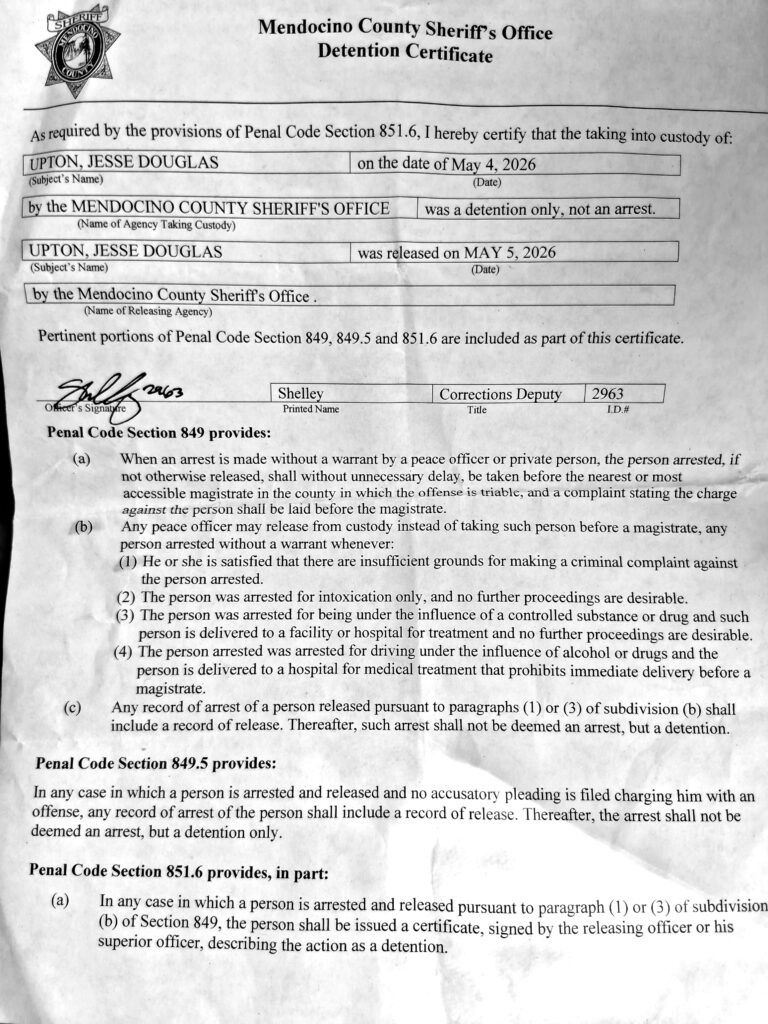
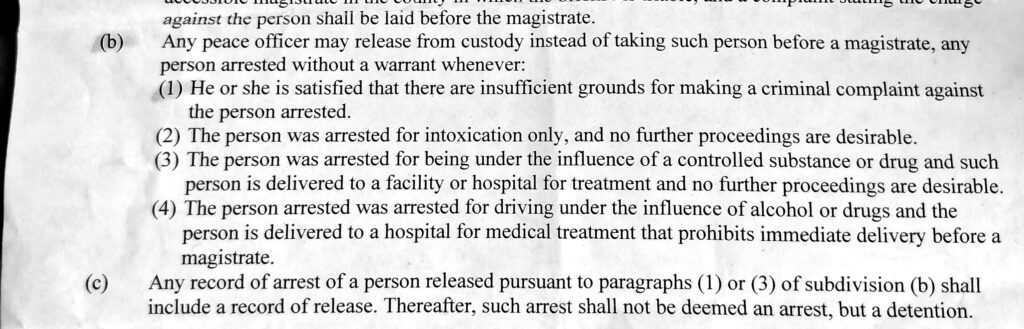
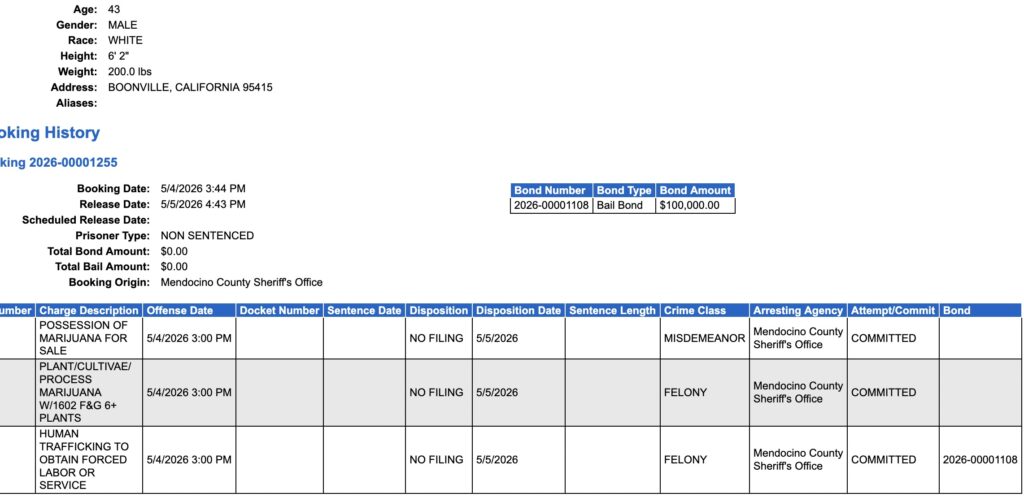
Upton was taken to jail and bail was set at $100,000. But he says he never paid that bail; he was released by a corrections officer, who had to check a box stating the release was being done because there was insufficient evidence to hold him on the charges or take him before a magistrate. (See the images below.) We will be checking into this and watching for charges to be filed. With all the media outlets screaming about some unknown type of human trafficking, we felt we needed to provide the chance for Upton to tell the other side of the story. We will be following this closely.
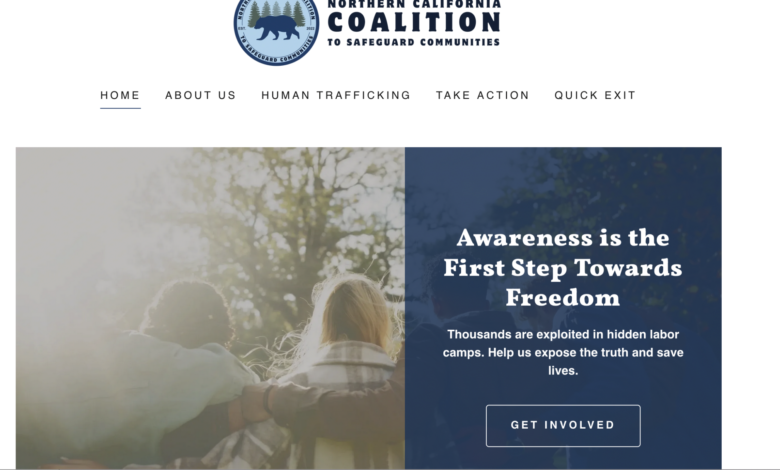
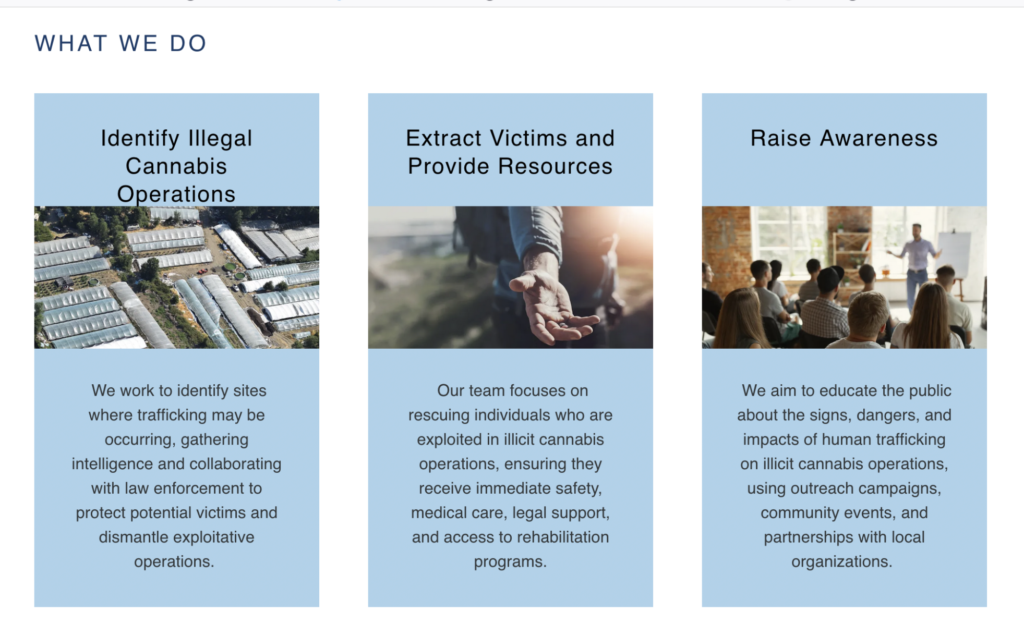
We also identified serious, still‑unanswered questions about the lead agency behind the raid, the Northern California Coalition to Safeguard Communities, whose role, public‑records practices, and authority remain only partially explained.
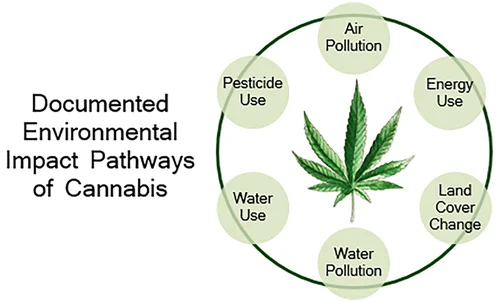
Is Navarro really a place that harbors human trafficking, as the media told the world last week? What we’re finding is that the trafficking case appears to have fallen apart almost immediately, yet it was broadcast so quickly — and so uncritically — that it has only grown as blogs and influencers have amplified the strange, fact‑deprived story. We were sent a “news” blog that pictures pollution pouring from the operation into Flynn Creek. But from what we know, this was an indoor operation. And the cops didn’t even say it WAS polluting the creek, only that it COULD HAVE. They did find dangerous chemicals LIKELY to run off into the creek.
“Investigators noted steep topography at the scene with no containment measures and visible runoff pathways. Discharge from the site could migrate downslope into a defined drainage leading toward Flynn Creek, which is part of the Navarro River watershed,” the press release said.
How effective has the NSSC coalition actually been at its stated mission — protecting forests from pollution tied to illegal cannabis grows and rescuing trafficked workers brought from other countries to labor on rural cannabis farms?
Are remote forest marijuana grows still a major problem in 2026, the way they were in 2016? We don’t see it — and we have looked.
Or could it be that pot growing in the forests has largely died out as prices collapsed — that far fewer people bother with low‑grade cannabis from the forests anymore, and that the vast majority of the armed crews who populated our forests a decade ago are now gone?
And if that’s true, the real question becomes whether we still need a task force that withholds even the most basic public information.
Earlier in this century, criminals — including Mexican cartels — flooded our region with illegal grows and the crime that came with them. Now, the collapse in cannabis prices and consumer demand for higher‑quality weed have made those operations unfeasible, and most are gone. We can show you 100 places they USED to be. The very real problem of environmental damage has also dramatically lessened. We could probably make money offering an abandoned pot‑farm tour in the county, although it has been long enough now that most of the mess they left behind has been cleaned up. But the bad working conditions facing the traveling trimmers who arrive every harvest continue to be a serious issue.
We think an organization that protects all trimmers, regardless of legal status, would be better than a coalition of prosecutors and cops that most of them would be scared of. The Coalition has tried to be that — focusing on victims, doing education that emphasizes that many in the industry are not criminals but workers, and aiming its efforts at the bosses. But because they operate in the type of extreme secrecy this case revealed, we can’t know whether those are just words on their website or something we can endorse. All trimmers, regardless of legal status, deserve protection.
Perhaps if the Coalition became more public, we would have reason to trust them. But when we interviewed them, we got only generalities, and it was a bit insulting that they still couldn’t tell us whether this worker was foreign or offer anything whatsoever. By withholding this sort of basic information, they leave the public to believe that our community may be part of some global smuggling operation or other scary stuff like sex trafficking. The Coalition must do better on openness — much, much better.
In a democratic society, it’s simple: you don’t trust the public and press with basic information, we don’t trust you.
But let’s forget them now — 99 percent of the fault here is with our colleagues in the modern news media.
Last week a press release landed in our inboxes. It claimed that the coalition is indeed still battling dangerous, remote marijuana grows. And then came the kicker: human trafficking in Rancho Navarro. Naturally, we at Mendocinocoast.news assumed readers would want actual facts about these dramatic allegations. There weren’t any, really, beyond this: Jesse Upton, 43, of Boonville, was arrested on human‑trafficking charges along with serious allegations of potential environmental harm tied to a marijuana operation that included using butane to make honey oil — a dangerous process, no doubt. Plus a lot of packaged cannabis for sale. If those allegations about butane are true, the task force was doing its job on that front at least, but it’s hard to trust those who don’t practice giving the public the basic information the public needs. We didn’t find enough to say much one way or the other about the illegal pot operation. Nobody, including Upton, would give us the address, and the amount of butane and packaged product was significant for 2026 at least.
But we found substantial problems with the most salacious — and most headline‑driving — allegation: the human‑trafficking charge.
The Northern California Coalition to Safeguard Communities led this raid and is withholding all information about the victim’s identity, declining to release even the basic details that would normally be provided in a case of this magnitude. We had not heard of this group before. When most people think of human trafficking, they think of sex trafficking, but the coalition’s own front page emphasizes labor trafficking tied to the illicit marijuana industry. (There is now very little sex‑trafficking activity reported in this region, even with Lake County included in the coalition’s coverage area.) Butte County, where sex trafficking has always been a bigger problem, was once part of the coalition but dropped out at some point after the coalition was created in 2021
The press release raises as many questions as it answers, and the allegations themselves are staggering. What we didn’t know included some of the most basic facts.
How many people were involved? The release says “authorities seized 300 cannabis plants and over 600 pounds of processed cannabis… packaged and processed for unlawful sales,” and that investigators found a butane honey‑oil lab and more than 240 gallons of butane. That scale takes more than one worker. We had to ask — and the rest of the media should have asked — the obvious questions: Were the other workers involved? Scared? Unaware that one man was allegedly being held prisoner?
Who was the alleged victim? We weren’t told whether the person was a man or woman, their age, or any basic identifying details that would help the public understand the supposed threat. Nothing.
How did the alleged captivity begin? Was this someone who came to work on a farm and was then prevented from leaving? And how, exactly, could one man keep another man captive for two years by himself? These are glaring inconsistencies the rest of the media should have examined before blasting out the press release — as even the Press Democrat did.
Where is the property owner in all of this? Could a man really be held prisoner for two years without the property owner knowing — and sharing at least some responsibility? Records show that Jesse Upton owns a property on Anderson Valley Way in Boonville, where he once had and may still have a legal cannabis operation, and a phone store across from Walmart in Ukiah. But he is not the owner of the property where the raid occurred. Nobody would give us the address, which suggests something is going on here. But what? And why didn’t anyone else ask this obvious question?
How did “trafficking” become the headline? Was the individual brought from another country? Living locally? What evidence supported the claim? In the end, we found that the case began with a phone call — not to the Coalition, but to the sheriff’s office. Upton was arrested, taken to jail, and then released without bail. No charges have been filed since.
We asked all of these questions. The sheriff’s office and the Coalition declined to answer any of them.
Looking deeper, we found that the coalition behind this raid operates like other new‑style law‑enforcement groups that wield significant authority while providing very little public information. These questions matter. No one else in the media chose to ask them. Secrecy has expanded dramatically in 2026, far beyond what was typical in earlier decades, and the public now receives only fragments of information about major law‑enforcement actions.
We very quickly learned the identity of the man who was allegedly trafficked, but we are not publishing his name. What we can say is this: he is NOT someone brought here to Mendocino County against his will, nor was this his first gig in the cannabis business. Heck, there are not many other jobs. He is a man in his 30s has been part of this community for years. We found he worked in the marijuana industry on his own before this, and multiple people recalled seeing him at local music events, parties, and gatherings — sometimes with Upton.
“They were both guys who liked to go to parties and they both seemed to be having fun when I saw them,” said one man.
While such statements wouldn’t by themselves mean the victim couldn’t have been imprisoned later, the press release asserting the captivity lasted two years seems particularly odd based on what we were told.
Upton declined to comment on the record, but he did provide a jail receipt showing he was released without paying the $100,000 bail after a correctional officer concluded that no charges were likely to be filed. See below. Upton said he was a man who went above and beyond to support veterans and law enforcement. Our investigation found that to be true.
He did not serve in the military himself, but many in his family did, and several people told us Upton often talked about supporting police and veterans. We confirmed that he provided medical marijuana to service members with PTSD on the Coast, and that he declined any public credit or publicity for doing so. We also found other instances in which he gave generously to veterans. Although this is not directly relevant to the case, we wanted to understand the broader picture; it takes a certain kind of person to imprison someone else, or so we think. We also learned that he often appeared in public with the alleged victim in this case, and that they worked together, helped others together, and socialized together.
The raid took place on Seabiscuit Drive in Rancho Navarro, between Navarro and Comptche — the stretch locals call the Deep End of Anderson Valley. Property records show most parcels along that road are owned by people from far‑off cities like San Francisco and Los Angeles. Each ten‑acre lot is effectively its own small kingdom: isolated, gated, and historically quiet. It’s the kind of place where a great deal can happen without a single neighbor seeing a thing.
Upton was among the first to seek a legal cannabis license in the Anderson Valley, and plenty of records document that history. Whether that operation is still active is something we didn’t try to track down; most licensed growers were forced to close when prices collapsed.
The operation in Rancho Navarro was not on file with the county. Thus it was illegal from what we know. Rancho Navarro is both isolated and surprisingly well populated; some properties function almost like small communes, and the official estimate of 150 residents is likely low. That isolation cuts both ways. It makes the area difficult for volunteer fire crews and the sheriff’s office to reach, and it leaves people scattered across roughly 130 parcels in a forested maze where oversight is thin and visibility is almost nonexistent.
When we examined the parcels in question on Google Earth, we saw only treetops — exactly what you’d expect in that terrain — though one neighboring parcel does appear to have a notably distinctive swimming pool.
The Deep End of Anderson Valley is an old term for the Navarro area, long predating the development of Rancho Navarro. And Rancho Navarro truly is the deep end — a place where a horror movie could be set, and also a place of dream houses and a level of splendid privacy most people can’t imagine today.
And it is a bad place for a fire. The press release also described a “big mess” on the property and “deplorable” living conditions, and warned that the operation could have threatened Flynn Creek. It could have — but no evidence was presented to show that it did. And if the conditions were truly that hazardous, why were no photos released with the press statement?
The operation also allegedly involved butane — roughly 200 gallons of it, according to the press release — and Upton will have to account for that if true. But it is still unfair for the media to characterize him, across the world, as a human trafficker. Based on what we’ve seen, we do not believe that charge will ever be mentioned again, but we will be watching. There may be more to this story and our take could be wrong, but we are sure this was not described in the press release and presented by the media in a way it should have been in an allegedly open, Democratic society where people are innocent until proven guilty.
Butane extraction is a well‑documented fire hazard that requires commercial‑grade safety measures, and while the environmental‑pollution claim in this case is described only as a potential risk rather than a documented impact, butane extraction sites in rural areas have thankfully become far less common in recent years — which means that if the allegation is true, this is one place where the task force may actually have been doing what it is supposed to do.
The news media has no excuse here.
It’s law enforcement’s job to give the situation as it is. It’s the media’s job to check and verify.
What was the hurry here, friends in the loosely organized media-law enforcement hammer? This case does not pose an immediate threat to the public. If it were a fire or a dangerous suspect on the loose, urgency would make sense. Instead, the rush — and the sense of competition — works entirely against justice and against any real understanding of what happened.
The press release follows below, unaltered. We were taught in journalism school never to run a press release verbatim, and our late professors would not approve, but in this case it’s necessary: readers need to see how a narrative presented at one moment can shift dramatically as more information emerges.
Upton appears to have moved here from Huntington Beach, the surfer’s borough of Los Angeles. He has been here for about 20 years.
We’re not saying the bust was entirely a bust — only that it wasn’t what it first appeared to be, and the media should have spent more time explaining and examining the facts instead of spending no time on that at all. When things don’t add up, it’s our job to ask questions. That’s the work. Almost nobody does that now, and it appalls us.
We’re doing this story because we’re deeply concerned about the rise of secrecy and the steady loss of public access to public records. We don’t believe the information in this case needed to be withheld to the extent it was, especially once we were able to learn enough about the victim to understand what kind of case this actually was. Basic details — gender, a rough age — should have been released, and if they couldn’t be, then no outlet should have published the press release at all. That used to be the standard. The Coalition also could have made clear that this case did not involve sexual abuse, cartels, or the smuggling of foreign workers into the marijuana industry.
This case shows how quickly a dramatic narrative can harden before any facts are tested. A sparse press release — approved by a little‑known regional coalition — became the entire public record, repeated widely and without verification. Once questions were finally asked, the story shifted, but by then most outlets had already moved on and almost never follow up.
That takes work — real reporting does. It’s not a one‑second repost. It means checking locations, confirming identities, sorting out conflicting details, and staying with a story after the first burst of information. That’s the standard we’re talking about here: doing the work, not just passing along whatever comes in.
That’s the risk of instant news: the first version becomes the lasting one. Serious allegations need time, context, and scrutiny, not a race to publish.
Another thing that took work was finding the address where this raid took place. It’s 3500 Seabisquit Drive. Upton is a part-owner of the property and filed a lawsuit in 2024 to quet title- to make himself the owner of record but we couldn’t figure out how that came out. The property rolls still show the property belonging to Bruno P Fontainha of Beverly Hills. The case seems to have been dismissed with some settlement reached. We also did extensive searches and found only traffic citations in Upton’s background.
There is a lot more to this story for sure, and we welcome all comments to frankhartzell@gmail.com
Northern California Coalition to Safeguard Communities:
Who We Are
“Through a victim-centered approach, we connect survivors with critical resources to help them rebuild their lives. Working alongside law enforcement, we hold traffickers and criminal organizations accountable to protect our communities,” the group’s website says.
The Norcal Coalition is a united effort to combat human trafficking and organized crime across Northern California.
Our Coalition Includes:
- Law Enforcement Leaders – Sheriffs and District Attorneys from Humboldt, Lake, Mendocino, Trinity, and Siskiyou Counties
- Crime & Data Experts – Specialists in environmental crimes, data analysis, and forensic accounting
- Technology & Investigation Teams – Experts in computer forensics and criminal investigations
- Victim Support Advocates – Dedicated professionals providing resources and assistance to survivors
The Coalition also answered our questions, although they provided generalities. not specifics. We asked how many arrests they had made but they had no numbers to offer. Our questions are first. Answers are from Summer Hansen, public information specialist with the Coalition show with a black circle in front of them.
When was the Coalition created?
- The Norcal Coalition was formally launched in 2021 as a collaborative effort between regional law enforcement agencies, prosecutors, investigators, and victim service providers focused on combating human trafficking and transnational organized crime impacting Northern California communities.
Are there any stats on what you have done, as in arrests and prosecutions?
- Coalition member agencies have been involved in numerous investigations related to human trafficking, labor exploitation, illicit cannabis operations, weapons offenses, environmental crimes, and associated violent crime. Because investigations and prosecutions are handled by individual agencies and jurisdictions, we do not currently maintain a centralized public database of arrests or prosecution statistics under the coalition itself. In addition, we limit the release of consolidated operational data in order to avoid compromising active and future investigations. Our focus is also victim centered and prevention oriented, not solely enforcement based.
From reading the website, I get the idea there are organized crime groups smuggling people in from foreign countries to work in illicit cannabis farms.
Is this a fair summary?
- Some investigations have identified transnational organized criminal networks operating within the cannabis cultivation sites, including cases involving labor exploitation and trafficking victims. However, circumstances vary from case to case, and we avoid broad generalizations about victims, suspects, or communities involved. Smuggling is rare; most of the exploitation we come across is done through force, fraud, or coercion.
The press release I got about the Navarro arrest lacks basic info normally provided, such as age of the victim, if there were other victims or suspects and gender of the victim and what country or area of the USA he or she is from.
Is there a reason for this?
- Certain information was intentionally withheld due to victim privacy considerations and the active nature of the investigation. In trafficking related investigations, limiting identifying details is important to protect victims, preserve investigative integrity, and avoid retraumatization. For that reason, we are not releasing additional personal details about the victim at this time.
I would also be interested to know how this victim came to be out there, kidnapped? Brought in on a contract and then not allowed to leave?
- We are not in a position to speculate publicly about the exact circumstances that led to the victim being in the location referenced. Human trafficking and labor exploitation situations are often more complex than physical confinement alone and can involve coercion, threats, intimidation, debt manipulation, isolation, fear of law enforcement, language barriers, or control over transportation, housing, or communication.
The whole story is odd to me in that its hard to imagine keeping someone prisoner out there with lots of drifters and a commune-like world among gated, mostly unused properties of absentee landlords.
- Trafficking situations often involve psychological coercion, isolation, threats, fear, financial control, or dependence, rather than what people traditionally picture as physical imprisonment. These situations can occur in a wide range of environments and circumstances.
I do know that imprisoning female trimmers and sexually assaulting them is a very serious issue, but that doesn’t seem to be what this is?
- We are not going to speculate publicly on investigative details beyond what has already been released. Human trafficking can take many forms, including labor trafficking, sexual exploitation, coercion, and other forms of victimization. The investigation remains ongoing.
Sincerely,
| Summer Hansen Public Information Specialist Norcal Coalition | NCCSC (707) 268-2547 |
The original press release
DATE: “May 8, 2026”
FOR IMMEDIATE RELEASE:
Incident Number:
2026-7529
Crime/Incident:
236.1(a) PC – Human trafficking for forced labor
245(a)(1) PC – Assault with a deadly weapon
11358(d)(3)(B) HS – Illegal cannabis cultivation with an aggravating environmental factor
11379.6 HS – Manufacturing a controlled substance
11359 HS – Possession of cannabis for sale
Location:
3000 block of Seabiscuit Drive in Navarro, CA
Date of Incident:
05/04/2026
Time:
08:00 A.M.
Victim(s):
Confidential Victim – Pursuant to California Penal Code 293
People of the State of California
Suspect(s):
Jesse Upton (43-year-old male from Boonville, CA)
Written By:
Lieutenant Aaron Clark
Synopsis:
The Mendocino County Sheriff’s Office is investigating an alleged forced-labor human trafficking case connected to an illegal cannabis cultivation site in Navarro, CA. During the investigation, Sheriff’s Deputies located one adult victim who reported being forced to live and work on the property for approximately two years, under inhumane and deplorable conditions. California law prohibits depriving a person of liberty to obtain forced labor or services.
Investigators documented that the victim was allegedly housed without pay, sufficient food, bathroom access, or humane living conditions while being compelled to work at the site. The victim further reported that suspect Jesse Upton used force, fear, coercion, and physical abuse, including assaults involving weapons, to prevent the victim from leaving the property. Evidence was collected in support of the alleged offenses, and charges are being sought through the Mendocino County District Attorney’s Office.
During a search warrant service at the property on 05/04/2026 where the alleged crimes occurred, deputies discovered an active cannabis cultivation site containing more than 300 cannabis plants and over 600 pounds of processed cannabis. The cannabis was packaged and processed for the purposes of unlawful sales. Investigators also located a butane hone-oil manufacturing laboratory and more than 240 gallons of butane at the property. California law considers unauthorized chemical extraction of concentrated cannabis with butane as manufacturing, and such activity can be prosecuted as a felony.
The victim was connected with support services through victim advocates with the Northern California Coalition to Safeguard Communities (NCCSC). The NCCSC provides specialized assistance, including human trafficking services and a range of other victim support programs, as part of its comprehensive victim services.
Investigators also documented significant environmental degradation at the property, including fuel and oil products, fertilizers, foreign soil, and chemical additives associated with cannabis cultivation. Investigators noted steep topography at the scene with no containment measures and visible runoff pathways. Discharge from the site could migrate downslope into a defined drainage leading toward Flynn Creek, which is part of the Navarro River watershed. Flynn Creek is a tributary within the Navarro watershed, supporting the concern from Investigators that pollutants from the site could affect waters of the State.
California officials have determined that illegal cannabis cultivation sites are sources of water pollution and environmental damage, including unlawful discharges and threats to streams and wetlands.
The Mendocino County Sheriff’s Office is investigating Jesse Upton for alleged violations of Penal Code section 236.1(a) – Human trafficking for forced labor, Health and Safety Code section 11358(d)(3)(B) – Illegal cannabis cultivation with an aggravating environmental factor, Health and Safety Code section 11379.6 – Manufacturing a controlled substance, Health and Safety Code section 11359 – Possession of cannabis for sale, and Penal Code section 245(a)(1) – Assault with a deadly weapon.
This case is actively being investigated and anyone with information related to this incident is requested to contact the Mendocino County Sheriff’s Office at 707-463-4086 (option 1). Information can also be provided anonymously by calling the non-emergency tip-line at 707-234-2100.
END PRESS RELEASE

We know that sometimes funding is created for a problem, and then crime and community conditions shift before that money is spent. We also know that dozens of the worst illegal pot farms were abandoned when cannabis prices collapsed. Covelo was, for a time, one of the most dangerous rural areas in the region because of cartel‑linked and other criminal activity, and that history still lingers in today’s high crime rate. Other drugs — especially fentanyl — have since become more prevalent. The Sheriff’s Office confronts this evolving and vexing landscape every day; the rest of us do not. What we hope to see is law enforcement, the courts, and all public‑safety agencies working harder to be open and to share information whenever possible, so the public can understand and evaluate what we, as a society, are doing.
For example, when we asked whether this was a sexual‑trafficking case involving a woman, Hansen could have simply said “no, it was not.” That single clarification would have helped the public understand the situation, strengthened the Coalition’s credibility, and allowed the courts to sort out the rest of this unusual case. The underlying allegations appear to center on operating a large illicit cannabis site, including the use of butane — a dangerous and unacceptable practice. As for the human‑trafficking claim, the evidence we’ve reviewed suggests it may have been misconstrued or, at minimum, premature to file before the cannabis‑related violations were further developed.
The larger failure here lies with the media. Obvious questions went unasked, and unverified claims were repeated without scrutiny. If you can’t look into something like this, don’t casually slap it online — the public deserves better. And they deserve better because cases like this don’t just happen “out there.” They happen in communities like ours, to people who don’t expect to wake up in a headline. That’s why transparency matters. That’s why verification matters. And that’s why we should all demand better — because one day, the person relying on the truth might be you.
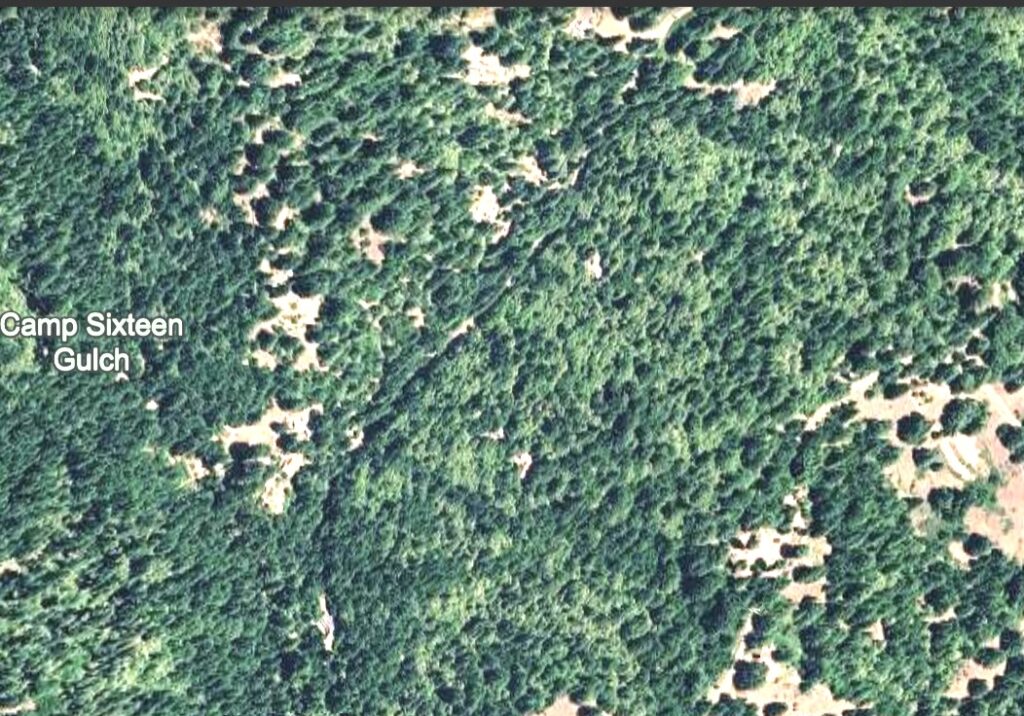
Environmental groups and law‑enforcement agencies will both tell you, without exception, that I’m wrong and that the illegal‑grow problem in the forest continues. I believe part of that comes from the funding tied to fighting the issue — and from the possibility that the problem could return someday, which is probably true. As for our own mea culpa: we preach heavily against relying on scanner traffic, yet a few days ago we used it to report what turned out to be an escaped and handcuffed detainee who had been pulled over along the road. Some readers were upset that we used an image of a prisoner in striped garb and called him an escaped prisoner. They felt it created undue fear, and they may be right.
We use the scanner only when there is a potential danger to the public — a wildfire, an armed suspect on the loose, or an escapee. That’s why we often say it’s wrong to rely on scanner traffic the way some outlets do every day, and in this case that warning came back to bite us. The scanner is not a police press release; it’s first responders talking to each other about what might be happening.
This incident unfolded inside Jackson Forest or very close to it on private forest land, where phones don’t work, GPS fails, and Google Maps is unreliable. The location became confused, and so did some of our readers when we reposted the early scanner information. A second, unrelated incident happening around the same time added to the confusion.
We want to avoid this kind of confusion in the future. At the same time, when there’s a report of an escaped prisoner, we feel a responsibility to get that information out quickly and let the facts sort themselves out as more becomes known. We’re working on an exciting solution that we believe will make situations like this much smoother next time. We’ll share more about that soon.
We endeavor to do our best, but this one came at us fast. I heard about it while at work, posted what I had during lunch, and Linda tried to sort out the story from there with nobody available to talk to. About two hours later, when I got off work, I sat in the hospital parking lot making calls and sending emails. A very helpful source on the inside — we’ll call him “Ron Gasoline” (inside joke) — straightened out key details for us, and we’re grateful to him.
As for the cartoon of the inmate in stripes, perhaps it did create fear or confusion. We used to run photos of sunsets or sea urchins in situations like this, but people got very angry about that too. Every post needs an image. A better choice here would have been the forest, since the setting ultimately played a larger role in a story that turned out to be more silly than scary.
But folks, a guy in handcuffs running through the woods is an escaped prisoner, right. Stay tuned.
For a realistic look at the state of the Cannabis industry here, read this article written by Nation journalists who asked the hard questions:
And folks, press releases are only a starting point. Good reporting digs deeper. Keep asking for that depth — it helps ensure the stories you rely on are complete and accurate.
Demand it. Your stories matter.