Gray Whales Made the Greatest Comeback on Earth — Now Climate Change Is Erasing It, Scientists Warn

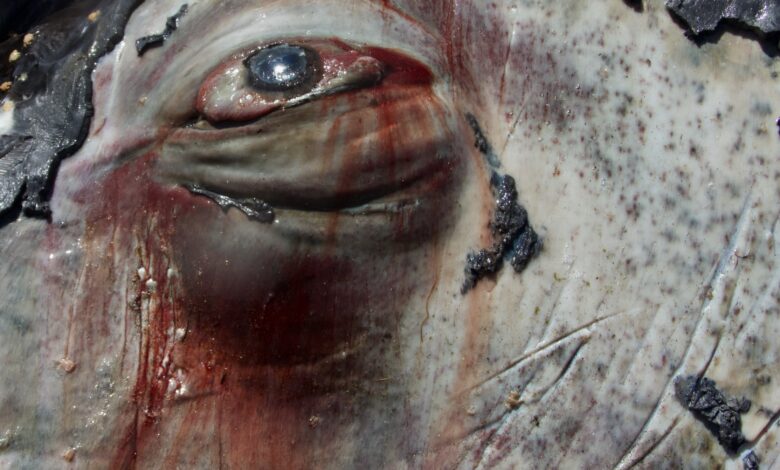
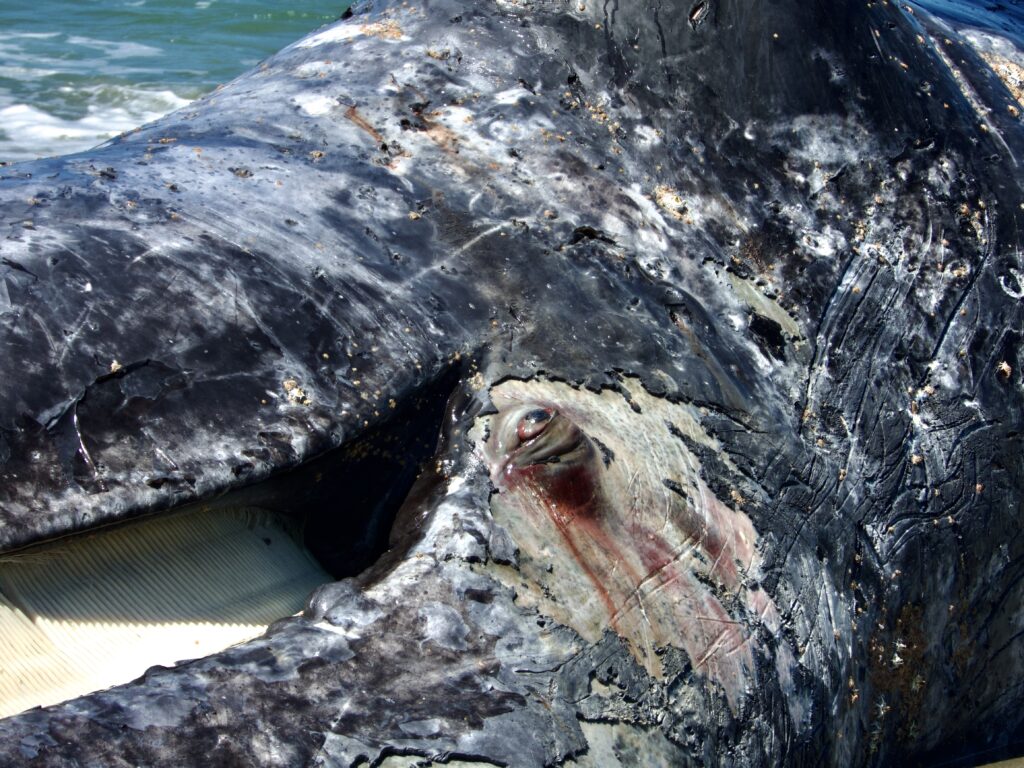
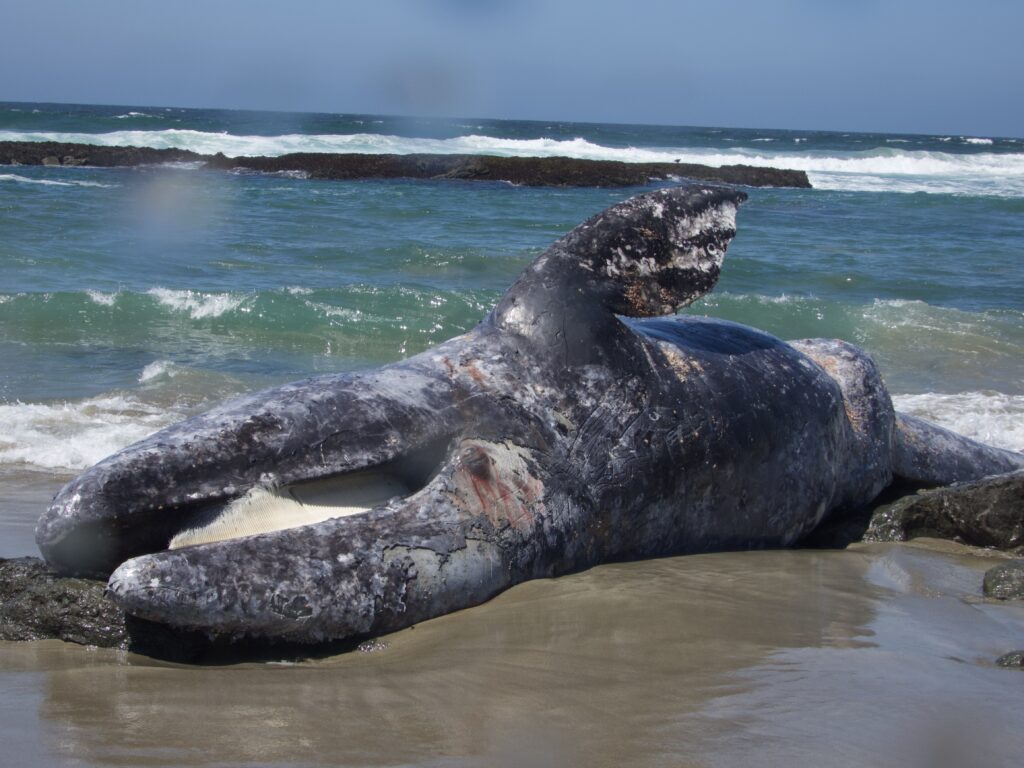
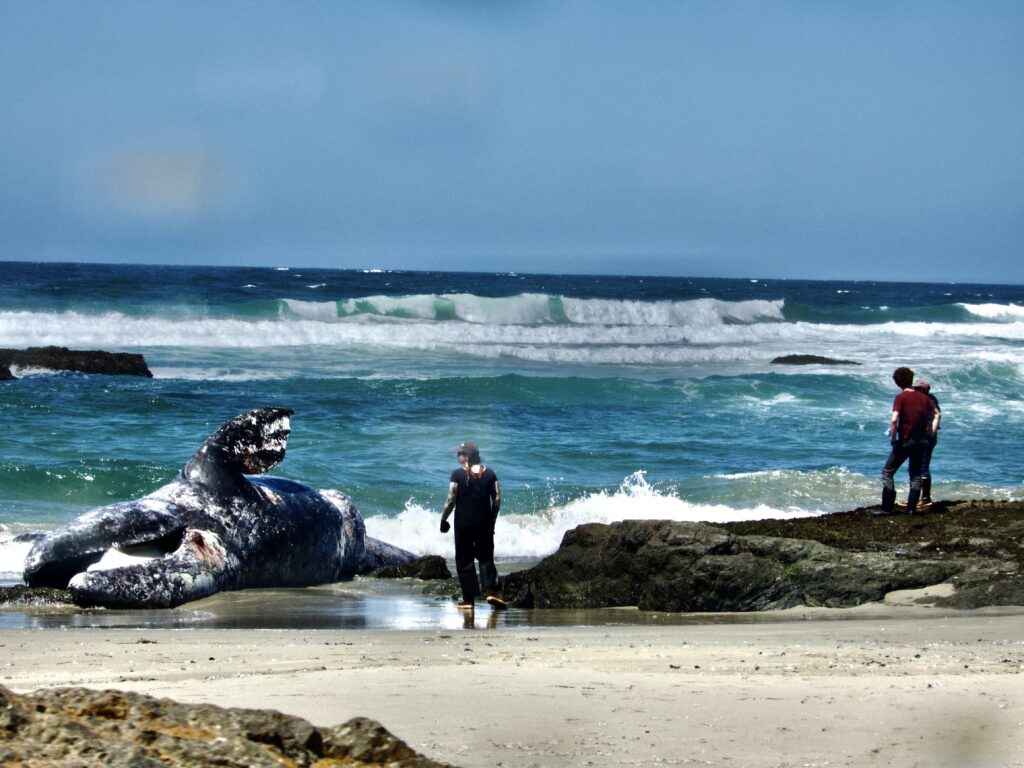
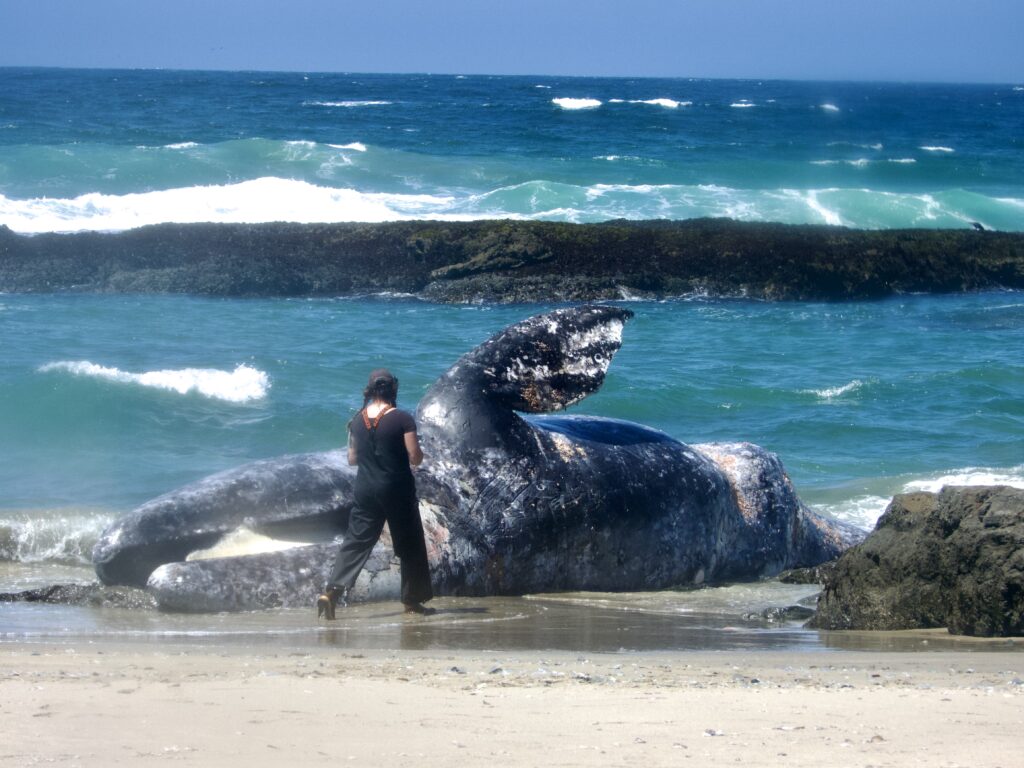
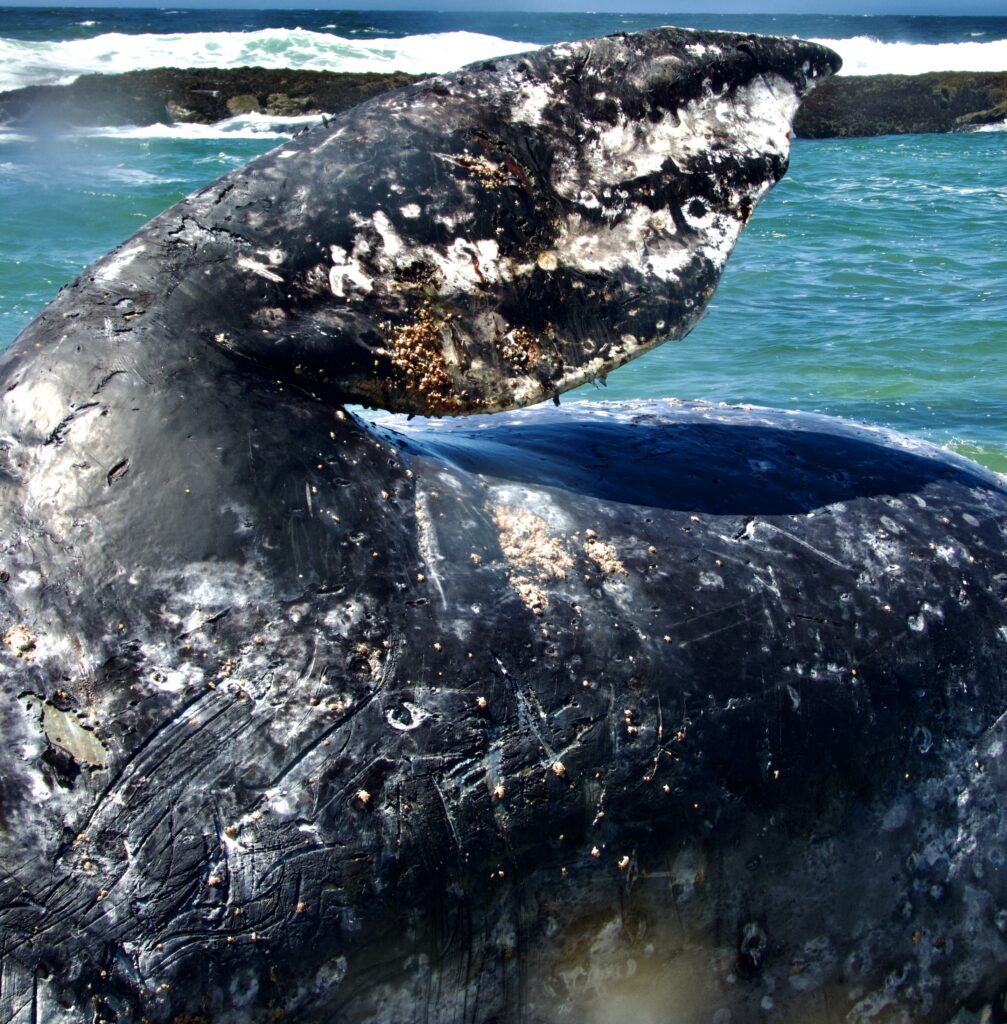
Frank had been warned by a leading gray whale scientist to expect at least one whale to wash up on a Mendocino Coast beach in late April — and to brace for a flurry of deaths in 2026. Still, when he came upon this magnificent young female on Wednesday morning, he wished he hadn’t. He didn’t want to photograph her, let alone share her picture.
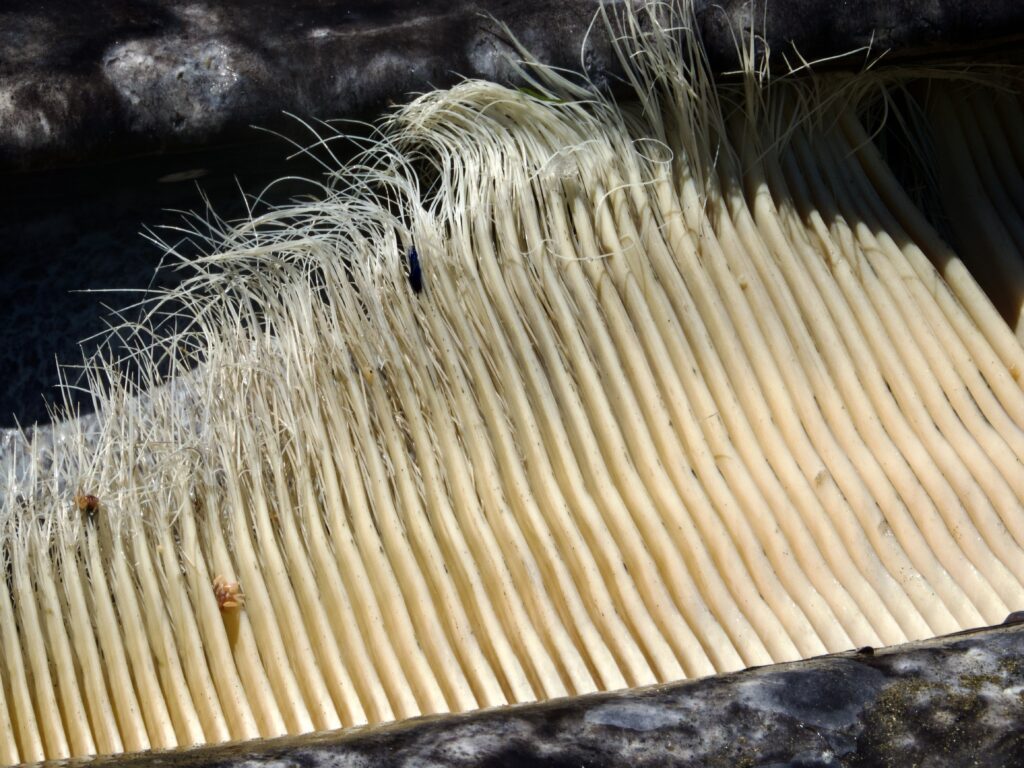
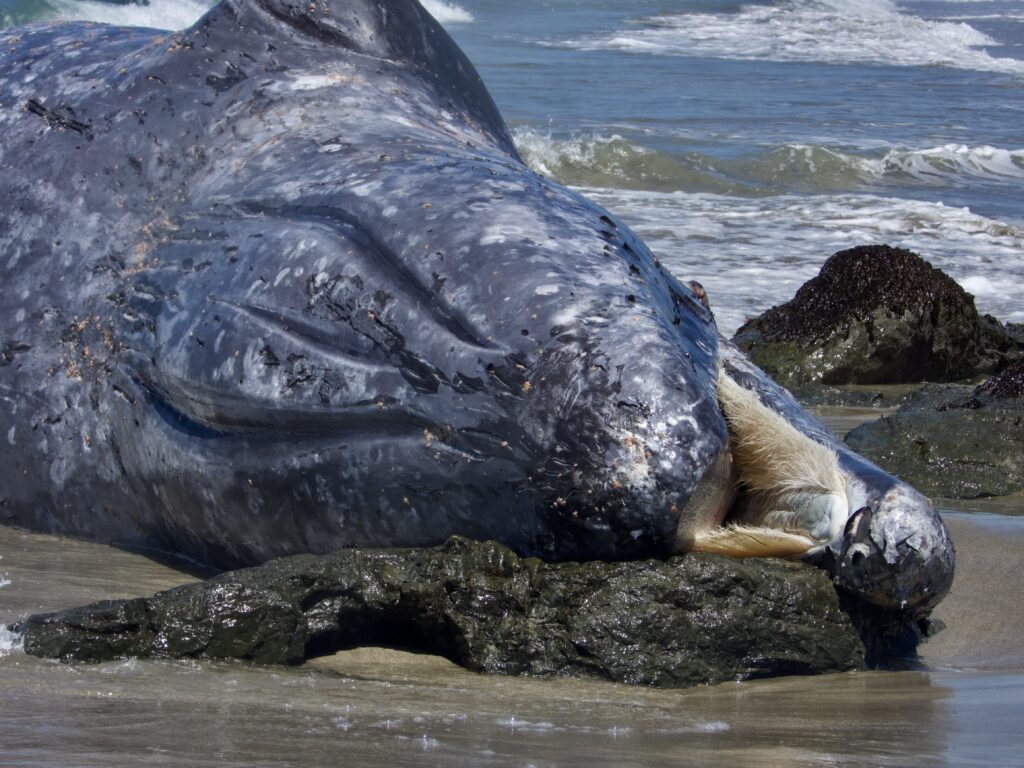
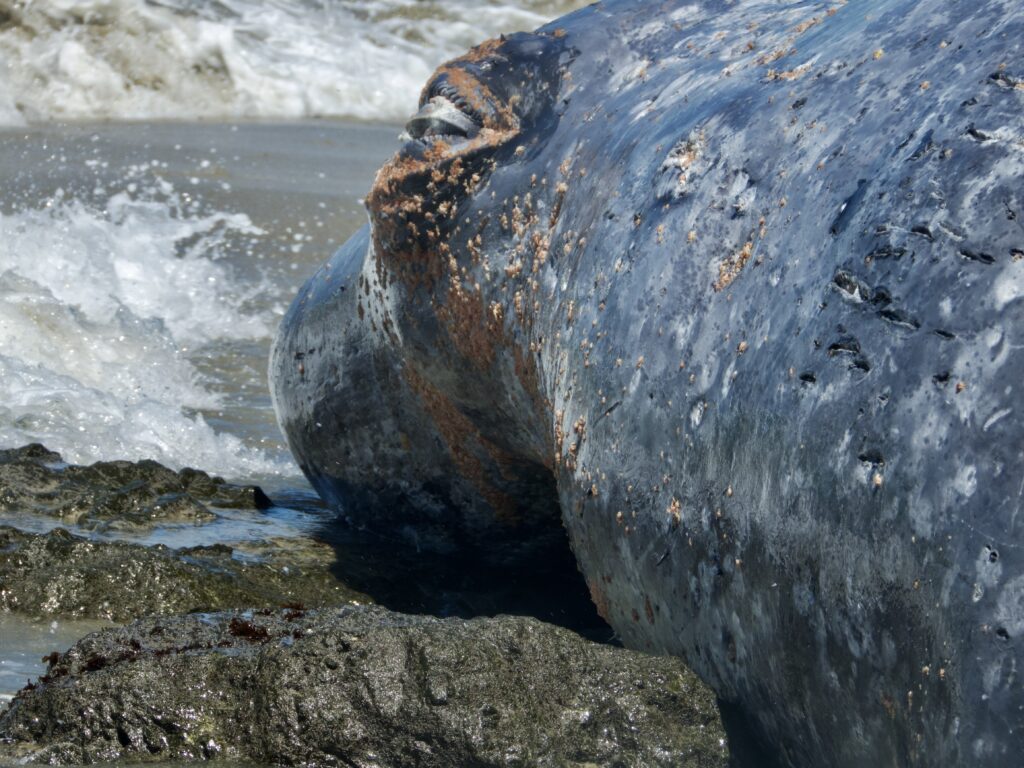
She wasn’t yet full‑grown, and her body was unmistakably leaner than it should have been. She had died only recently — the air still held no trace of decay. Her elegant baleen fanned from her open mouth, and her eye, just a bit larger than a human’s, gazed blankly toward the sky.
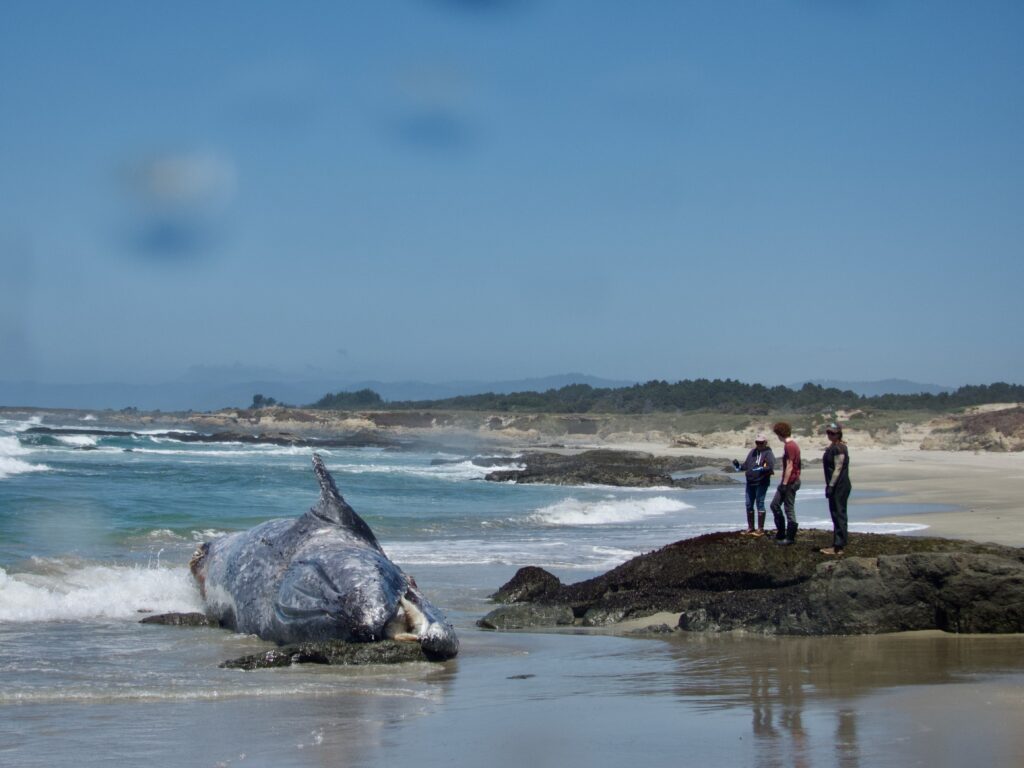
Her fins drifted in a slow, swimming motion as the waves nudged her. As a newsman, I made a rare decision: I chose not to report the story or publish the photos that day. She had come ashore on Virgin Creek Beach, one of the most fragile habitats in MacKerricher State Park — bordered by a bird rookery, an estuary, and a years‑long restoration project on the bluff above. I hoped the ocean might carry her to a more accessible stretch of coast, or perhaps pull her back out to sea. The Noyo Center for Marine Science arrived while I was still there. To my surprise, they immediately reached out to another media outlet and shared a photo of the whale.
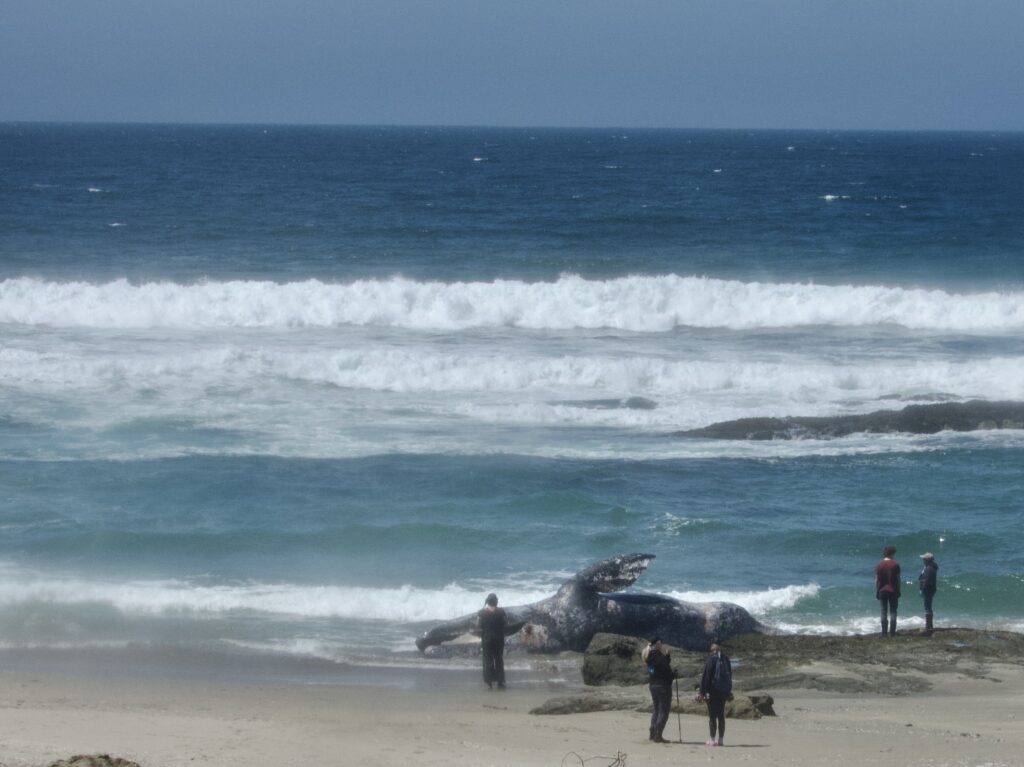
I headed home and issued a warning to surfers. Unfortunately, the place where the young female washed up is one of the most frequented surf spots on the Mendocino Coast, especially on rough‑water days. Along with Big River, it’s where people go when they’re determined to get in the water. Our coastline isn’t famous for great surfing, but this beach is as close as it gets.
We photograph the ocean daily and, in twenty years, we’ve never seen a great white shark fin — but their behavior is shifting, and they almost always show up when there’s a dead whale. In Santa Cruz, officials had to tow a whale carcass out to sea because sharks were circling it in the surf zone while people were still trying to paddle out. Surfers here needed the same warning. You never go into the ocean when something large and dead is in the water, and it’s wise to steer clear of spots thick with seals and sea lions.
For me, I wanted to take some time to make the death of this glorious mammal mean something — to explain why it likely happened and what, if anything, can be done to save the whales… for a second time.
Gray whales went from being the best‑known and possibly most plentiful whales on Earth to being hunted to near extinction everywhere except along the West Coast of North America. When American whalers discovered gray whales calving in Baja in the late 19th century, a mass killing of mothers, calves, and every whale they could find began. In just a few furious decades, the once‑abundant population was driven so low that whalers simply couldn’t find them anymore.
“Human beings killed roughly three million whales in a period of seventy years,” Stewart said (we were talking about all whale species at this point). He added that the United States and the other whaling nations didn’t stop whaling out of nobility. “So many had been killed that whalers just couldn’t make any money anymore, so we stopped.”
By the early 1940s, gray whales were close to extinction. In 1946, the International Whaling Commission was formed, and laws were passed prohibiting the killing of gray whales.
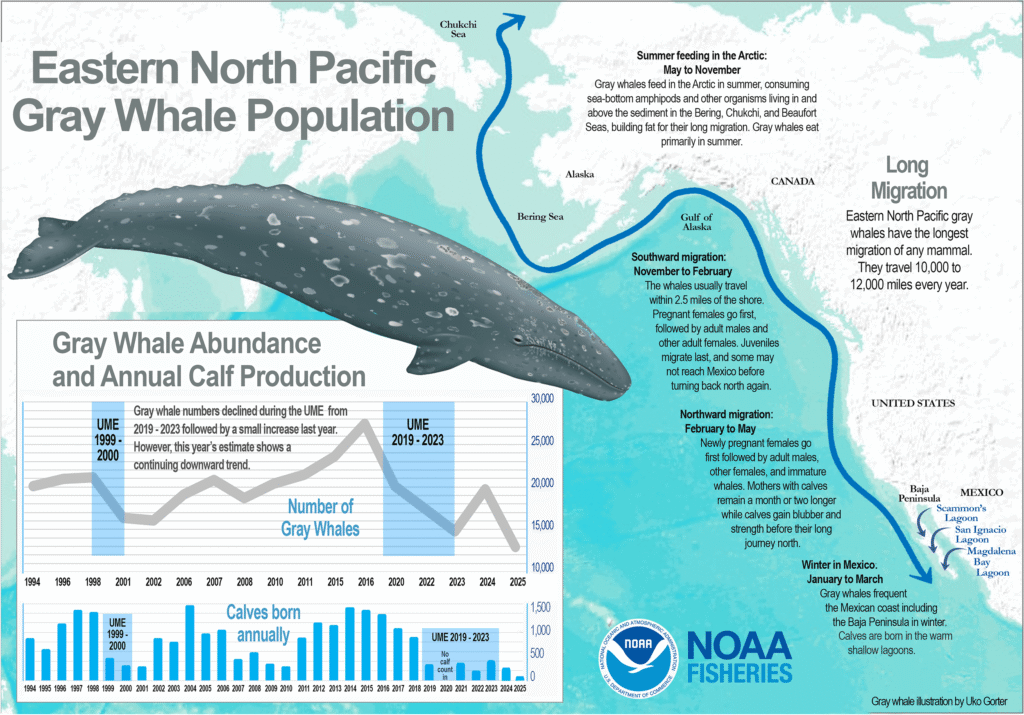
Between 1946 and 1983, the population of fewer than 2,000 whales grew by about 14,000 — roughly 500 per year. By 1983, there were 16,000 gray whales off California. By 1992, the population topped 20,000, and in 1994 the Eastern Pacific gray whale was removed from the endangered species list.
It was a moment of pure elation for conservationists — a rare victory in which the animals did most of the work themselves, with just a little help from humans. The population continued to rise until 1999, when a major die‑off occurred. Just as scientists began to panic, the whales rebounded again, reaching a new high of 26,000. Researchers concluded that gray whales were simply prone to dramatic population swings.
But around 2016, the news turned grim. The cycles continued, but a steep downward trend began. Stewart and other scientists dug into water temperatures, Arctic ice loss, and the tiny creatures living in the mud at the bottom of the sea. They also examined whale bodies.
Then came the worst die‑off ever recorded, from 2019 to 2023. Scientists labeled it an “Unusual Mortality Event,” hoping it was a temporary anomaly.
It wasn’t.
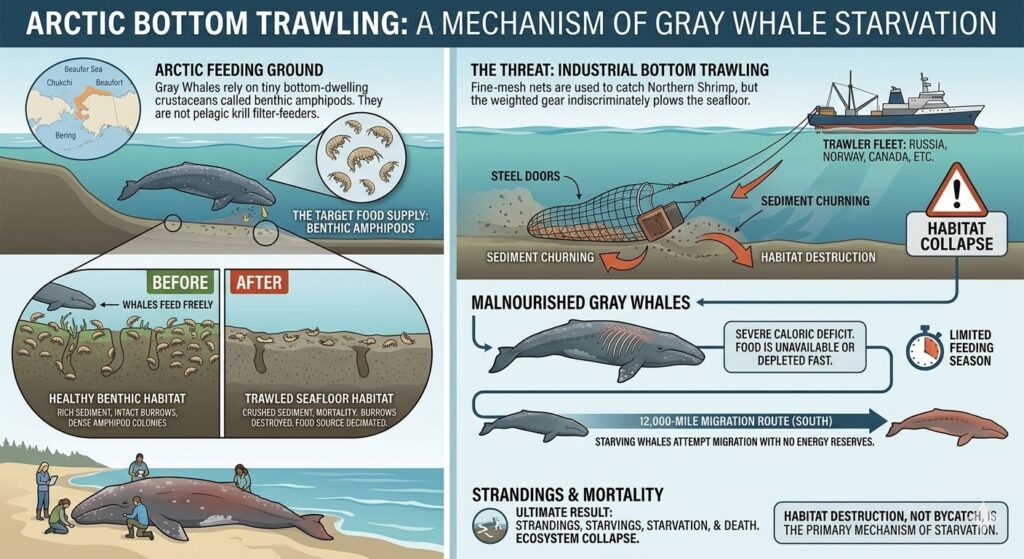
The gray whale’s primary food source is a small shrimp‑like creature that lives in the cold mud of the Arctic seafloor. Those animals need frigid temperatures. As the Arctic warmed, their numbers plummeted. Gray whales dive, scoop up mouthfuls of mud, and filter out the shrimp through their delicate white baleen. Until recently, there were enough of these tiny creatures to fatten the whales. Now, thanks to warming waters, each mouthful contains far more mud and far less food.
Their secondary food source, krill, has declined even more sharply. Krill feed on an algae that lives only in sea ice. With less sea ice, there is far less food for krill — which affects whales, fish, and the entire Arctic food web. There is also increased take of krill by huge factory boats. And trawlers are tearing up the mud. If those fishing practices were happening without climate change, it would likely be Ok. They were studied before the temperature change. But with scientific measurements showing far less carrying capacity of both krill and the benthic shrimp etc, action is needed to curtail fishing in the Arctic, but that is unlikely as numerous nations have fishing rights and the current climate is virulently anti-environment and anti science in the USA and other countries have stepped back somewhat also from protecting natural resources.
Spotlight on Krill: Tiny Species, Massive Importance – Quark Expeditions
It has all happened incredibly fast.
“Climate change in the Arctic is four times faster than in other places,” Stewart said.
Last year, gray whale numbers fell to just over 12,000 — less than half their peak and alarmingly close to the roughly 2,000 whales that existed in 1946 when whaling ended. The decline has barely made the news.
“People can’t bear to think that after their amazing recovery, it could go back the other way so quickly.”
Stewart later gave an interview to NPR, both while off on leave, saying he doesn’t need to be on the clock to talk about whales or help educate people about them.
“I always have time to increase education about the whales,” he said.
We also talked about Humpback whales which boats like Capt. Tim Gillespie’s Sea Hawk are seeing many more of. They don’t feed in the Arctic. They are doing better.
They are seeing more because there just are more of them.”I
I had asked if the reason I might not have seen many gray whales over the past few years was that they were further offshore. I asked Stewart and others if the kelp die off might have forced grays to move away from our Coast. They all said there was no proof of my theory about the kelp.
“And the reason you are seeing less gray whales is simply there are less, they haven’t moved further offshore.”
Solving the mystery of the west coast’s beached whales : Short Wave : NPR
Gray whales once lived in every ocean on Earth, even the Mediterranean Sea. Because they migrate close to shore and follow consistent routes, they were easy for humans to find — and kill. Ancient humans wiped them out in the Indian Ocean and Mediterranean. European whalers killed the last gray whale in the eastern Atlantic during the Age of Exploration. After the New World was colonized, every gray whale in the western Atlantic was killed as well, along with those off Africa — all by European whalers.
That left only two surviving populations: one migrating along Russia, China, and Japan, and the other passing the Mendocino Coast. Only the Eastern Pacific population recovered.
Now, as humanity struggles to confront climate change, gray whales are once again in danger — not from harpoons, but from a rapidly warming Arctic. Stewart doesn’t frame it as doom, but he is clear‑eyed: gray whales are finding new food sources, but the pace of climate change is so fast that adaptation may take centuries.
Gray whales have survived climate shifts before. During the ice ages, the Arctic was frozen solid, blocking their feeding grounds entirely.
One of the most astonishing behaviors we discussed is something made possible only by modern climate change. For centuries, explorers searched for the “Northwest Passage,” a mythical route over the top of Canada. It didn’t exist — until now. Today, thanks to melting ice, ships can travel from Newfoundland to Russia through the Arctic each summer.
Gray whales can swim it.
A small but unknown number have done exactly that. They’ve been seen in the Atlantic again, even off Florida. One whale that once migrated past Mendocino now lives in the Mediterranean — where gray whales haven’t existed in any numbers since the time of Christ and were driven extinct in the days of the Holy Roman Empire. Others have crossed the Pacific and joined the tiny Asian population, which numbers only about 100 whales. Their movements are astonishing — a mysterious evolutionary drive to find new feeding grounds and increase genetic diversity.
“They are adaptable,” Stewart said, “but the climate change is happening so fast this time, it is very difficult for a species to change that quickly.”
If humans could slow climate change even slightly, he believes gray whales might have the time they need to adapt.
But he added, “Since there does not seem to be any collective will to take any meaningful action on human contributions to climate change, it’s hard to be optimistic right now.”
NOAA Fisheries has published detailed reports describing the severity of the situation
Some scientists, wanna bee scientists, bloggers and global warming doubters have promulgated other theories, such as that krill harvesting by humans may be the reason or that bottom trawling is killing the creatures that live in the mud that are the prime food source for gray whales.
This new high-tech fishing, often aided by robotics now, is indeed also bad news for gray whales, commercial fishing and indeed the entire planet, as the Arctic is literally the food basket for the entire planet. But the temperature modeling that Stewart’s study did shows a much more direct correlation.
While Donald Trump has fired hundreds of scientists and has refused to allow the federal government to take climate change seriously, the Trump Administration’s NOAA fisheries has followed the science in this case. However, self-styled blogs and global warming doubters have promulgated other theories, not supported by science such as that krill harvesting by humans may be the reason or that bottom trawling is killing the creatures that live in the mud that are the prime food source for gray whales. Both of these are bad news for gray whales, commercial fishing and indeed the entire planet, as the Arctic is literally the food basket for the entire planet. But the temperature modeling that Stewart’s study did shows a much more direct correlation.
Michael Milstein of NOAA was one of several who recommended Josh Stewart’s work at the best science and sent me this link, which you can also follow.
“The best information about the population changes comes from a 2023 research paper published in the journal “Science” by Josh Stewart, a researcher at Oregon State University. The paper reported that climate-driven changes in the Arctic feeding grounds—specifically, changes in the amount and distribution of food there—were the primary factor behind the population change.”
I started this article because I was irked with the Mendocino Coast Whale Festivals. In recent years, the Chamber of Commerce event has been fantastic for chili tastings, wine tastings, the Rotary beer fest — all kinds of fun. But the festival, and the millions being made all along the California coast, seemed to be forgetting the gray whales and their terrible recent plight.
We dropped that angle when we saw that the Noyo Center for Marine Science had launched a superb whale‑education program for the 2026 festival. This year, they made sure it was at least partly about whales.
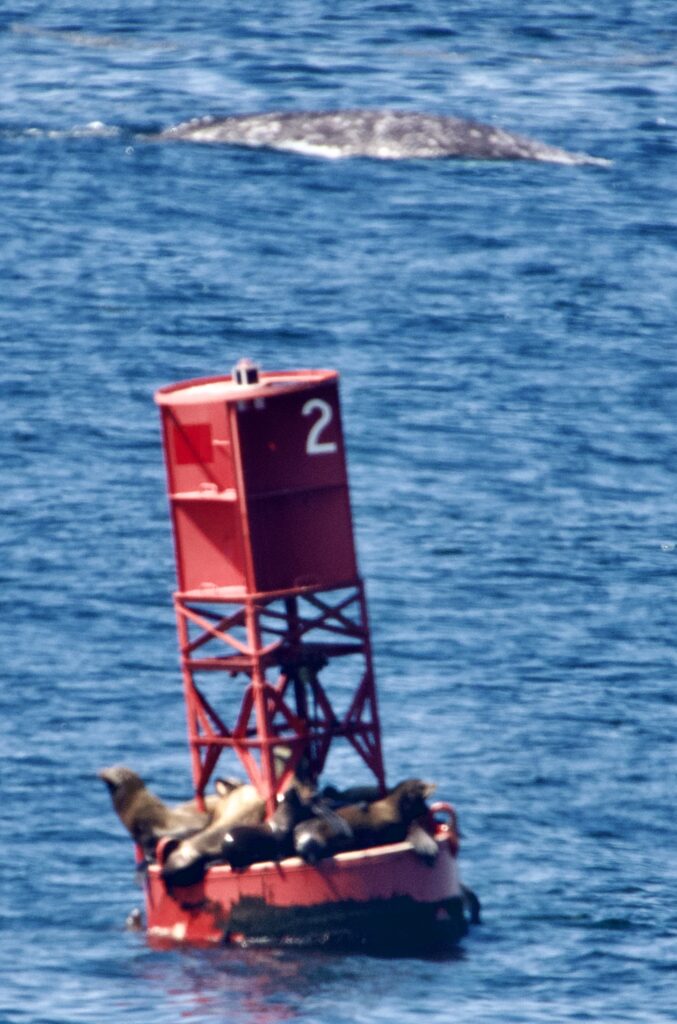
Gray whales are famous for their migration, but there have always been some that don’t migrate at all. Instead, they “chill” along the coasts of California, Oregon, and Washington..
“A small population of about 200 whales spends the summer around the coast of Washington and the Strait of Juan de Fuca, where they feed on the sea bottom there and in the Salish Sea. “
This article originally included criticism of the Mendocino Coast Whale Festivals. In recent years, the Chamber of Commerce event has been fantastic for chili tastings, wine tastings, the Rotary beer fest — all kinds of fun. But gray whales weren’t getting the emphasis we felt they deserved. And shouldn’t we all pause the party long enough to learn about their terrible recent plight?
We dropped that angle when we saw that the Noyo Center for Marine Science had launched a superb whale‑education program for the 2026 festival. The Chamber of Commerce has built the whale festival into a terrific civic event, and we’re glad to see a stronger focus on the whales this year.
Gray whales are one of the great tourist attractions of early spring along the West Coast, including during Mendocino’s month‑long whale festivals in March.
One of my favorite things about gray whales is that some of them don’t migrate at all. A small number simply “chill” along the coasts of California, Oregon, and Washington.
“A small population of about 200 whales spends the summer around the coast of Washington and the Strait of Juan de Fuca, where they feed on the sea bottom there and in the Salish Sea.”
Stewart says gray whales are adaptable and will likely find a way to survive, even if in smaller numbers. But the implications of global warming — so visible at high latitudes — may not be obvious enough in the middle latitudes, where most people live, to convince them to act. And without action, the death and suffering of countless individuals of many species, including our own, will continue to accelerate.
Strandings in Oregon and Washington are up this year, as are those in British Columbia. In California, there seems to be no coordinated statewide tracking system beyond the work of the Marine Mammal Center in Sausalito.
The Center’s spokesman, Giancarlo Rulli, said there have been many gray whales swimming under the Golden Gate Bridge this year, searching for food.
“There have been 10 gray whale strandings in the wider Bay Area so far this year, seven of which have been reported dead inside the Bay,” he said. “Last year, 26 gray whale strandings were reported or responded to in the San Francisco Bay Area by The Marine Mammal Center and partners at the California Academy of Sciences. Of those, 21 were gray whales, with nine classified as suspect or probable vessel strikes.” The vessel‑strike number was a record.
Before the 2019–2023 die‑off, only five to ten whales of all species combined were typically responded to each year by the Academy and the Center.
Scientists had hopefully termed 2019–2023 an “Unusual Mortality Event.” But Stewart’s research shows it wasn’t unusual at all — it was part of a long, depressing slide in numbers that is unlikely to reverse quickly.
Gray whales are doing their best. Many are trying to find food in new places, including the San Francisco Bay — which is exactly why ship strikes are increasing.
“Last year’s record number of Bay Area strandings coincided with a record number of gray whales entering the Bay — 36, including at least 10 at one time,” Rulli said. “Scientists believe changing Arctic conditions, where gray whales feed during the summer, may be forcing the species to adapt to unprecedented environmental changes. There are also reports of elevated numbers of strandings in the Pacific Northwest and British Columbia.”
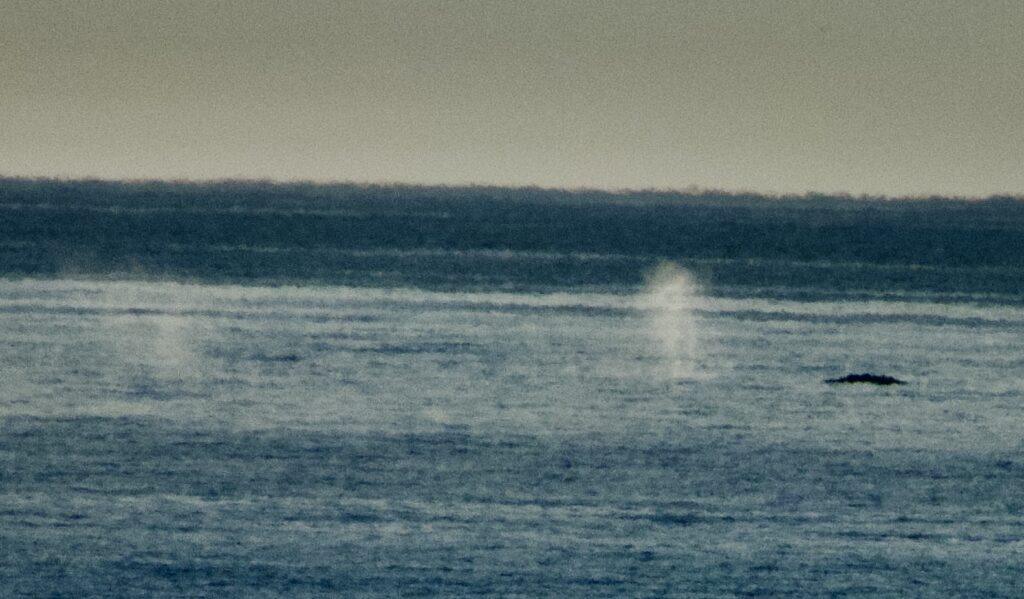
He added that individual gray whales are now spending longer periods inside the Bay during migration and many are actively foraging, which heightens the risk of vessel strikes. Gray whales are currently heading north toward their traditional Arctic feeding grounds. The estimated calf count of 85 is the lowest since record‑keeping began in 1994 — far too low to support population recovery.
The story of gray whales is not just a story about whales. It’s a story about us — what we notice, what we ignore, what we celebrate, and what we allow to slip quietly away.
These animals survived the harpoons. They survived centuries of slaughter, ice ages, and migrations longer than any road we’ve ever built. They survived us once already. And now, as the Arctic warms four times faster than the rest of the planet, they are trying to survive us again.
The teenager female at Virgin Creek never got to live her adult life. And worse, young female whales are either not giving birth or the cal es are not surving. She will never swim past Mendocino again, or raise a calf, or dive into the cold mud of the Arctic for a mouthful of shrimp. But she can still mean something. She can still be a warning, a lesson, a moment when we stop stirring chili and swirling wine long enough to look at the ocean and understand what it’s telling us.
Gray whales are doing everything they can. They are exploring new waters, crossing new oceans, pushing into bays and straits and passages that didn’t exist a century ago. They are adapting faster than any giant mammal should ever have to.
The question is whether we will adapt with them.
If we slow the warming even a little, they have a chance. If we don’t, the next generation of whale festivals may have little left to celebrate but memories. We are the great last hurrah of the Great Whale called the gray whale.
The dieoff does not apply to Humpbacks, orcas and dolphins who are all doing well. Blue whale populations are a mystery.
For now, the whale at Virgin Creek lies where the waves placed her. If you go, tread lightly. Leave the dogs at home. Don’t touch. And stay out of the surf.
Look at her, and remember that she is not just a casualty. She is a messenger. And she is asking us — while there is still time — to listen.
Why Sea Ice Matters | National Snow and Ice Data Center