JAG Shake‑Up: Amy Wynn Resigns, John Anderson Signals Exit as New Chris Rogers Bill seeks to redefine demonstration forests
COME JOIN ME/US for a fascinating forest tour at noon!
Amy Wynn, a prominent Fort Bragg businesswoman, has led the Jackson Advisory Group (the civilian advisory body to Jackson Demonstration State Forest) through some of its most contentious years. She became emotional as she announced she would be leaving the JAG at its next meeting, now planned for June. Wynn was asked to step in as chair when George Hollister’s term became controversial. Hollister, John Anderson, and Wynn are among the longest‑serving JAG members, and Hollister has remained on the group. JAG members and the chair are appointed by the CAL FIRE Director and confirmed by the California Board of Forestry. Wynn is the owner of Wynn Coastal Planning and Biology, which helps property owners work with the intricate rules on the Coast.
Anderson said he was considering stepping aside after 14 years and that he had shared those plans with chair Wynn. He said there were some things he wanted to see through and didn’t have a departure date like Wynn. The audience, including critics, both expressed sorrow when the announcements were made. Wynn said she was stepping aside because of a personal situation requiring more of her time.
One of the biggest flashpoints in the JAG’s history has been the question of local control. In the early 2000s, local environmentalists and timber companies forged a hard‑won compromise that created the JAG as a body with genuine local input. The Board of Forestry initially accepted that plan — and then, in a move many here still describe as cutthroat, dismantled the compromise and stripped the JAG of any real local authority. That decision directly fueled the 2020 protests that shut the forest down, and it has remained closed ever since.
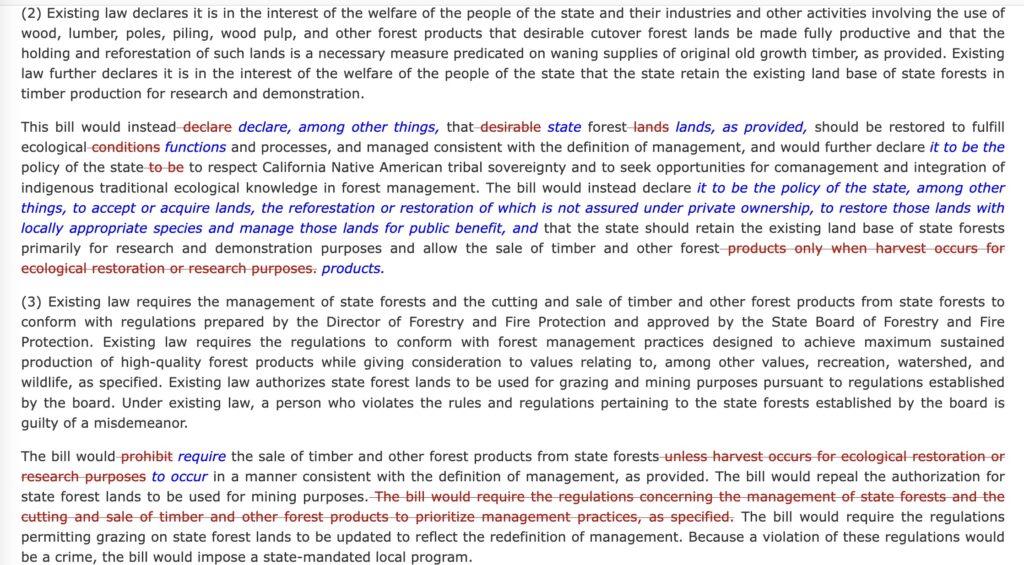
That was then. Now is a AB2494, a bill authored by Assemblymember Chris Rogers, that would change the purpose of the demonstration forest system. No longer would the system be about scientific logging but would broaden to allow study of a much wider range of topics, from carbon sequestration to recreation to mushroom science.
The new bill seeks to redirect the purpose and governance of the demonstration state forest. So we asked the obvious question based on the history: where does local authority fit into this vision? The answer, so far, is unsettling. The bill contains no provision for local control — not even the limited, hard‑won influence the JAG once held. If anything, it centralizes power even more firmly in Sacramento, potentially leaving the community with less voice than it has now. Read the amended bill and see how watered down it has become. It gives the head of Cal Fire wide latitude to interpret the role of logging now, with language saying logging could only happen as part of environmental restoration- HAS BEEN EDITED OUT.
Read the ENTIRE BILL to see how local power sharing was possible but NOT included and how the bill actually hones the power of the state fire board and the head of Cal Fire…….That’s our interpretation but read for yourself and we will have more coming.
The mandate for Indigenous co‑management remains, and that is significant. But the idea that the JAG — created specifically to ensure genuine local input — might have no meaningful role going forward would be a dramatic shift. Once, local voice was the cornerstone of the compromise that made the JAG possible. Now it could be slipping away entirely. This bill was the opportunity to deifne the role of the JAG. At one time, each demonstration forest was supposed to have meaningful local input and even income through the JAG. Only Jackson ever got a JAG and it was defnged by the state fire board. Now this bill offers nothing local, no power, no money, instead affirming Cal Fire’s role when the bill could have, should have, defined local involvement. As it is has been REVISED, all the new purposes like climate change and recreation are in the same basket with logging, if logging is simply determined to be compatible. Determined by who? Cal Fire, of course. While Cal Fire foresters would happily expand into these purposes, the decisions would not be made at Jackson, but at HQ, which has a long standing belief that they make all the decisions and interpretations.
The bill also has a provision that allows the state to violate its own previous laws and charge more for recreation than providing the servcie costs them. Perhaps Cal Fire could replce logging revenue by opening a glamping facility?
Why not a structure that honors both: tribal–state co‑management and a JAG with real authority? Why not a model that reflects the forest’s full history — Indigenous stewardship, local knowledge, and statewide responsibility — instead of erasing one to strengthen another? Carbon credits could be sold in the forest and the money could be split between tribes, the state and local communities to fund the best uses of the forest.
Local — everything local — has slipped off the priority list in so many arenas. And that loss hits hard. For some of us, local control, local voice, and local stewardship aren’t fringe concerns; they’re the core of what makes a community resilient and accountable. Watching that value fade feels like watching the Coast lose one of its oldest compass points.
We’re sad because we believe this is the most important issue there is: decisions made close to home, by the people who live with the consequences. When that disappears, something essential in the civic ecosystem disappears with it.
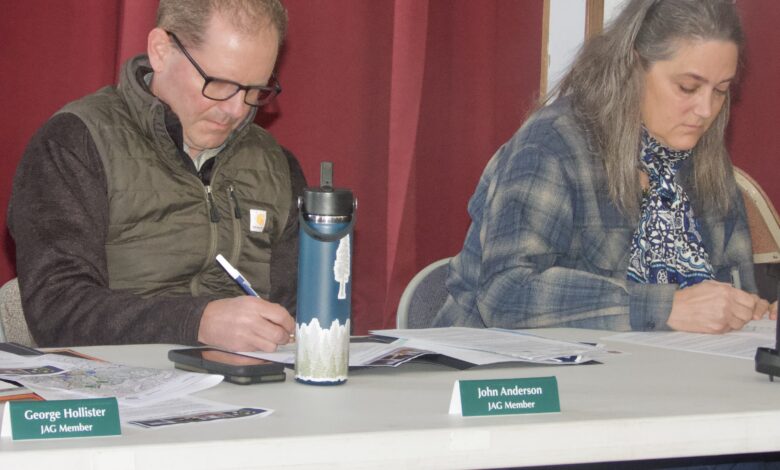
The JAG had seven members present Monday at Lions Hall in Fort Bragg — six of them men. Mary Rose Kaczorowski, reporting for The Mendocino Voice, asked when gender parity might come to the advisory group. Wynn’s departure leaves eight men on the JAG. There are 13 positions but only 9 filled at the moment. The position involves no compensation.
I’m wondering when the goal of gender parity is going to happen on this agenda, for this group,” Kaczorowski said.
“We have 13 spots, and I think right now, we’ve got nine filled. And so I think the (lack) of gender parity doesn’t have to do with iterview the interview process,” Wynn said in response.
“It has to do with watching how you do the interview, and having a selection process that makes sure a valid process is happening, not just waiting for someone to show up,” Kaczorowksi said.
Wynn emphasized that the issue hasn’t been exclusion, but simply the difficulty of finding enough volunteers willing to serve.
In addition to Wynn, John Anderson — Director of Forest Policy for Mendocino and Humboldt Redwood Companies and one of the JAG’s longest‑serving members — said he also plans to step down, though he did not give a date.
Another important move at the meeting came when Kevin Conway, head of the state’s demonstration forest system, announced he was stepping into a promotion in Cal Fire. He introduced Justin Britton, the new head of the Demonstration State Forest System. Britton told the JAG about his lifelong study of and work in forestry. Conway often became the focal point of protesters, although they usually recognized Conway was explaining the will of a state forestry board that had changed course several times over the years.
And so here was the JAG again, at Lions Hall, watching another hinge moment in the long, bruising story of this forest. Two of the JAG’s longest‑serving members preparing to step away. A new bill rising in Sacramento with no place carved out for local authority. A community that once fought its way into the room now finding the door quietly closing again.
Yet inside that hall on Monday, the conversations were still alive — Native voices speaking with clarity and patience, JAG members listening, the old tensions surfacing but not breaking the room. Outside, the forest waited for the noon tour, the same forest that taught so many of us — Keith, Wade, all the Coasties who’ve walked those roads — how to read a hillside, how to listen for what’s missing, how to understand what’s at stake.
Local control may have slipped from the state’s vocabulary, but it hasn’t slipped from ours. Not here. Not on this Coast. Not in a place where people still show up, even when the audience is thin, even when the decisions feel pre‑written somewhere far away.
Because the truth is simple: the forest is still closed, the questions are still open, and the people who live closest to these trees are still the ones who know what they need. Whether Sacramento remembers that or not, we will keep saying it. We will keep showing up. We will keep walking the forest at noon.
The story isn’t over. It’s just turning another page. We will have a follow-up piece on what happened at the meeting and the tour in the forest.