Five days after Green Bridge failure, driver remained in hospital as county official says collapse was ‘shocking’ and likely involved an ‘external factor’
We reached the man whose car plunged into Mill Creek when the Green Bridge suddenly collapsed. We also interviewed Howard Dashiell, director of the Mendocino County Department of Transportation. In an earlier interview, Dashiell said the replacement bridge would take two to three years to complete, but he is now working to accelerate that timeline — ideally to next year, if possible. His full interview follows the account from the driver. Here are two key quotes:
‘MCDoT was not seeing any visible signs of change from the last two years… I truly was shocked to learn Friday evening that this bridge collapsed.”
And
“ I truly believe this – likely had some other external factor yet to be determined as the accident is investigated. The reason may never be known .”
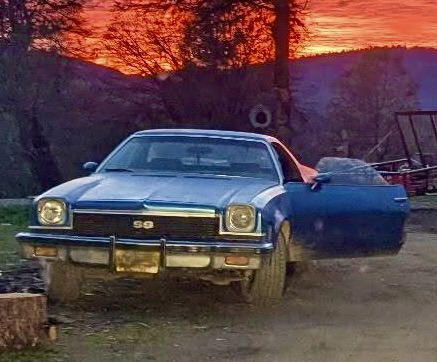
Jimmy Sausedo, 49, of Covelo, was driving his beloved light‑blue 1973 El Camino on Friday afternoon along Hill Road when he suddenly found himself at the center of California’s only public‑road bridge collapse of 2026.
Jimmy Sausedo, 49, of Covelo, was driving his beloved light‑blue 1973 El Camino on Friday afternoon along Hill Road when he suddenly found himself at the center of California’s only public‑road bridge collapse of 2026.
Initial reports from the scene — used by us and by all other media — indicated that Sausedo, 49, had suffered only minor injuries. The CHP log notes that he got out of the car on his own and initially said he was OK, then left the scene briefly and returned. Paramedics evaluated him. He was hurt.
Sausedo was to be taken by helicopter, almost three hours after the crash, to Santa Rosa Memorial, the CHP said. He was taken by an ambulance to a pickup spot in Covelo. Then the helicopter was diverted to Vallejo, according to the CHP report. A first responder said Sausedo was badly hurt.
We reached Sausedo by email. He said on Wednesday that he remained in the hospital five days after the crash and said he is not feeling up to an interview. He also asked that we not publish a photo of him that we have.
Did he arrive at the worst possible moment, with the one‑lane bridge pitching his car into the creek as it collapsed? Could a large truck have crossed just before him, or could someone have struck the bridge in the moments before he arrived?
The bridge‑warning sign was lying on the ground in one of the photos mendocinocoast.news obtained. The question is when it fell: was it knocked over the night before the collapse, or weeks or months earlier? It’s also possible it was moved by first responders as they made their way down to the car.
Does anyone know whether this sign was already down before the collapse? We have never been on Mill Drive, and it’s entirely possible the sign had been on the ground for some time. It’s also possible it fell more recently. At this point, we simply don’t know.
Could Sausedo have hit the bridge with the El Camino?
We asked CHP spokesman Olegario Marin those questions. He said that information won’t be released until the CHP completes its investigation, which could take several weeks.
Our previous story:
Howard Dashiel, Director of Mendocino County DOT was shocked when he heard the bridge had collapsed somehow.
“MCDoT was not seeing any visible signs of change from the last two years… I truly was shocked to learn Friday evening that this bridge collapsed. Yes, the bridge was weight-limited to about half of normal loads… had been for decades. Yes, we wanted to replace it and had been going through the process. But no, there were no telltale signs. Repair work recommended in the report was quite routine and yes, the county crew would have addressed those lose wood deck issues… however the failure of the metal frame is not dependent on the wood deck which only caries the axial loads (gravity loads – strength for vehicle weight) – the metal frame provides the Lateral load strength and I assume some sort of lateral force contributed to this failure. I don’t know what that is and might not ever know. “ Dashiel said.
The complete inspection report by Caltrans is in our previous story.
“My staff looks for any unusual changes between the two-year Caltrans detailed reports… My engineers or I have gone to look at changes of concern reported by staff… MCDoT then has the option to request a special extra review with the FHWA funded Caltrans , Office of Bridge Asset Management, Structure Maintenance & Investigations (M&I). Or MCDoT has consultants on contract we can call on for special review if we see concerns.”
Dashiel said he feels comfortable driving over any county bridge.
“I trust the counties’ bridges… you can look at MCDoT web pagehttps://www.mendocinocounty.gov/departments/transportation/current-projects for “Current Projects” 2006 Director Report (these also link to the CEO Report presented before the BoS) Please note that this report was done BEFORE the Hill Road collapse and showed 2028 as the replacement date for Hill Road Covelo at Mill Creek – we still hope to make that schedule BUT as labeled all these projects have “Anticipated Construction” dates and can change. Still, as I have been saying, we will do everything we can to replace this bridge by next year.”
Dashiel feels it’s likely that some external factor caused the collapse.
“All the other Bridges listed in the above-mentioned Director Report under Highway Bridge Program (HBP) are safe within any posted limitations until we replace them in my opinion. I know that might sound unimpressive given what just happened in Covelo, but I truly believe this – Covelo likely had some other external factor yet to be determined as the accident is investigated. The reason may never be known unless some witness provides additional information about how the bridge fell, or other evidence is found.”
We asked Dashiel if this was the worst county bridge the county has had to deal with. He described two bridges that were replaced on an urgent schedule, but that still look years, with regular monitoring.
“Your question about other bridges in the County… are or were there worse bridges?… yes, in 2005 when I got this job, we had a lowest scoring bridge at Feliz Creek on CR 110 in Hopland, which MCDoT had to reinforce with large I beams that was visibly destressed… took me seven years, but we replaced it. More recently, the bridge on Lambert Lane in Boonville started experiencing a scour distress in 2016… we watched it took intermediate measures… started the replacement process, and now it looks like that bridge will be complete this year (ten years) later.”
The MCDOT has a list of bridges on the docket to be replaced, or at least work to begin in the next year:
Dutch Charlie Creek Bridge Replacement on Wilderness Lodge Road, CR 320, M.P. 0.72
Mattole River Bridge Replacement on Briceland Road, CR 435, M.P. 0.63
Mill Creek Bridge Replacement on Hill Road, CR 327B, M.P. 2.05
Philo-Greenwood Road Over Navarro River Bridge Rehabilitation, CR 132, M.P. 17.33
Outlet Creek Bridge Replacement on Reynolds Highway, CR 310, M.P. 4.87
Usal Creek Bridge Replacement on Usal Road, CR 431, M.P. 5.93
North State Street Intersection Improvements, CR 104, roundabouts at Kuki Lane and the southbound State Highway 101 interchanges
Note — videos circulating on social media that appear to show other California bridge collapses are AI‑generated and did not happen. There is no comprehensive database of all bridge failures, but our own diligent searching found no evidence of any other bridge collapse in California in 2026. At this point, the Green Bridge failure appears to be the only confirmed public‑road bridge collapse in the state this year.
We live with old bridges the way we live with old stories — assuming they’ll hold because they always have. But every so often, something gives way in a single instant, and the familiar becomes a question mark. The Green Bridge fell in seconds, yet the echoes of that collapse will travel far longer: through engineering reports, through county meetings, through the quiet calculations of anyone who drives a one‑lane span without thinking twice. And maybe that’s the real shift here. Not the metal in the creek, but the way a century‑old crossing reminded us that even the most ordinary routes can surprise us, reroute us, or ask us to look twice at the things we trust without a second thought.