Your Tuesday Newspaper, Aug. 25, 2026 — Great White Shark Buzzes Fisherman Mike + AB2494’s New Version Raises Big Questions + We Answer 12 Hard Questions About Redwood Harvesting + New Covid Variant Spreading Locally, Would You Try This New ‑Type Vaccine? + Weird Missing Dog Poster, Missing Cat
DON’T SPEND TIME WORRYING ABOUT SHARKS — BUT DO WORRY ABOUT THE FUTURE OF THE FORESTS, AND READ OUR EXCLUSIVE ACCOUNT OF THIS CRITICAL ISSUE…
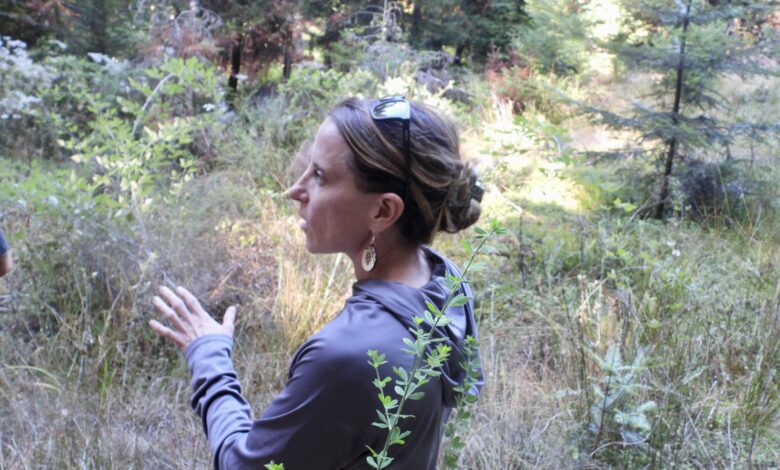
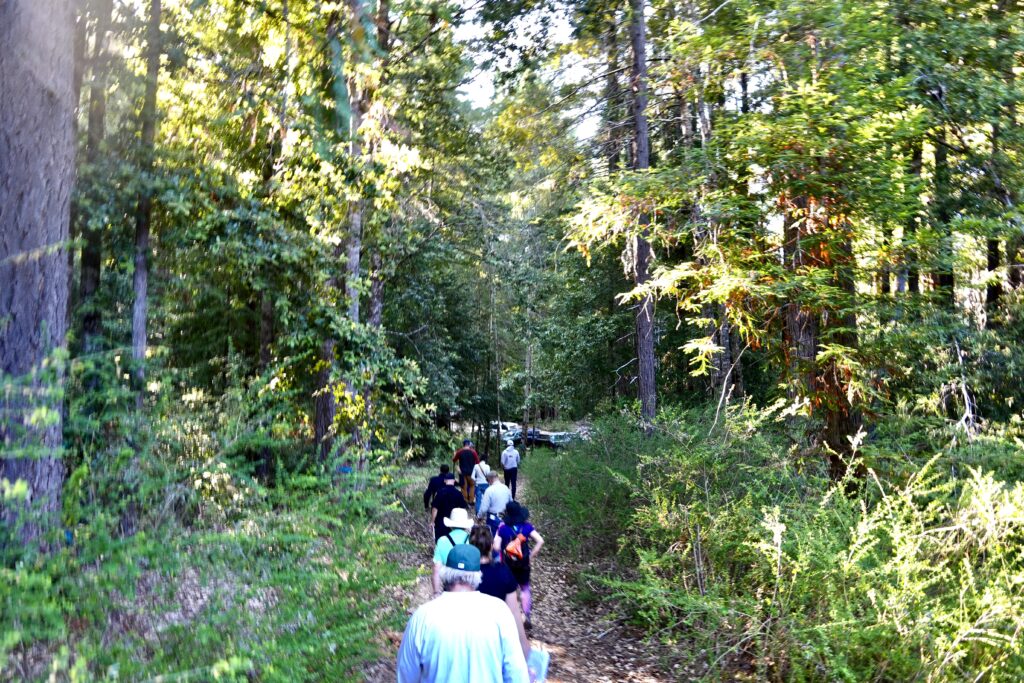
Julia Butterfly Hill’s true tall‑tree tale helped launch and shape the life’s work of Dr. Sarah Bisbing, who led last Tuesday’s Aug. 18, 2026 forest tour of the upcoming timber harvest in the Jackson Demonstration State Forest.
“ I also understand a lot of the skepticism. I was born and raised in the city of Chicago. I had no experience or exposure to the natural world. I read Julia Butterfly’s book about her action the Redwood Forest when I was 18, and I became really inspired about forestry. I thought I wanted to be a tree sitter and a tree hugger.”
For 738 days, Julia Butterfly Hill lived in the crown of a 1,000‑year‑old redwood she called Luna, refusing to let Pacific Lumber Company fell it. She eventually negotiated a deal that saved the tree. Her vigil became a defining moment in modern environmental activism, and the movies and books that followed carried her story — a woman fierce, stubborn, and unwavering in her moral code — to millions across the globe.
Bisbing went on to become a forester and earned a doctorate in the field, later serving as a professor at Cal Poly San Luis Obispo before launching the Bisbing Laboratory on Forest Persistence Potential at the University of Nevada, Reno. Her life’s work focuses on how forests can persist through the dual challenges of climate change and recovery from the damage left by earlier logging eras.
“I am still a tree hugger. I’ve hugged an awful lot of trees. But the reality too is, I learned in the long run that I needed to be able to keep forests in the landscape in the future. I needed to undo some of the wrongs from our direct and indirect management, and so part of that is going in and modifying the structure of the forest.”
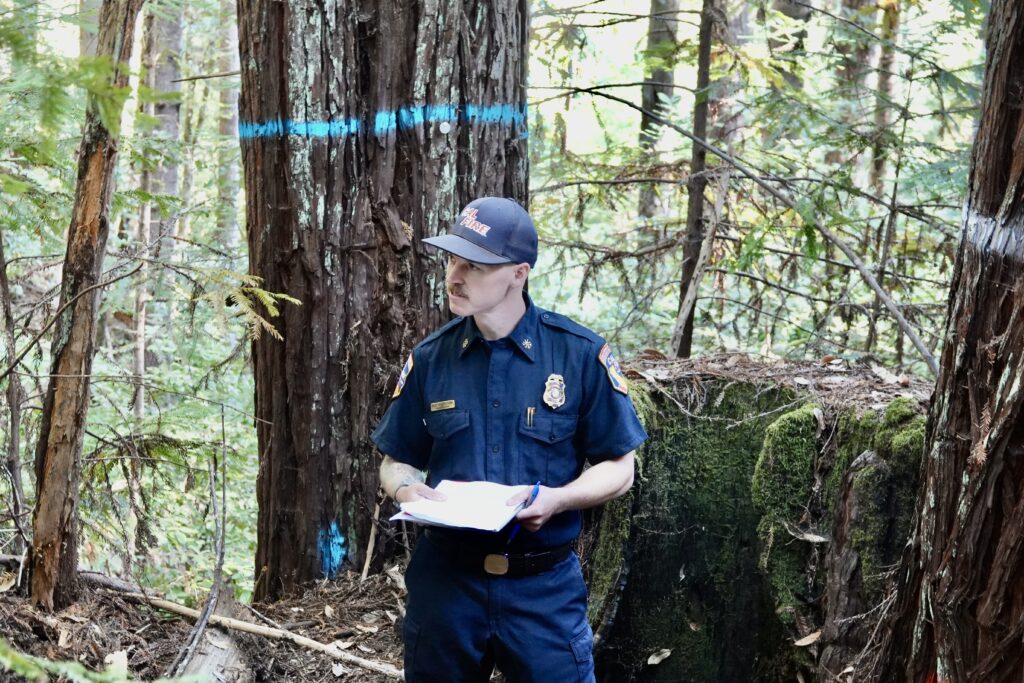
Watch Acheya Wachtel’s video of Frank’s conversation with Dr. Sarah Bisbing, joined by Cal Fire’s Jeremiah Steuterman — who directed preparations for the AMEX (Adaptive Management EXperiment) harvest — and Justin Britton, who leads CAL FIRE’s Demonstration State Forest Program.
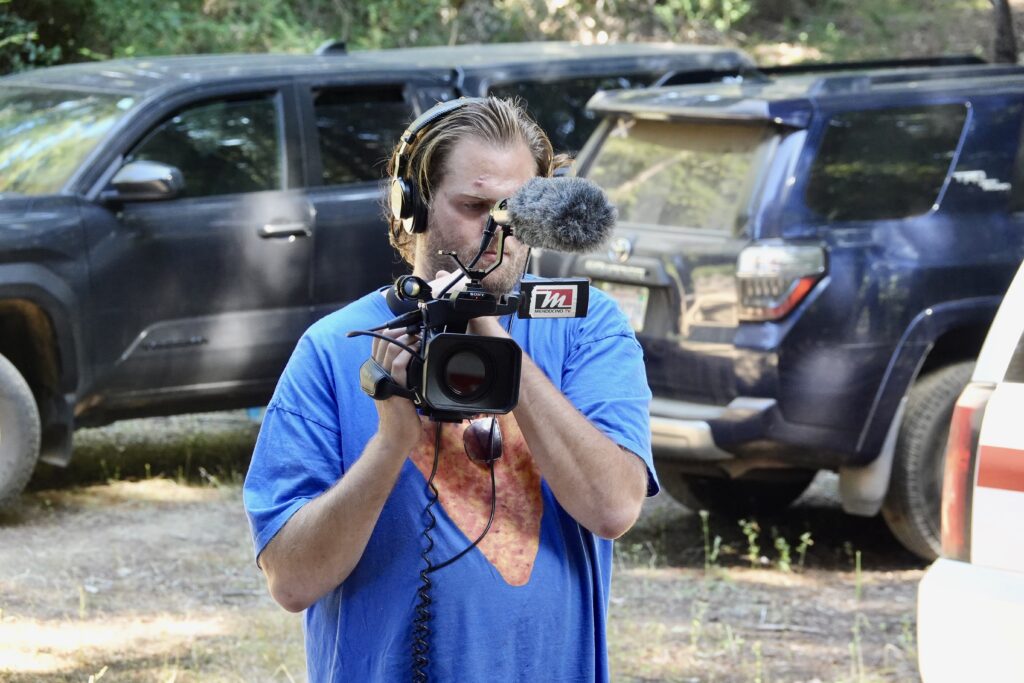
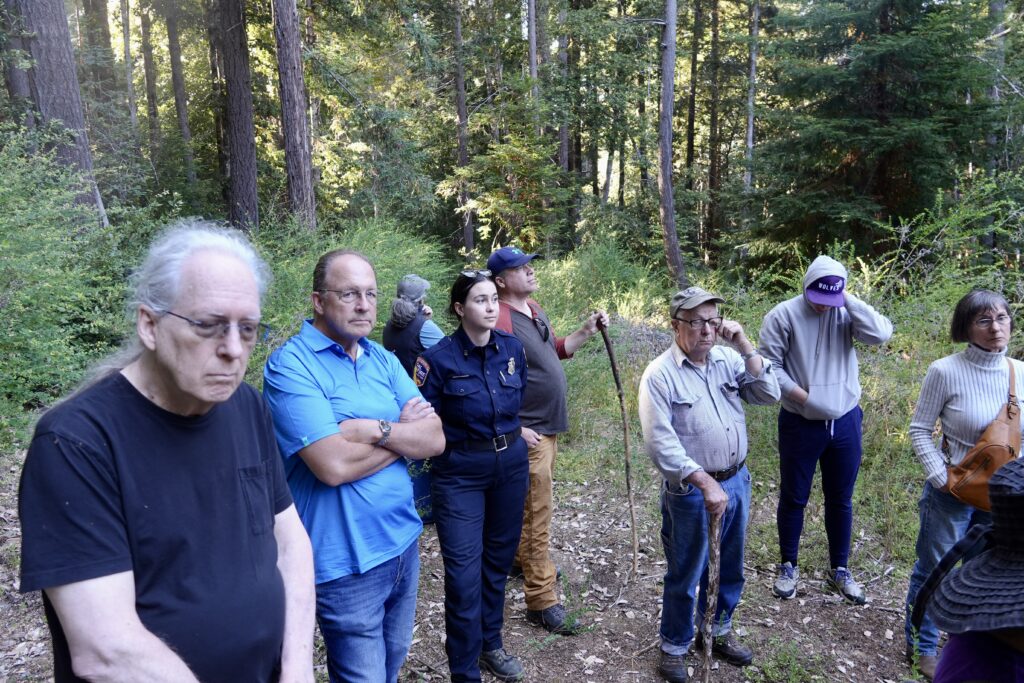
Bisbing’s visit landed at a pivotal time in the industrial and environmental story of the Mendocino Coast. Her scientific tour complicated what seems like a simple question — should logging resume in the Jackson Demonstration State Forest? MendocinoCoast.news — myself, videographer Acheya Wachtel, and Noyo Harbor resident Sarah Ginskey — joined the tour and pressed for answers. Later, Wachtel and Frank covered the Save the Jackson Forest Coalition rally outside Town Hall on Saturday. Our documentary will explore what people are saying now, the forest itself, the science behind it, the politics around it — and track how the next chapter unfolds in the woods and in the boardrooms.
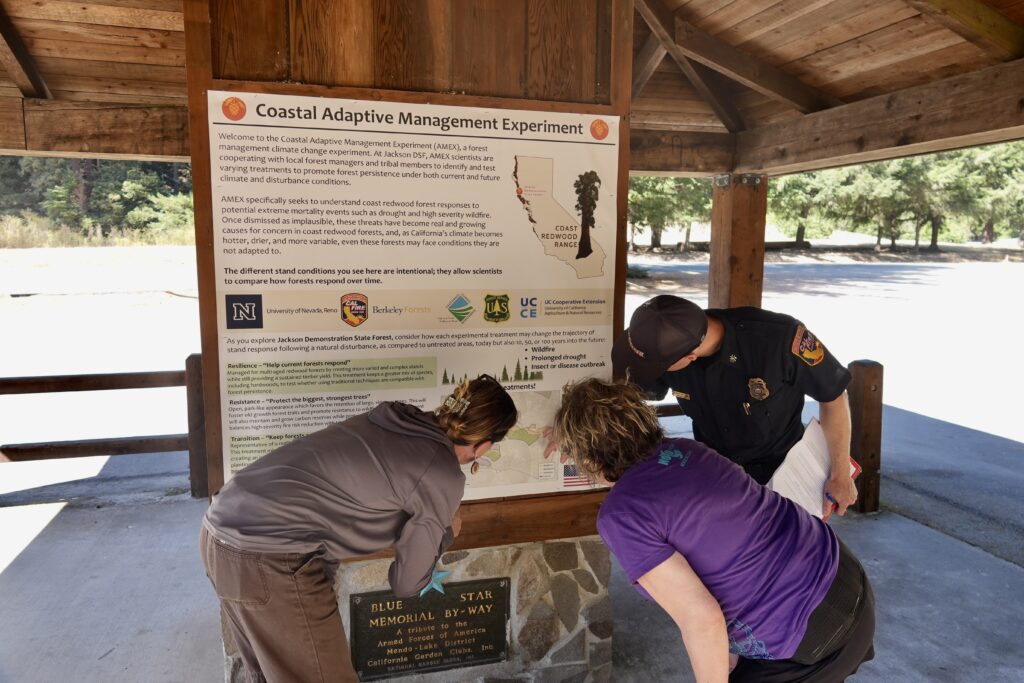
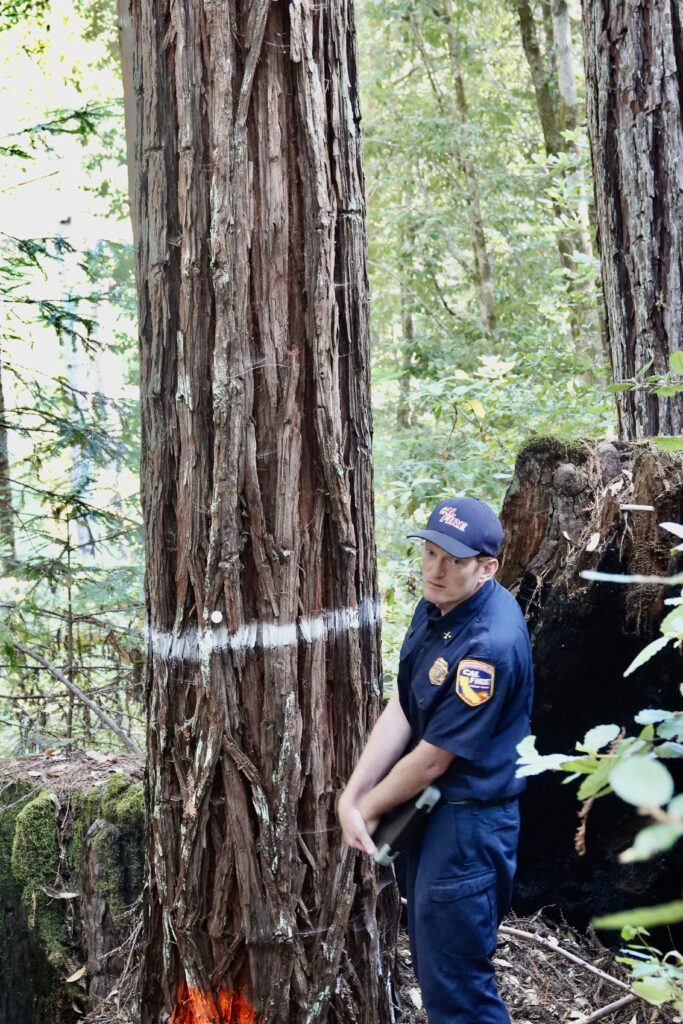
Bisbing’s AMEX plan covers nine additional sites across eastern California and western Nevada and rests on science that makes one point unmistakable: after early logging wrecked these forests, they now need continual intervention to stay healthy and economically viable. Local environmentalists question how much of this is driven by economics versus genuine ecological stewardship. Bisbing argues the forest can be restored and can persist — but right now, that requires logging companies, who both profit from the work and perform the experiments and mastication needed to clear the hazardous brush left by past logging and by catastrophic fires in other regions.
Forests whose ecology was shattered by the irresponsible logging of the past — and they did know better — now require logging if we hope to work our way back to a time when big trees ruled, Indigenous people burned the underbrush, and forests sustained far more complex ecosystems.
But hard questions remain for all sides of this debate.
Bisbing and the Cal Fire representatives overseeing the AMEX harvest in the Jackson Demonstration State Forest led Tuesday’s tour. The AMEX would mark the first new commercial timber harvest since 2020, when environmental activists halted operations. Those activists, now organized as Save Jackson, say they hope at minimum to delay this harvest — but also emphasized they are willing to return to the forest for additional field discussions.
“I don’t want to get up at 4 a.m again and go out to (stop the trucks) but I will if I have to,” said Naomi Wagner, one of the leaders in the protest movement for the past five years.
The harvest was originally scheduled to begin in July, then pushed to August, but contracting has since stalled for reasons Cal Fire has not yet identified. Cal Fire proposed the THP, took extensive public comment at multiple meetings, and ultimately received approval from the Jackson Advisory Group. Two Brothers Logging will carry out the work on behalf of Mendocino Redwood Company.
Bisbing’s laboratory is directing the scientific component of the project, which tests three different forest‑management strategies across roughly 300 one‑tenth‑acre study plots scattered throughout the 480‑acre harvest area. Those plots are being monitored intensively as statistical samples. The remaining 90 percent of the acreage will undergo conventional selective‑cut harvesting — but informed by current research on how to restore forests heavily degraded by past logging practices.
The experiment acknowledges the limits of today’s methods and uses the three contrasting approaches to explore what a future‑resilient forest might look like under accelerating climate stress.
This puts Bisbing on the opposite side of the saw from many other admirers of Julia Butterfly Hill, several of whom returned to protest the following Saturday. Their presence underscored the divide between Bisbing’s science‑driven approach and the activist tradition inspired by Hill’s vigil.
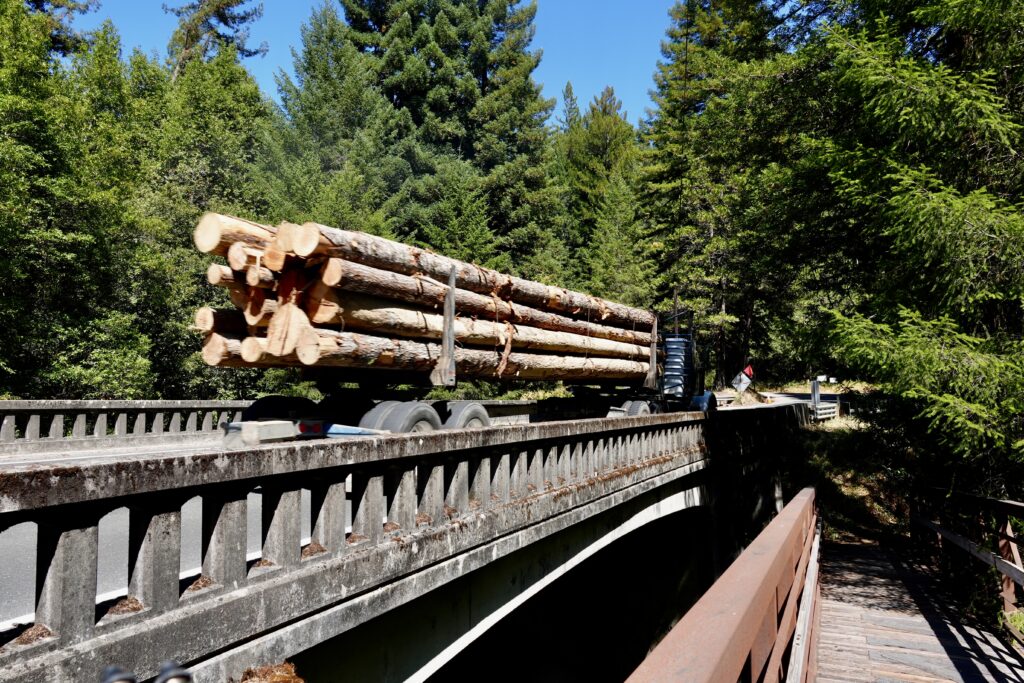
Mendocino County roads are routinely filled with logging trucks hauling timber — but none of those loads have come from Jackson Demonstration State Forest in recent years. Jackson was established after World War II as the public forest where science would lead the way in developing better timber‑harvest methods and shaping statewide forest practices. New approaches were meant to be tested on the demonstration forests and, once proven, adopted by commercial operators.
California’s demonstration forest system has certainly failed at times — pushing logging forward with “study” more an excuse than a reality, as we have seen. But it has also produced 75 years of critically important, ongoing research that the private companies owning most of the region’s forests — and employing the drivers of those logging trucks — have used to improve their own practices.
The Demonstration State Forest system helped reduce clear‑cutting, improve lumber production, and shape the healthier forests that existed here until the old‑time loggers cut most of them down. Its legacy is complicated, but its scientific contributions remain central to modern forest‑management standards and the shift_away_from_clearcutting that reshaped statewide policy.
But how much logging should occur in a public forest? The science — and what Dr. Bisbing demonstrated on the tour — indicates that some level of active management is necessary. Without it, large portions of the forest would drift toward unsafe, overgrown brush fields dominated by invasive species and imbalanced stands. That outcome is well‑documented in forest‑succession research and is central to the case_for_active_management in Jackson.
All sides in this debate have oversimplified the issues, and we’ve been subjected to plenty of spin and omission. Yes, we all live in wood houses, and yes, this study has real value for the future. But the harder question is how to ensure that anything done today will endure — scientifically, politically, and ecologically — in the decades ahead.
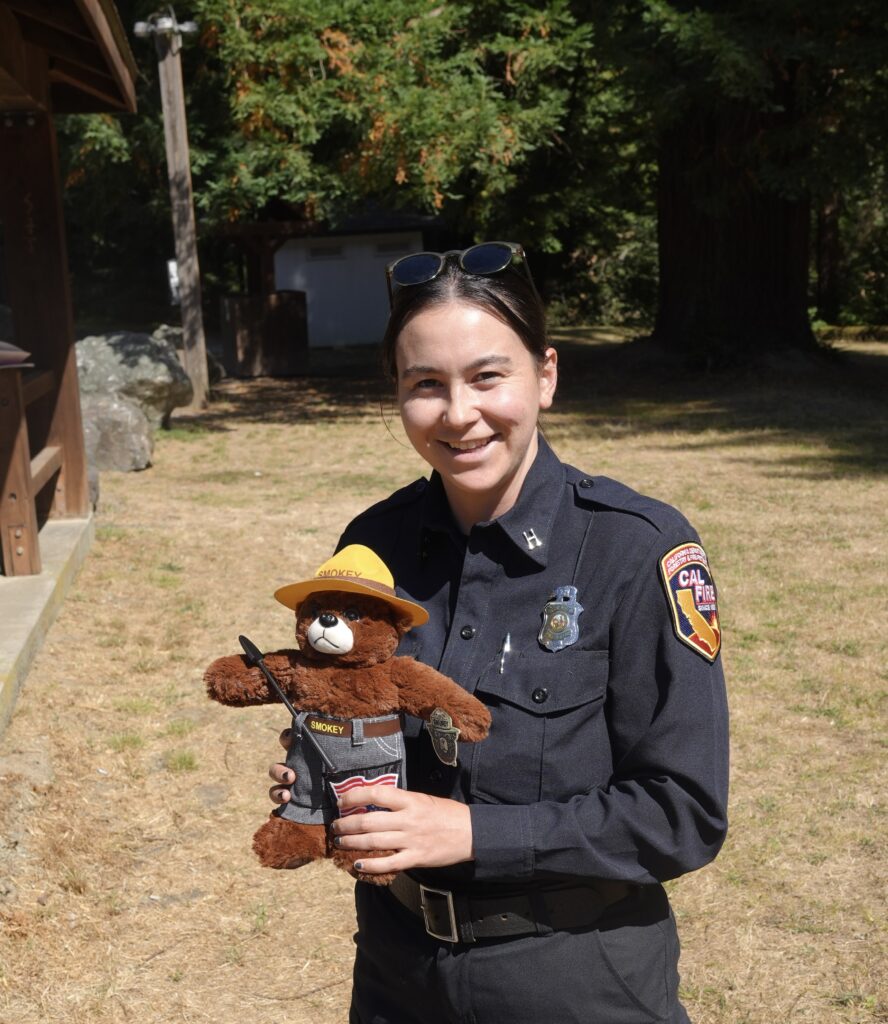
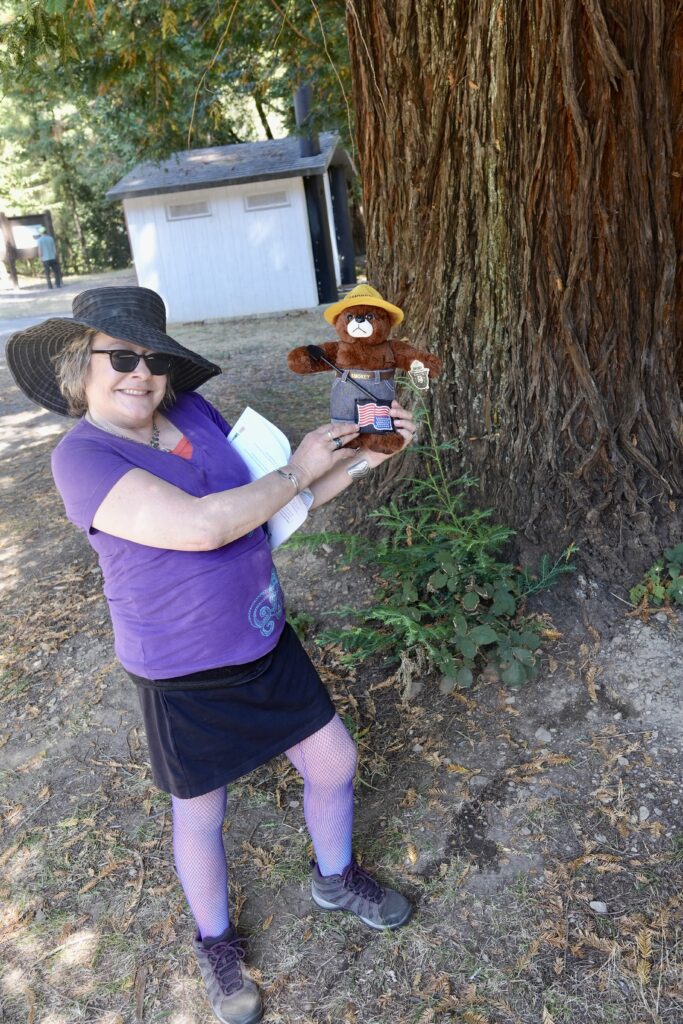
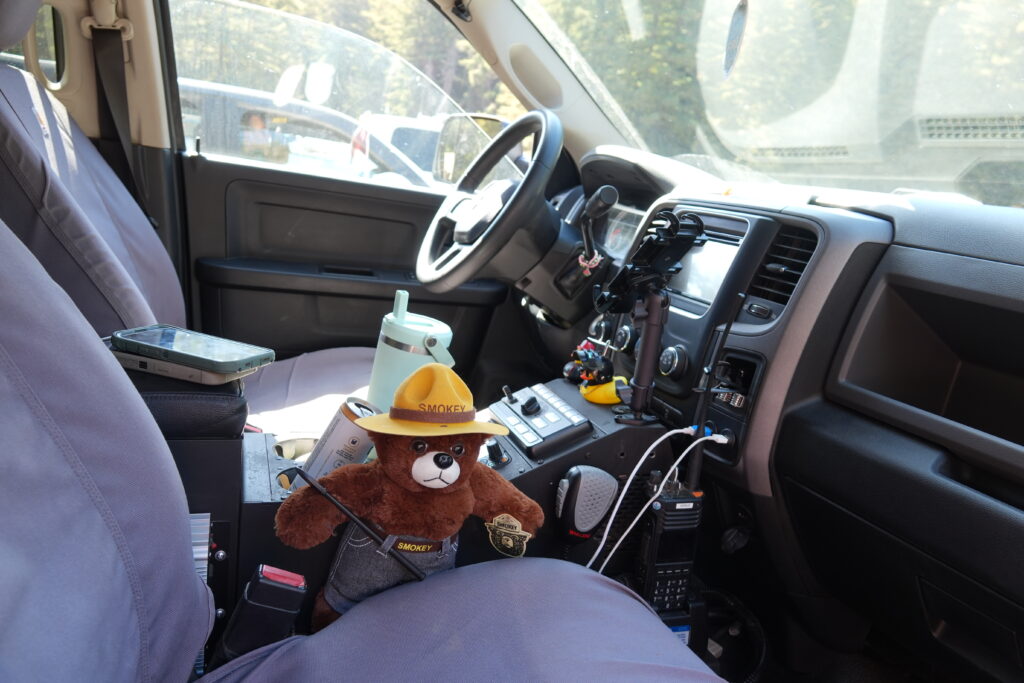
Sarah Ginskey arrived at the tour as a long‑time opponent of any logging. She brought a stuffed Smokey the Bear and draped him with an upside‑down American flag to show her objections. Cal Fire scientist Caitlin Grace immediately fell in love with Smokey and ended up taking him — flag included — back to her office.
We talked for two hours. And despite our differences, every one of us was struck by the depth of Dr. Bisbing’s research approach and the clarity she brought to the long‑term forest questions that will shape what happens next.
“I didn’t come to this expecting to like them,” said Ginskey, laughing about the fun we were all having and how dense the topics at hand were and how much it helped to see the science versus reading about it.
Ginskey raised the toughest question for Cal Fire and Dr. Bisbing — the same question we believe the environmental community could help answer but is not answering. They could be pushing for a better bill, not just any bill, and they could be pushing for local control and authority, but they are not.
We placed that question last on our list of the eleven big questions raised by environmental protesters and by the three people on our tour team about the AMEX and the broader idea of logging large redwood trees. It remains the question without an answer — alongside the equally significant question of why the new bill contains no local element at all.
Both questions sit at the center of the unresolved debate over public‑forest governance and the future_of_Jackson.
Question #1: Did Cal Fire break promises by starting the AMEX now? Save Jackson argues that Cal Fire went back on its word and broke promises made when logging was halted. We asked both sides what those promises were — who made them, when, and under what circumstances. No one could provide any specifics. So far, we have seen no written records, no contemporaneous notes, and not even a clear account of who promised what to whom.
The central claim is that Cal Fire said it would not resume logging until the management plan was completed. We did not hear that promise ourselves, though we missed some meetings, and it is reasonable to assume some assurances may have been made when protesters forced the halt. But if such a promise existed, we have not seen evidence of it.
Meanwhile, we have watched the AMEX move through the legal process Cal Fire uses, appearing on two previous JAG tours. Cal Fire says it paused logging and then relaunched the process in 2022 with the creation of the New Plan.
“That promise was never made and would be counter to the Board of Forestry and Fire Protection’s policies for the Demonstration State Forest,” said Kevin Conway, a Cal Fire top banana and then head of the Demonstration Forest program.
So the unresolved question remains: Was there actually a promise to wait until the management plan was complete — which has only now been finalized?
It is the first of the eleven major questions raised by protesters and by our tour team, and it remains unanswered.
“Here is the relevant portion of Board Policy 0351.10: CAL FIRE shall continue management of the state forests under existing plans, with appropriate consideration for changes in law or regulation, until amendments or new plans are approved by the Board. (link),” said Conway. OK, that still doesnt give the process for what CAL FIRE said when it decided to give up on the Caspar 500. It is fact that Cal Fire was stopped from doing legal management and fulfilling legal contracts made to the logging and milling contractors because of the protesters. So the legal process was interrupted and we don’t know exactly how or what was said.
As historians of this entire process, we still do not have a clear, documented account of how protesters ultimately stopped the Caspar 500 plan. We have long felt that Cal Fire overreached with the Caspar 500 THP — it was extremely close to where people live and recreate, and it removed large, well‑known trees along public trails. Yes, that “mama tree” was beloved by many hikers.
We have no primary source describing what happened next, beyond our own eyes and ears. What we would include in a history book as visual witness, absent any official explanation, is this: the Caspar 500 THP ended when one contractor refused to put his employees into a dangerous situation. This occurred after members of Save Jackson went into the forest and began placing themselves in harm’s way while trees were being felled.
The contractor, Anderson Logging, did not want to expose its fallers to that risk and pulled out. After that, the plan collapsed — though we still do not know what, if any, promises were made at that time.
The collapse of Caspar 500 remains one of the most consequential turning points in the modern history of Jackson Demonstration State Forest, and one of the least clearly documented. It sits at the center of ongoing questions about protester tactics, contractor safety obligations, and the limits_of_public_forest_governance.
Cal Fire did then shelve other timber harvest schedules in the pipeline until new ones were launched in 2022 but not to wait for the management plan (although protesters did insist on this on a regular basis)
“All the commitments we made are in writing and available for your review. (he provided a copy of the New Vision, which we put at the end of this long story. ) This is the document we refer to as the “New Vision” and has guided the public and tribal outreach and focus of each of the projects we have brought forward since 2022. We have been keeping our kept our commitments from the very beginning when we volunteered to protect the “Mother Tree” and adjacent trees within the Caspar 500 when the protests first started.”
With all the facts we have now, we consider the “broken promises” claim to be unfounded. Without documented proof, it is not a credible reason to hold up a scientific harvest. The record — such as it exists — simply does not support the allegation.
This remains one of the central unresolved issues in the debate over AMEX accountability and the broader question of public‑forest commitments.
Question #2: Should Cal Fire have waited for the new management plan to finalize the AMEX? Save Jackson argues that Cal Fire should have waited until the new management plan was fully finalized before moving ahead with the AMEX. On its face, that seems reasonable — especially given the unexplained delays already pushing the start toward the October 15 cutoff, when wet weather makes the forest unworkable for logging.
But unless someone can correct us, nothing substantive would change if Cal Fire waited. The agency prepared the AMEX with extensive public input and followed the legal process. They also designed it to align with the new management plan, even though that plan is not yet final.
Britton told us that no other management plan in the Demonstration Forest system — at least in his experience — has ever received this level of public input, adjustment, and scrutiny. (Jackson plans did receive heavy scrutiny in 2010.) And he believes protest continues even when Cal Fire delivers what protesters ask for.
“Like the approach here on the AMEX was the response to the public input that said, ‘We want climate change research. We want this. We want that. We want the other things.’ And Cal Fire saying, ‘We’ll deliver this to you on a silver platter,’ and we did. But yet, you know… and maybe there’s money to be made in pushing back against these things,” Britton said.
As for the new management plan itself?
“It’s in executive‑level review at Cal Fire right now and will go to the State Fire Board in the next couple months,” Britton said.
The question remains central to the debate over AMEX timing, the role of management plans in public‑forest governance, and whether waiting would meaningfully change anything on the ground.
Question #3: Does the state of California have a current mandate for tribal co‑management? Yes. California already has a broad and explicit mandate for tribal co‑management — one that is stronger and more sweeping in the 2020 legislation advanced by Gov. Newsom than anything contained in AB 2494.
AB 2494 does accomplish something important: it makes clear that the mandate applies within the Demonstration State Forest system. But it does so in weaker and more confusing language, the kind that is almost guaranteed to create unpleasant consequences down the line if the bill is not edited one more time.
The contrast between the 2020 mandate and AB 2494 sits at the center of ongoing questions about tribal co‑management authority and how clearly that authority is expressed in Demonstration Forest legislation.
Bill Text: CA AB1284 | 2023-2024 | Regular Session | Chaptered | LegiScan
Question #4: Did Cal Fire always handle communication about tribal co‑management in Jackson well? No. Most of the time their message was clearly delivered — but simply not believed. And in one key area, we believe Cal Fire failed outright: they did not identify state priorities or state outcomes in even general terms during negotiations with tribes. They did not need to disclose what tribes said, but they did need to disclose what the state was doing — and they did not.
Cal Fire should have told the public what the state wanted from the process and produced documents showing what the state needed from tribes. Their agenda (without tribal names, if necessary) and the outcomes taxpayers received. Instead, Conway and other Cal Fire representatives repeatedly told us they could not say how many tribes they met with, which tribes, or what was discussed.
Yuki elder Edwina Lincoln of Round Valley made this point in the most polite, grounded way possible. She did not claim to represent her tribe formally, but she spoke with full knowledge of what was happening. She implored Cal Fire at multiple public meetings to represent taxpayers — if not the tribes — and she openly doubted any reports coming from secret meetings. Frank could not understand why Cal Fire did not adopt many of her suggestions. She once stayed talking with Cal Fire staff on an AMEX tour until dark, asking the same question again.
And now the situation has shifted: prominent members of several local tribes are steering the effort toward slowing or even stopping logging.
“Tribal liaisons helped identify where work could and could not occur, including avoiding cultural or sacred sites, and plant data was shared so tribes could track species such as huckleberry and redwood lily across treatments,” Bisbing said.
It is no surprise tribes would not want their cultural knowledge published or shared. History has bred mistrust — including recent history, such as the 2011 compromise where the state suddenly pulled the rug out from under a community process that had taken tremendous effort to build.
Conway and Britton told us that tribes identified tanoak groves traditionally burned to strengthen acorns and the surviving trees — but not where, which is appropriate. This managed burning, as their ancestors practiced, produces larger acorns and stronger tanoaks. It is similar in spirit to what the AMEX seeks to do with the redwood forest — if Cal Fire can be trusted to follow through long‑term.
This question sits at the center of unresolved issues about tribal co‑management transparency, state obligations, and the long‑standing mistrust that shapes the future of Jackson.
“I don’t think relationships have ever been stronger,” Britton said
“The tribes are consulted ahead of any project before we go public with it. As I mentioned to you in writing, sort of the those government-to-government consultations are confidential and. and it would be disrespectful for us to talk about how that goes. I would encourage you to reach out to them and allow them to comment. But we would be-it’s sort of, I guess, receiving the continuous question of, well, what are you doing with the tribes? Is disrespectful to the tribes in and of itself. It’s their business, and and we’re honoring it. And you can you can imagine they would speak out against it if we were doing them wrong.”
Question # 5 DOES AB2494 FORCE CAL FIRE TO MAKE THE CHANGES EDWINA AND OTHERS ASKED FOR TO THE SECRECY?
No. Read the AB2494 section under question 10, but we found the answer is no, because the new co-management statement in the bill lacks a process for the tribal co-management to be implemented, so its really up to CAL FIRE to do whatever they want.
Question #6: Is Cal Fire an agency with ill intent toward the forest? Are they bad people? Do Save Jackson protesters simply want to stop all logging without regard to science? Are they bad people? No, no, no, and no. Neither side in this debate is made up of villains. Cal Fire staff are not out to harm the forest, and the Save Jackson protesters are not blindly opposed to science. Both groups include people who care deeply about the land, who have studied the issues, and who believe they are protecting something precious.
At Saturday’s rally, several people driving by screamed obscenities at protesters and revved their truck engines. They could have stopped and talked. Instead, they chose disrespect toward people who have spent years learning the forest, loving it, and fighting for it. It was the same rubbish we see from screaming trolls on social media — a symptom of a debate that has become horrifyingly shallow, dominated by shouted talking points picked up from influencers rather than any real understanding.
This question sits at the heart of the broader issue of public‑forest polarization and the challenge of restoring good‑faith dialogue in a community that cares deeply but often talks past itself.
This jerk was not the only person to scream at the Save Jackson crowd. And during the event, a Cal Fire staffer came up quietly to listen — because they genuinely respect the take of thoughtful protesters like Larry and Phyllis Aguilera, who have asked polite, informed questions on multiple tours, seen everything, and still oppose much of the logging.
But after one compelling speaker, another took the mic and began vilifying Cal Fire personnel personally, calling them “really bad people” and more. That was not the general tone of the protesters, but the Cal Fire staffer left — and later tracked me down.
Their main point was simple and sobering: future generations are being ignored by all sides, and they have tried to bring young people into the process with almost no help.
That frustration — from both Cal Fire and protesters — sits at the heart of the deeper problem: a debate where good‑faith participants are drowned out by personal attacks, and where the long‑term needs of the forest risk being overshadowed by the loudest voices.
This moment ties directly into the broader questions of public‑forest polarization, intergenerational stewardship, and how to rebuild respectful dialogue in a community that cares deeply but often talks past itself.
“This is not the first time I’ve experienced that, and it makes it really difficult to listen to what they have to say.”
Nobody in this process deserves disrespect, to be screamed at, or called evil. I’ve never seen one of the screamers on a forest tour. The people who show up — Cal Fire staff, tribal representatives, scientists, longtime activists, and everyday residents — are the ones doing the work, asking questions, and trying to understand a complicated forest.
The screamers are outsiders to the actual conversation. They contribute nothing. And their behavior only deepens the divide in a debate that desperately needs respectful engagement and shared stewardship rather than personal attacks.
This is the heart of the matter: disagreement is not disrespect. And the forest needs disagreement — honest, informed, science‑based disagreement — far more than it needs shouting.
Save Jackson folks have participated in the process, learned the material, and asked questions — sometimes pointed ones. They love the forest and have raised valid concerns. Many of them understand the science and simply do not trust the State Fire Board, Cal Fire Sacramento, or the long history of destructive logging in Mendocino County.
But there also appears to be a push from outside the region to fight all logging, regardless of any science offered. That outside pressure is different from the local Save Jackson members, whose objections are rooted in lived experience, long memory, and a deep mistrust of state institutions.
Save Jackson became frustrated with the JAG because it approved every timber harvest plan, and to some members it felt pointless to participate. But that misses the larger truth: much was learned through that participation, and harvests were genuinely improved by local involvement.
We have heard too much spin — and too many lies — from both sides. And that is why the forest needs more science‑based dialogue, more local participation, and far less absolutism from people who never show up to walk the ground.
Question #7: Does AB 2494 hurt research efforts in other state forests? Bisbing says yes, and we were alarmed by what she told us. It also appears that no one else is grappling with this question publicly — not lawmakers, not agencies, not advocacy groups. In a debate dominated by spin and special interests, this broader issue simply fell between the cracks.
Bisbing’s concern is straightforward: AB 2494 is tailored for Jackson Demonstration State Forest, but its language applies statewide. That statewide application could harm ongoing studies and operations in other Demonstration Forests — especially those working to protect old‑growth giant sequoia.
“The other problem with AB 2494 is that it’s a Jackson‑specific legislation that is then being applied to all of the other demo forests on the landscape, and I have concerns about the impacts to old‑growth giant sequoia. If we are shutting down action on old‑growth giant sequoia, we will not have old‑growth giant sequoia into the future because we get catastrophic wildfires.
If we’re going to write bills that are statewide, we need to be thinking collectively about all of the participants across the state. If there’s a Jackson‑specific bill, that would be a very different thing, but one that takes the conditions at Jackson and applies them across all the Demonstration Forests may cause real harm.”
The Sierra Nevada forests are already far more imperiled by climate change. As we write, parts of Reno are in the midst of a massive fire. Hundreds of thousands of acres — and thousands of homes — have burned in recent years, a scale of destruction never seen in previous centuries. Numerous scientific reports have documented unprecedented tree mortality across the Sierra.
The AMEX and similar studies in the Sierra are mostly on private lands. But for giant sequoia, the key research comes from the Mountain Home Demonstration State Forest — studies that Bisbing says could be jeopardized by a “Jackson‑centered bill” applied statewide.
She also questioned why there was not more scientific consultation in drafting AB 2494, saying the bill seemed to arise entirely from the office of its sponsor, Sen. Mike McGuire. And the bill is opaque.
This question exposes a major gap in the debate: how a bill written for Jackson may affect giant sequoia resilience, statewide forest science, and the future of Demonstration Forest policy far beyond Mendocino County.
“There is one researcher that I’ve been told participated, but that he he or she remains nameless every time, so that is not transparent to me. Whereas I people may disagree with me. I showed up, I expressed my concerns, and I publicly stated my name. And so you can watch it, and you can see what I had to say. And that’s part of a transparent process. Is Jeremiah and I show up, and Justin shows up, and we talk about what we did, and we listen, and we get feedback, and we move through that process, and that’s the reality of it. And I would be hopeful and expect that of other parties as well.” Bisbing said in the interview with Frank, where Jeremiah Stueterman and Justin Britton, both of Cal Fire, also participated.
Question #8: Should Cal Fire wait until AB 2494 passes to restart logging? Save Jackson wants Cal Fire to wait until AB 2494 passes before beginning logging. And honestly, we should have waited before writing this part of the story. AB 2494 was a mess when we first began — a bill that changed dramatically, repeatedly, and confusingly.
When we started, the third version of the bill actually strengthened the commercial logging mandate — the very version some environmentalists were mysteriously promoting. They clearly had not read Revision 3. Protesters told us to wait before judging, and they were right.
Twice while writing this article, we had to rewrite the entire section. Major revisions dropped on Friday, August 20. The first version seemed to ban scientific logging. The third seemed to green‑light all logging and make it easier to do bad harvests. Now the version before the Legislature lands somewhere in between: logging for science is allowed, but the bill provides no process or logic explaining how that will work.
The bill also solidifies the State Fire Board’s control over everything, while supposedly broadening the purpose of the forest in ways that should require input from the Department of Fish and Wildlife and the Air Resources Board. They do not appear anywhere. And local input — including the JAG — is explicitly excluded.
This is supposed to be good for the future of Save Jackson?
I’m the environmentalist here, I think. And the bill feels like lukewarm holy water: it doesn’t remove the underlying “sin,” and it may be a gigantic missed opportunity.
It also illustrates why Cal Fire says it cannot wait for the bill. Britton pointed out that hundreds of proposed bills are in process at any given time, and no agency enforces a law until it actually passes. They can only operate under existing law — and that is what Cal Fire is doing.
AB 2494 is confusing, constantly changing, and may or may not pass.
This question sits at the center of the larger debate over AB 2494’s impact, AMEX timing, and whether legislative uncertainty should halt scientific harvests that are already legally approved.
But a bigger question is—- Does AB 2494 really change anything in the Jackson Demonstration Forest?
AB2494 is the biggest deal in years. As advertised, it would provide a mandate for indigenous co-management and put logging as a purpose subservient to newer priorities like climate change, recreation and environmental restoration.
Here is the new stronger, but still weak “tribal mandate”. Read the below, its only a tribal mandate if the new governor and his administration are symphathetic and define “good faith” in a way tribal backers would like.
The bill would authorize the Secretary of the Natural Resources Agency would require the Secretary to make good faith efforts to collaboratively develop co-management agreements with California Native American tribes, as defined, to incorporate local traditional ecological knowledge and local indigenous knowledge into the management direction of a forest in the Demonstration State Forests.
This language is weaker than what is used in the 2020 tribal mandate bill pushed through by Gov Gavin Newsom. It does directly apply it to the Demonstration State Forest System. Natives do get a more direct role in the Jackson Demonstration State Forest system, even if loosely defined and having no process for implementation.
With no process from AB2494 and with the State Fire Board even more firmly in control now, it would stand to reason that the passage of this bill might change nothing about co-management in the Jackson, and it would be entirely up to the new governor to decide if they wanted to actually make progress on tribal co-management. It provides general direction without any timelines or any seat at the table for tribal entities or local entities like the JAG. Everything is in the hands of the State Fire Board, which is ridiculous because the expanded purposes would need more involvement from the Department of Fish and Wildlife and the Air Resources Board, which oversees carbon programs. But perhaps the bill can still be improved one more time?
The tribal mandate in the bill is crystal clear compared to the entirely opaque marching orders on commercial forestery. There is some language put in during the latest revision that DOES make commercial logging in an apparently secondary position, but after reading it 5 times and having others do so, it looks to all of us like this bill on logging is something like the Bible- everyone will have their own interpretation.
But one thing is for sure- the bill now allows scientific logging of the type in the AMEX, as of the Aug 20 revision. The AMEX fits all the criteria of the scientific study of logging called for in the bill. Millions have been spent on the science but only $300,000 income will be generated.
“The bill would authorize timber harvesting within the demonstration state forest system if in furtherance of specified objectives,” the bill states.
“The original intent was not that. It was not going to allow treatments like Amex or experiments like Amex. it’s changed over time. The reality is that if you oppose a timber harvest plan that supports an experiment, there’s no way to actually do that experiment because I have to cut down a tree to implement the experiment, and I kept cut down the tree until CAL FIRE gives me permission through the rigid process that is the timber harvest plan. In order for the science to happen, I need the timber harvest plan to go forward,” Bisbing said.
Forest lovers who don’t want to save all the trees and the forest at the same time must make a hard choice there.
“I stood in opposition because we’re working in very, very, very small parcels, right? We are talking hundreds of acres when we have 33 million acres of forest land in California, and trying to develop practices that can be implemented all across the state in order to keep forest in the landscape, and so I come at it from a very different stance. I’m not making any money. I make very little money compared to what I could make if I did some other things, but I’m passionate about this, and so I did stand in opposition to that. And I would like to see modifications where there are actually collaborative conversations with researchers that help define what research looks like, because no one bothered to talk to me about it, and it was quite upsetting to learn that my research is fine, but the mechanism to get at the research is blocked.”
One more odd thing about AB2494, it is tied to AB 706, a bill to promote biomass power using forest leftovers. If that bill passes first and AB 2494 last, monies from the biomass will be used to fund demonstration forest activities. If the bills dont pass in that order, the funding will not apply. This is generally done to get votes on a less popular idea (biomass) because it supports a more popular idea (AB2494) and because backroom deals are being made. We favor biomass power, especially if it had a local motivation, which it does not. Do environmentalists know they are supporting biomass power this way?
https://calmatters.digitaldemocracy.org/bills/ca_202520260ab706
AB2494 also allows CAL FIRE to hike camping and related fees in the Demonstration Forests.
QUESTION #9 DOES THE BILL ABOLISH THE JACKSON ADVISORY GROUP?
NO AND YES
By deliberately not referring to this local advisory group and with much language insisting on complete control of everything by the State Fire Board, the JAG is rendered even more meaningless than it was the first time the State Fire Board screwed eveyrthing up for us here by taking back the compromises local CAL FIRE, local Loggers and local enviornmentalists had made for an active JAG. Whose to say now that AB2494 gives more power to the State Fire Board than ever that they are ever going to grant any public input or listen to any public input?
The worst mark against Save Jackson and Big Green backing them is they apparently never made any effort for local control. This bill is a tragically lost opportunity to have local input into every Demonstration Forest, so people who live near the forests and whose communities are benefited by its beauty and timber harvesting would have a say so. It seems that another good goal of Save Jackson- lessening the power of the State Fire Board has backfired and the State Fire Board has more authority than ever under the bill.
Half the bill is about creation of a new local study effort in the Soquel Demonstration State Forest in Santa Cruz. Beyond weirdly, the bill acts like this is something new, ignoring the JAG entirely, even though the author Sen. McGuire comes from here. And this time the State Fire Board Control is absolute. In other words, people can talk and experiment all they want in Santa Cruz, but there is no guarantee anybody will be listening.
QUESTION NUMBER 10- Should big trees like the mama tree of the Caspar protests EVER be cut?
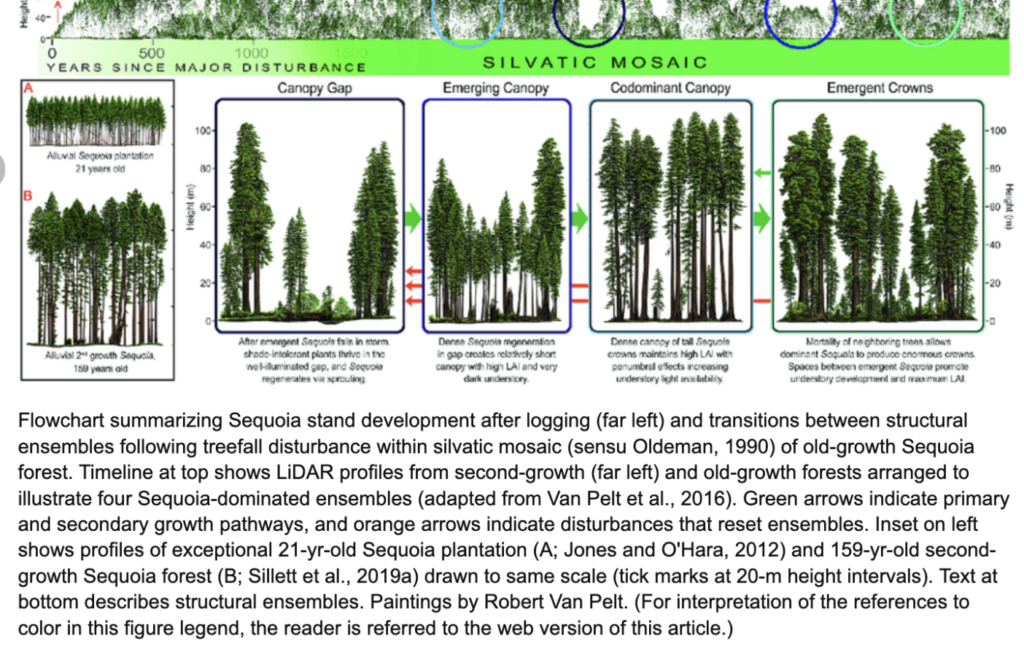
The established, published science by Humboldt State professor Stephen Sillett clearly shows the answer to be yes. Sillett has demonstrated that naturally, an optimal number of large trees would arise and create the healthiest, most diverse and ecologically balanced forest possible. Without dragging another scientist full of dense theories into this article, that science shows its best to take out one 50 inch diamter redwood tree to enhance another 46-56 inch diameter redwood tree nearby.
There should not be a ban on cutting trees of a certain size, but there should be strong limitations on cutitng snag (dead) trees and a total prohibition on cutting any old growth trees. The Demonstration Forest has that prohibition on cutting any old growth, but at one time in the 1970s, CDF (CAL Fire now) did trade with California State Parks, giving up an old growth grove in Jackson that promptly got razed by the timber company. The public got the Mendocino Headlands, the Jughhandle Headlands and a big part of MacKerricher State Park, so this was a great trade perhaps for the public. The saddest part of Jackson is that the old Caspare Lumber Company, who sold the Jackson Forest to the state was the one lumber company that tried save their forest for the future somewhat, while the others just cut with zero thought to the future. So then one of them got a really nice parcel that Caspar Timber Company and the state had stewarded.
Overall, very few of the remaining groves of old growth redwood in the Jackson were ever cut under state management and remain. They were left by loggers because they are very deep in the forest and hard to access.
Question #11: How do we guarantee anything good is going to last?
Sarah Ginskey’s question to Sarah Bisbing was, to us, the biggest moment of the tour. Ginskey said she was pleased to learn about the AMEX and the science, but asked: What guarantee is there that future state and federal administrations — and future incarnations of Dr. Bisbing — will continue the work? And if they don’t, wouldn’t cutting the trees now be a terrible shame?
This was the hardest question of the day. The answer is Yes and No.
Jeremiah Steuterman said California’s Forest Practice Rules — the toughest in the nation — make it very hard to return to irresponsible forestry. That is true. But leadership changes, priorities shift, and funding from state and federal sources (our tax dollars) is already moving away from science at a breakneck pace.
And the public is not engaged enough in these issues to hold future administrations accountable. That is the real danger: science can be abandoned quietly, without anyone noticing until the damage is done.
Ginskey’s question exposes the core uncertainty in the AMEX: the science is strong, but the guarantee that it will be carried through across decades is weak. It raises the larger issue of long‑term forest stewardship and whether California can sustain scientific management through political cycles that increasingly reward short‑term wins over long‑term care.
QUESTION #12 CAN WE EVER TRUST THE GOVERNMENT TO TREAT THE ENVIRONMENT RIGHT
Bisbing didn’t ask for that, but instead for people to see and participate in a process and stay involved.
“Past management practices heavily influence our current stance on things. I would also say, as an educator, and I teach my students about this. I feel like my role as a professor is less about the data and the facts, and more about training them to be critical thinkers and collect data. The reality of human nature is we very much think like things to be black or white or zero or one. So in the case of forestry, the way we view things is very polarizing. When the reality is, the majority of us, the majority of what we’re doing, is in the 90% in the inner space. And so, for people like me to come in, what we’re doing is we are attempting to meet ecological, social, and economic objectives, and we are using things like a timber harvest plan to get there. So that’s where the crossover is, right? Is we’re trying to modify forest structure, and in order for me to do that, to get at these questions, I have to cut a tree, and in order to cut a tree, I have to rely on an expert like Jeremiah to develop prescriptions, to work on a timber harvest plan, to sign off and follow all of the environmental rules that I am not an expert in because I am not an RPF like Jeremiah is, and so that’s how we merge the two. ‘
GREAT WHITE SHARK NUMBERS ARE WAY UP, BUT WHAT DOES THAT MEAN FOR SWIMMERS?
There are more great white sharks off California, but nobody really knows how many. Frank did a deep dive (while staying out of the water) into the issue by reading all the science he could find and talking to several important shark scientists.
Our investigation started when a local teacher was bitten by a great white shark at Big River Beach. I already knew great white shark numbers were up after researching the sea otter issue. Great white shark numbers off California have risen alongside the explosion in the sea lion population. When efforts were made to get sea otters to move north back into their old range (the entire Pacific Coast), scientific studies found two factors preventing their return. One was the lack of islands. The second was that otters traveling in open water were being bitten in much higher numbers by more prevalent great white sharks. Like humans, when a great white bites a sea otter it spits it out — great whites don’t like the taste of humans or otters. But the bite kills the otter every time, since they are much smaller than us.

So when the attack happened, I wanted to know — does the greater number of sharks mean more shark attacks are coming? I got pretty angry at some of you readers who tried shouting me down with “duh — there are sharks in the ocean.” About twenty people made that inane post. My dogs go in the ocean every day, and I was determined to find out for them. Sadly, the shark researchers told me a few dogs have been killed by great whites, but it’s very unlikely, as those four spinning legs don’t look much like a sea lion.
What we found was both happy‑making and surprising — more sharks has not created more shark attacks overall.
“I don’t think white sharks are lacking for seal/sea lion prey along the CA coastline, so it is highly unlikely this explains the bites on humans, ” said DFW shark scientist Chris Lowe. He imagined that sharks, seeing so many more seals and sea lions they are less likely to bite other prety-like humans- by mistake. And their hunting areas have changed to match the movements of the seals, so its always smart to dive and swim away from those animals.
Many years ago, I told Mike Brimley that I had never seen a great white shark here in more than 20 years of diving and 40+ years of regular bluff and beach walking. I thought this was significant. But then Mike told me something truly astonishing — he also had never seen one, despite having at least 100 times more time on the water than I do. He is in the ocean pretty much every day and has encountered countless forms of sea life, showing me creatures I had no idea lived here.
Many boat fishermen have told me they also haven’t seen a great white in years at sea — though some have. But yesterday, Mike told me he saw one for the first time, and it was in “sensaround,” full Jaws. He was kayaking when he saw its mouth open below and above the water, moving fast, chasing abundant anchovies or perhaps the bigger fish the anchovies were running from.
Mike said he knew the shark saw him and wasn’t interested in him, but it was scary nonetheless, even as the shark whizzed by and continued chasing prey before disappearing. We wouldn’t normally print a shark story unconfirmed, but we’re making an exception with Mike, who has shown me an amazing range of beach life and fish I never would have seen without a guy who knows.
With a bounty of anchovies this year bringing in more salmon and other shark tasties, they have less reason than ever to bother an undesirable kayaker. But that doesn’t mean it won’t scare the daylights out of you if you see one — like it did Mike.
The dogs are back to swimming.

Sensaround by the way was 1974 hi tech, in which they made the movie theater appear to shake during the Charlton Heston/Ava Gardner movie Earthquake. I went to the theater and my chair did not shake but it was very cool stereo sound, even if the movie was extra stupid.
NEW COVID STRAIN SPREADS ACROSS WORLD AND IS TOWN- SHOULD PEOPLE VACCINATE
A new variant of the Omicron COVID family has spread across the world and made its way to Mendocino County. It’s very contagious but, like the rest of the Omicron family, milder than the deadly Alpha and Delta strains. Still, wash your hands, and if it suits you, wear a mask and get the vaccine.
I had COVID four times during my years working at the hospital, but I haven’t had it in many years now. I could be wrong, but I think the vaccines I took carried over — or that I’ve been inoculated by being exposed to small quantities of COVID over time. Inoculation, the practice of exposing someone to a tiny amount of a disease, predated vaccination by centuries. Sometimes it worked during outbreaks, and sometimes it made you sick or killed you. Vaccination is the step beyond: dead or weakened virus, or other safe components, are used instead.
Of course, vaccination has become wildly controversial in the Internet age. Now there is a new kind of vaccination being tested — this strain is being studied in non‑human primates. The vaccine is a non‑adjuvanted type, meaning it does not use immune‑boosting ingredients like aluminum salts. Instead of triggering a strong immune response, it relies on its active ingredient to neutralize the virus directly. Early studies suggest this type of vaccination could provide protection for up to a decade across multiple COVID variants.
SEPTIC WHISPERER SAVES RADIO SHOW WITH WINDOWS, NO TP NEEDED!
From Bob Young, GM at KNYO via the Listserve.
“When long-time radio Programmer Long John from Laytonville had a computer failure we thought we had lost a great show, Tubby Tunes from 4-6 PM on Sat., also on other stations. Long John’s preferred audio editing software runs only on a Windows XP computer. When we reached out to the great Announce list we got a rapid response and a donated computer from Rick Ricca, the Septic Whisperer! Thank you Rick, you saved the day and saved the show!! We depend on community-minded folks
for our support and this was a great example of our great Community.”
Thanks MCN Announce list and thanks Rick!” Bob Young
Bob KNYO

By the way, if you want to give to a local media source, KNYO is a great choice. Skip donating to the rest. Really. Just stop giving them money.
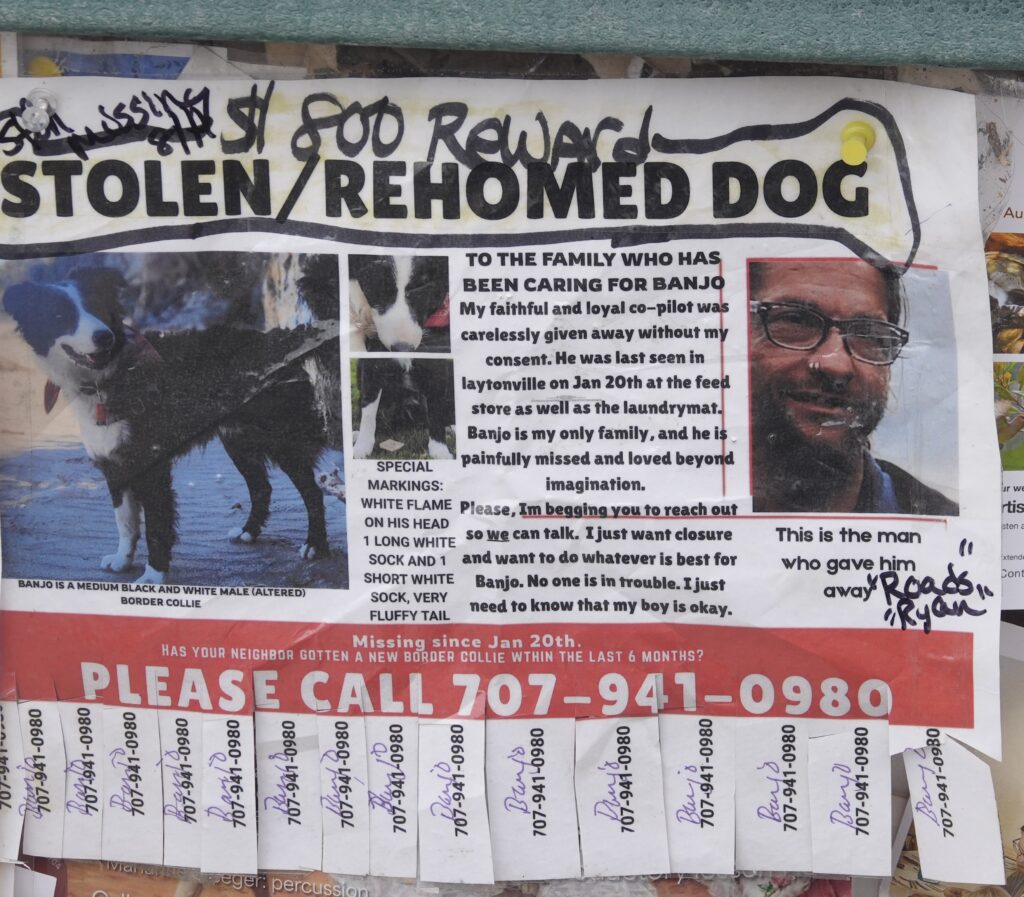
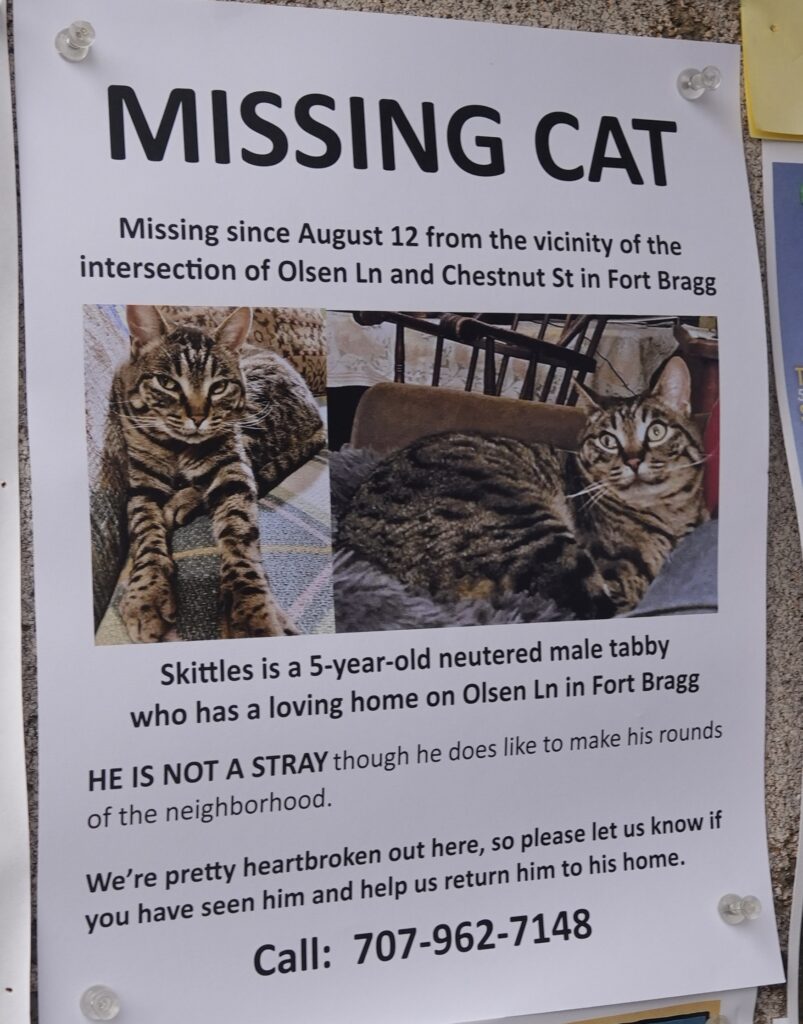
So yes — the sharks are out there, more of them than before, sliding through the kelp forests and bait balls like shadows with teeth. And no — that doesn’t mean the ocean has suddenly turned against us. What we found, after all the science, all the interviews, all the fear and all the noise, is that the story is bigger than a single bite at Big River Beach.
It’s about a coastline where great whites rise and fall with the sea lion boom, where otters hesitate at the edge of their old range, where anchovies flash silver and pull the whole food chain behind them. It’s about Mike Brimley finally seeing his first great white in full “sensaround,” and still paddling home. It’s about dogs who go back to swimming because the ocean is still the ocean — wild, dangerous, generous, and ours to share.
And maybe it’s about us, too. How we learn. How we listen. How we keep showing up even when the water gets dark beneath us.
Because the truth is simple and strangely comforting: the sharks are here, but so are we. And for now, that balance still holds — a thin, shimmering line between fear and wonder that keeps us walking the bluffs, diving the coves, paddling the estuaries, and loving this coast with everything we’ve got.