Your Monday 7/13 Paper + Red Rino becomes Rotten Robbie + Time‑Machine Question: Should There Be News Every Day? + Flock Meeting + Wonderland’s music + One Surprising Old‑Growth Fact
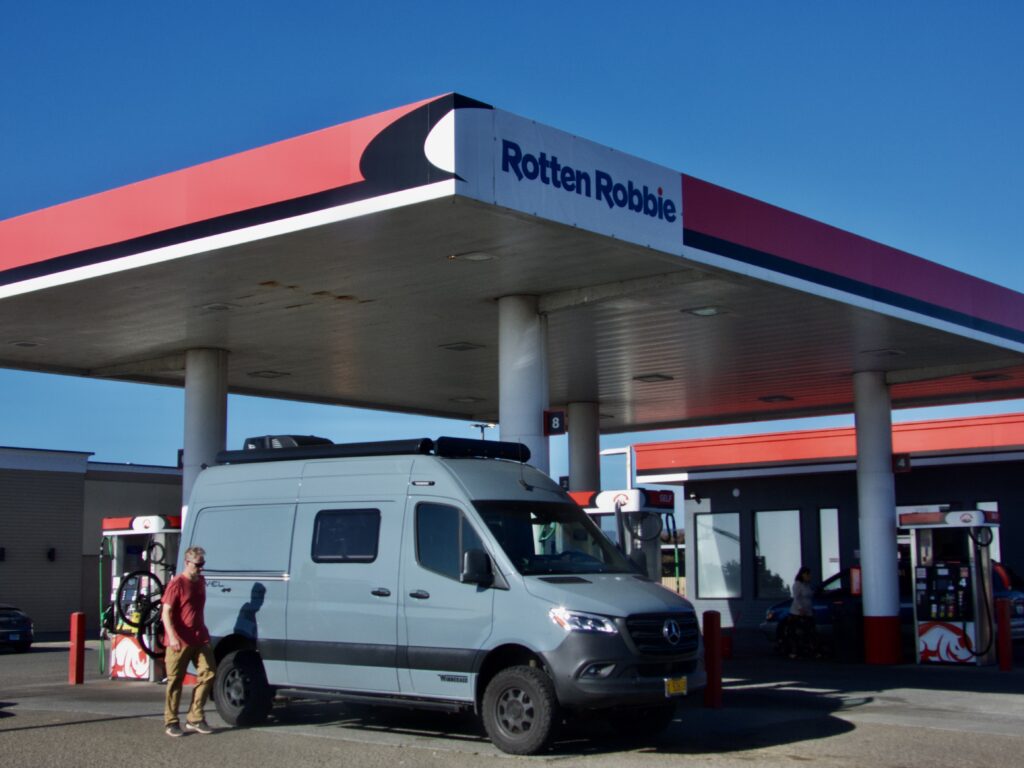
WILL GAS COST MORE IN FORT BRAGG ? RED RINO IN FORT BRAGG SELLS TO ROTTEN ROBBIE
Some potential bad news for Fort Bragg. The Red Rino gas station in Fort Bragg has been sold by Robert Reed Rhinehart for $2.25 million to Robinson Oil Corporation. The name of the gas station and convenience store is now Rotten Robbie. There are about 40 other Rotten Robbie Stations.
Robert Rinehart was something of an unseen benefactor for Fort Bragg, keeping gas prices low and from what we know, selling to the other stations as well through his distribution company. There was also some sort of legal case that we wrote about years ago related to this.
We hope the ownership change doesnt mean for sure that Fort Bragg will go back to having much higher prices than everywhere else. Gas prices were not hiked right after the sale. We noticed a new counter and cash register and the items inside the store we checked cost more. But not gas prices. The new owners have to wait until the city approved new signage. So Rotten Robbie, a familiar chain in NorCal is posted on paper signs above the pumps.
The sale, completed last month, was made on behalf of a trust. Rhinehart, who also owns the Taco Bell property immediately to the north, spent decades in the regional fuel business. His company, Rhinehart Distributing, once operated 20 service stations across the North Coast before gradually selling them off. The Fort Bragg Red Rino was the final remaining station in that portfolio. Rhinehart lives in Ukiah and was distributing there, and quietly made the decision to keep gas prices lower than he could have. New owner Robinson Oil, of Santa Clara, CA, is a big company,with all the Rotten Robbie’s but even bigger in distribution of petroleum products to fleet gas stations.
Robinson Oil of Santa Clara CA
HOW A NEWARK EDITOR SAW THE FUTURE OF NEWS BEFORE IT ARRIVED
This section is by Linda Hartzell. Frank was flabbergasted Linda was able to turn an old memory into relevant news and even. more so, that Frank had remembered it all correctly.
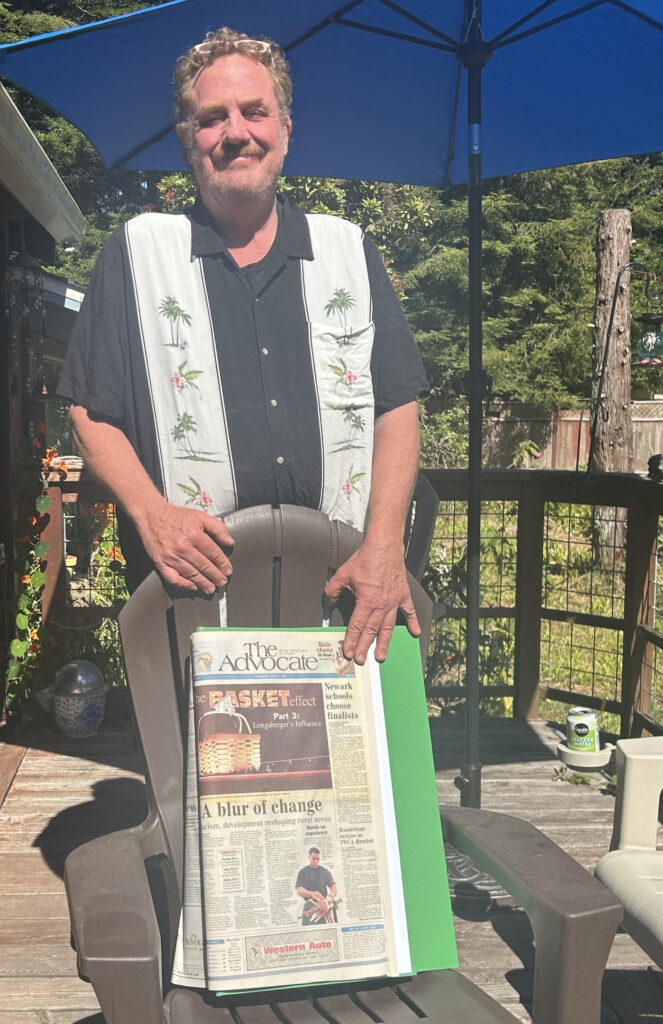
During his tenure as City Editor of the Newark Advocate in Newark, Ohio, Frank Hartzell had the rare opportunity to work directly with Jean‑Louis Gassée, a French media‑operations consultant whose research for the Poynter Institute was reshaping how journalists understood newspaper production. At the time — 1998–1999 — the Advocate was a solid mid‑sized daily with an estimated 30,000–35,000 daily readers, a circulation typical for regional papers serving a county‑seat city and its surrounding communities. It was large enough to feel the pressures of daily production, but small enough for an editor to see every distortion created by the fixed‑volume mindset Gassée was studying.
Frank and others working for Lord Thompson were amazed at the consultant’s deep thinking about the business. He asked the questions that editors rarely say out loud. Did we diminish our credibility with big headlines on slow news days? Did we have to pretend something exciting was happening every single day in Newark, or Napa, or Fort Bragg simply because a paper was being produced? And if we did that — if we kept pushing urgency onto routine city‑council items or minor crimes — did we make readers jaded, convinced we were crying “BREAKING NEWS” far too often?
The consultant’s findings were blunt: American newspapers behaved as if every day contained the same amount of news. Page counts stayed fixed. Press schedules stayed fixed. Reporters were pushed to generate a steady stream of content whether the news justified it or not. Frank saw this firsthand — the inflation of minor items, the padding of slow days, the quiet erosion of investigative time. The consultant argued that U.S. papers were producing a product of fixed dimensions, not a record of the day’s events, and that this rigidity would eventually collide with digital news, shrinking staffs, and reader expectations.
He warned that the industry would drift toward predictable content streams, press‑release dependency, and formulaic coverage. He said readers would eventually gravitate toward outlets willing to reflect real news cycles — expanding when the news demanded it, contracting when it didn’t.
Those warnings were issued in 1998–1999.
EDITORS NOTE: Frank hates A! research tools and the dependance on Google Search, calling them grossly incomplete and unreliable. Linda won a small victory here. Amazed the consultant could even be found using one of the newer search platforms — a reminder that, despite their gaps, these tools occasionally surface exactly the person you need.
THE FUTURE ARRIVES
By 2026, the consultant’s cautions have become the lived reality of the American press. Many papers have shrunk, consolidated, or disappeared. Others have leaned harder into templated coverage and predictable daily quotas. The fixed‑volume mindset didn’t just persist — it became the industry’s default survival mode.
The result is the landscape we report in today: fewer reporters, fewer investigations, more formulaic content, and a public that increasingly turns to outlets willing to do the slower, harder work of actual reporting. The kind that moves with the community, not with a quota.
The French consultant warned that if newspapers kept printing the same amount of news every day, regardless of reality, the industry would eventually lose its ability to tell the truth of a place. Frank saw that warning up close in Newark. And now, nearly three decades later, the future described in 1999 has arrived in 2026 — not as theory, but as the daily condition of American journalism.
THE SUNDAY MORNING ORIGIN
This story came together the way many newsroom truths still surface on the Mendocino Coast — over a quiet Sunday‑morning coffee, when Frank regaled Linda with the long‑ago account of the consultant who predicted the future of journalism we are living today. He remembered the conversations, and the moment when an outsider diagnosed the very system he was working inside.
Linda plans to reach out to Jean‑Louis Gassée — he, too, is still working — and share this article with him. She’ll ask whether he remembers the 6’8″ giant editor from Newark, Ohio. We may also reach out to the founder of the Poynter Institute, whom they shared dinner with while Frank’s beautiful mother, Betty Lou Hartzell, charmed him with a conversation of worth from someone who wasn’t a journalist at all — a small reminder that truth often arrives from unexpected places, and sometimes from people who have never set foot in a newsroom.
THE WORK CONTINUES
So we keep doing the work. We report what’s real, not what fits the page count. The story expands when the coast demands it, contracts when the day is quiet, and always follows the truth of this place. And on the days that simply are not news days, MendocinoCoast.news will say nothing at all — because silence can be the truest record of the coast. And MendocinoCoast.news will be right here for every twist, every correction, and every truth that still needs telling.

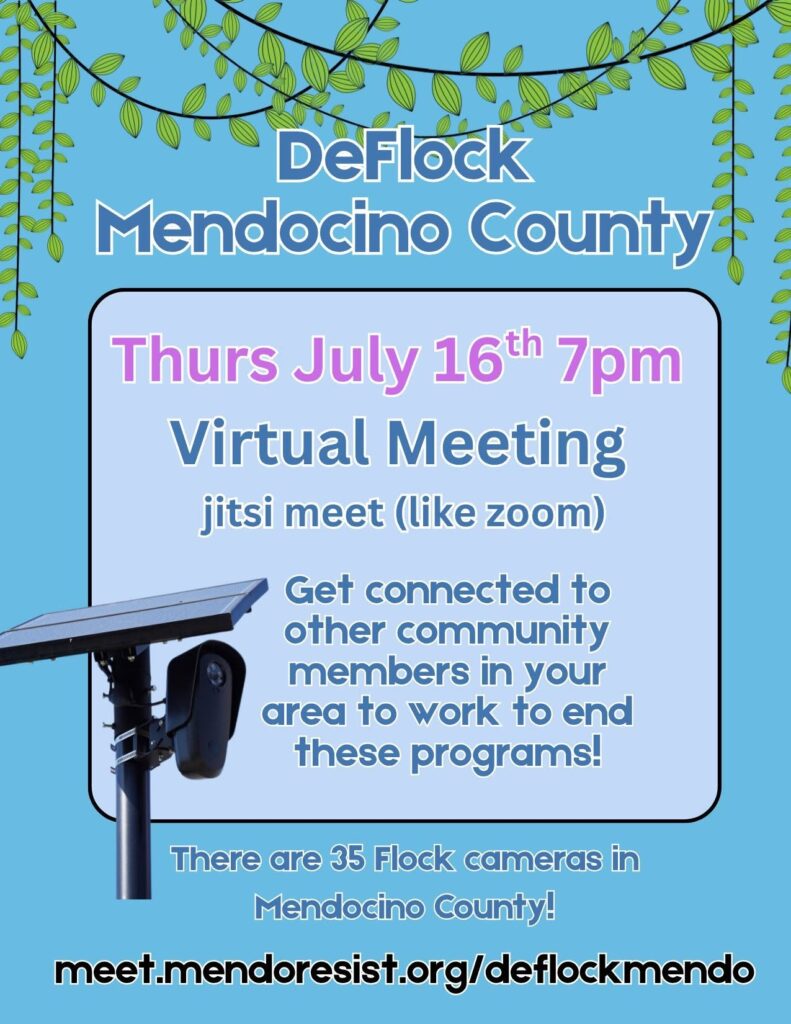
DEFLOCK MENDOCINO COUNTY
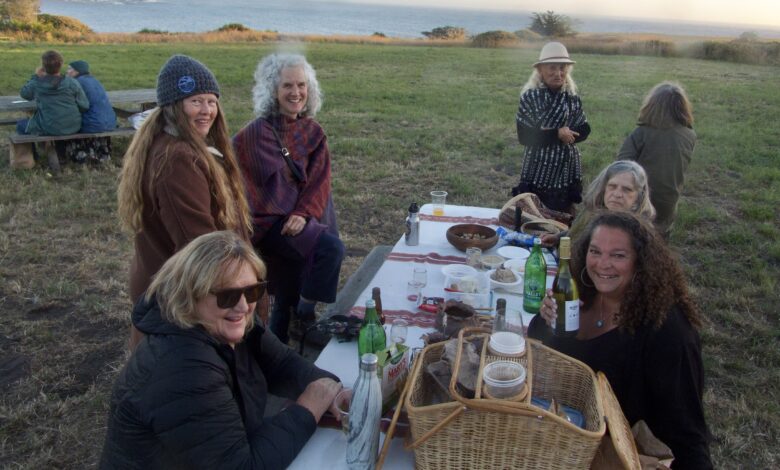
Organized opposition to Flock cameras has led to removals in many communities, but in Mendocino County the effort has been scattered and ineffective. Fort Bragg paid little attention to the disarray and moved ahead with its Flock system. This image shows one resident attempting to herd the local cats into something resembling organized action — and maybe slowing the conversation long enough to consider the broader implications.

And don’t forget the annual Elk Volunteer Fire Department Summer BBQ — always a crowd favorite and an important fundraiser for Elk’s fire department. It’s a chance to show your support, enjoy a fantastic meal, spend a day with friends, and let the kids dive into some hands‑on activities.
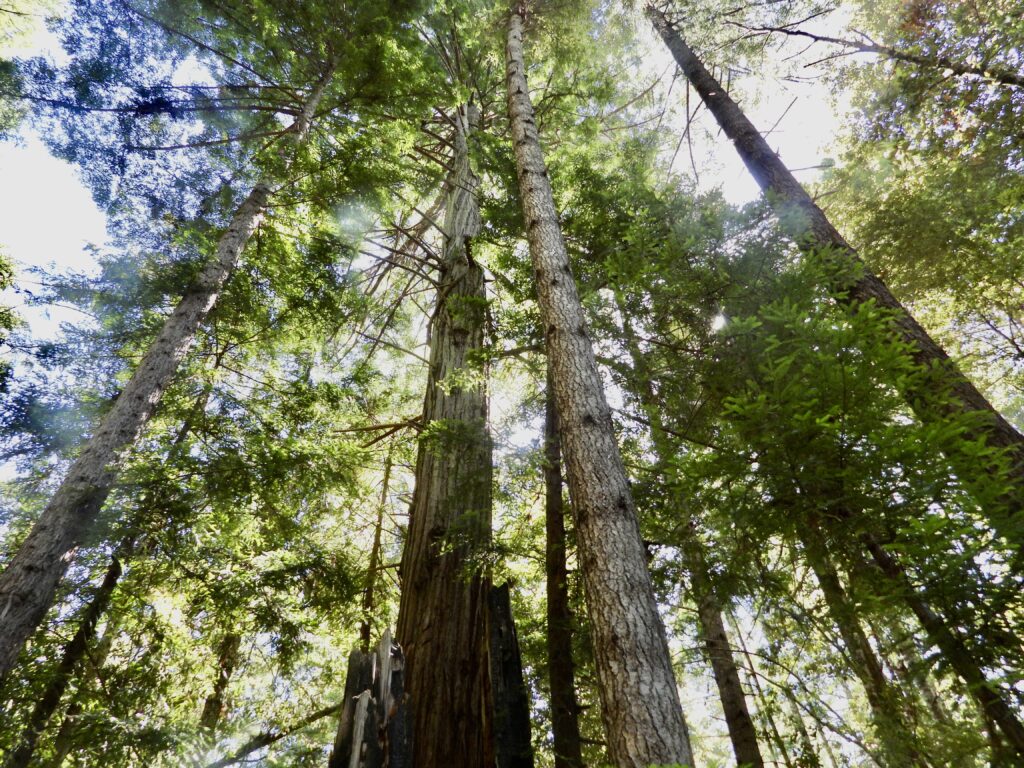
This week — and twenty‑seven years after the first warnings were issued — we are still fighting the decline in standards within American journalism. The old problems didn’t vanish; they simply changed shape. Fixed‑volume thinking, templated coverage, and the slow erosion of investigative time have become the daily condition of the press. Yet here on the coast, the work continues: learning from a lone old‑growth redwood, sorting fact from noise in the surveillance debate, and showing up for the Elk Volunteer Fire Department BBQ because community still matters. It’s a reminder that the future of journalism isn’t decided in boardrooms or algorithms — it’s decided in places like this, by people who keep choosing to do the work.