Help us find a museum for a heavyweight piece of priceless Mendocino Coast and American history- Calling All Curators: Mendocino’s Historic Heavyweight Needs a Stage!

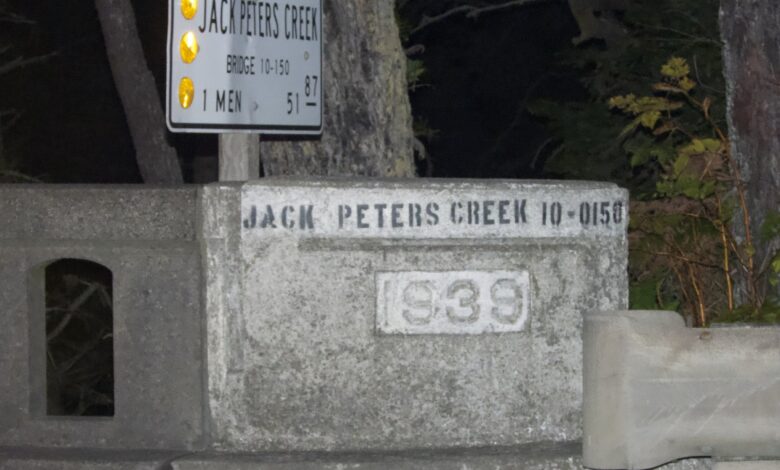
A New Deal-Era Treasure Needs a Home As Caltrans wraps up the new deck installation on the Jack Peters Creek Bridge, they’ve generously offered to donate its original corner marker—an iconic artifact from President Franklin Delano Roosevelt’s Great Depression-era stimulus program. This piece of Mendocino County and American history deserves a permanent place in a local museum, they believe and we agree!!
Still Homeless: A Heavyweight Piece of History Awaits a Museum So far, no takers. The Kelly House considered it, then politely passed. It’s a big artifact—fitting for its outsized role in Mendocino Coast and American history. The Mendocino County Museum has shown interest, but I’d love to keep it on the Coast. Willits, to be fair, has the coolest and most comprehensive history collection in the county, so they may end up with the donation. I’ve been writing about the Jack Peters Creek Bridge widening for two years now, and it’s finally nearing completion. The waits are getting shorter but paving is going on today so expect longer waits on Thursday in the first week of October—and so is the time to find this New Deal-era treasure a proper home.
Built to Last, Finally Made Safe The Jack Peters Creek Bridge was solidly built by our ancestors—good for another hundred years, at least. But times have changed. It was far too narrow, and the old railings were crumbling. One cyclist was once whooshed off the edge into the steep canyon below by a passing car.
Now, thanks to the widening project, there’s room to walk, bike, and breathe. Sidewalks and shoulders offer safe passage and stunning views of the ocean and the dramatic canyon drop.
There’s a beach below the bridge—but don’t go. It’s a trap. You have to scramble past the rocks at low tide, and once the tide turns, you’re stuck. Beautiful, yes. Safe? Not remotely.
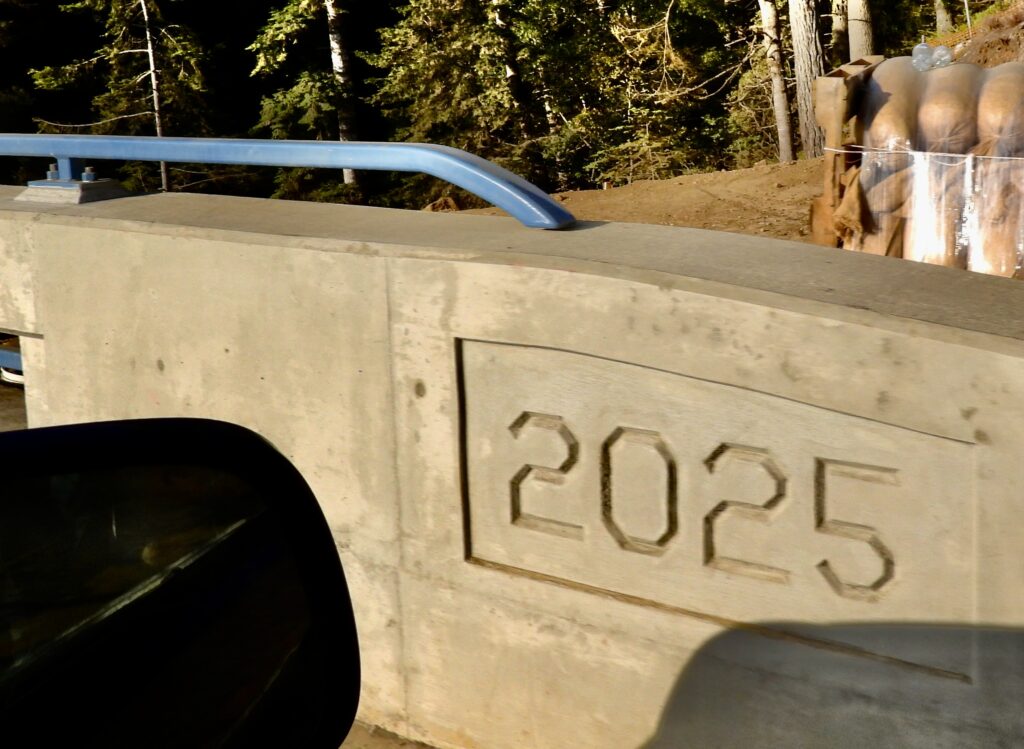
New Deal Grandeur with a Flawed Crown A massive influx of federal spending during the Great Depression forever reshaped the Mendocino Coast. Among its most iconic legacies: the Russian Gulch Bridge, admired worldwide for its sweeping Roman arch and architectural tributes spanning centuries—from classical symmetry to Medieval castle-like railings.
Those railings, though striking, were overused here—and ultimately became the weak point of these bridges, also bridges that used it later, Pudding Creek (now replaced), Hare Creek and the Little River Bridge (don’t blink). A grand design with a vulnerable flourish.
Built by the People, for the People Great Depression stimulus money didn’t just build bridges—it shaped the soul of the Mendocino Coast. Cotton Auditorium in Fort Bragg remains one of the largest and most utilitarian school buildings in local history. And the Mendocino Woodlands Camp? A marvel of its time, born from a national push for self-sufficiency and local resilience.
Back then, people had lost faith in chain banking and leaned hard into community. The New Deal wasn’t just infrastructure—it was a cultural reset. A belief in local strength that feels almost foreign today.
The Forgotten Siblings of Russian Gulch Two more bridges came out of FDR’s New Deal playbook: Jughandle Creek and Jack Peters Creek. Neither earned the fame of their big brother at Russian Gulch, but they carried history just the same.
Jughandle, in particular, had a rocky reputation well into the 21st century. Back in 2006, Frank crawled underneath and documented spalls and structural issues. Caltrans responded with a high-tech deck fix and a modern bridge sealer—and since then, silence. No signs of trouble.
Sometimes the quiet ones just need a little attention.
Built on the Edge—Then and Now Jack Peters Creek was the last of the three New Deal bridges to rise on the Mendocino Coast. It faced a formidable challenge: the depth of the canyon. At just 223 feet long, the bridge spans a dramatic drop where crews—then and now—have precious little “elbow room” to work.
Not in 1939. Not this time either. Some things never change—especially gravity.
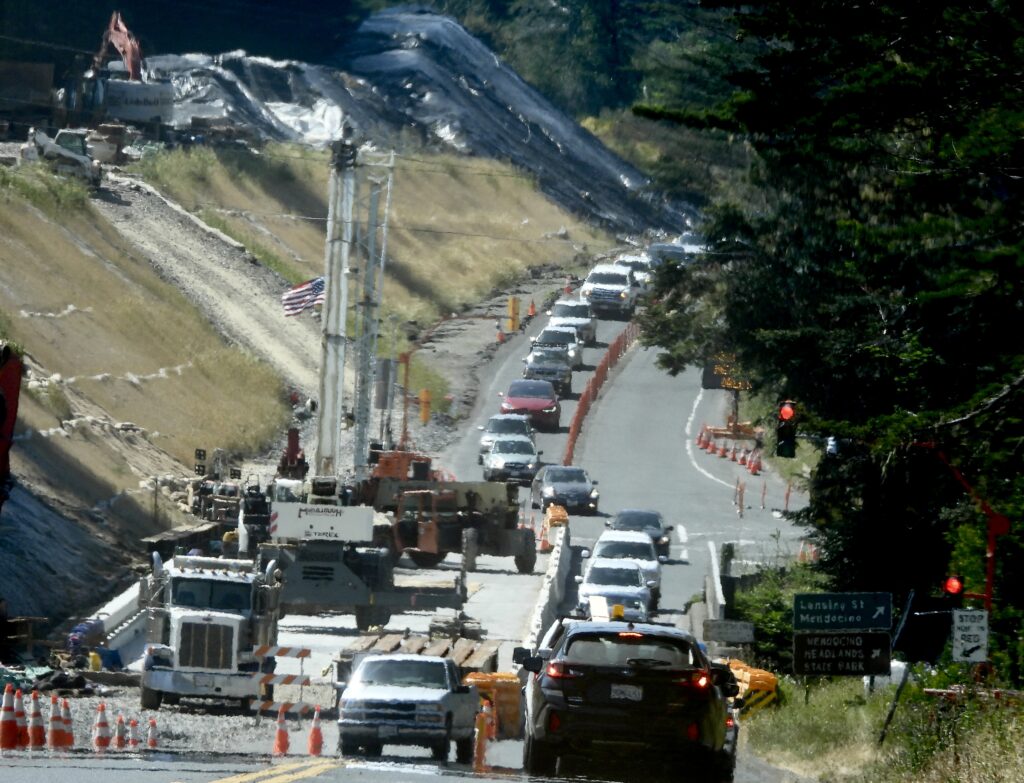
No Room Left to Give Since 1939, slow but steady erosion has crept westward. Today, there’s not an inch left to spare. The bluff’s edge is holding firm—for now—but the margin is gone.
A Subtle Shift for a Safer Span To accommodate the wider bridge without introducing a bend in the road, engineers had to gently torque the alignment eastward. It’s a subtle pivot—barely noticeable to drivers—but essential for preserving flow and safety.
Caltrans is often willing- but history can be a difficult sell– Caltrans once tried to donate the Covelo monument, a gigantic tribute to settlers than greeted those entering at the overlook to Round Valley. Nobody wanted it and they eventually took it to Russian Gulch State Park, where it ended up as a big pile of rocks that mystified latercomers. Eventually, the enterprising Mendocino County Museum came and chipped the plaque off of the rock it was on and that at least is preserved. Another mystery was what happened to the two great Van Damme obelisks? Those towers with the name Van Damme were removed at some point by State Parks with a map showing where they relocated mysteriously into the Pygmy Forest. However, the map turned out to be more of a Blackbeard’s Treasure map than something functional. Thanks to the enterprising Caly Dym of the LIttle River Inn, one obelisk was found but the other remains only on maps. The first one is now featured on the trail from Van Damme to the Little River, one of the coolest walks there is. We think the old Covelo monument should be revived and brought to Blues Beach, where it could be reverse-purposed by Kai Poma, such as is happening with Sutter’s Fort.
Rocks from Above: A Disturbing Sight Below the Bridge In both 2023 and 2024, I visited the Mendocino Headlands Beach beneath the Jack Peters Creek Bridge—and witnessed a steady shower of rocks tumbling from the cliffs above, right where the road veers toward Mendocino.
Something seems to have changed. The rockfall appears to have slowed, though I haven’t investigated what was done. Whatever the fix, what I saw back then was deeply unsettling.
Still Standing Strong The bridge remains as solid as the day it was built—now bearing a bigger, wider deck without flinching. A testament to the skill and foresight of its original builders.
Built Right the First Time We’re lucky our ancestors knew how to build. Their rock-solid concrete foundation kept this upgrade project to just $11 million. A full replacement, I’m told, would’ve cost more than four times that—and might’ve been nearly impossible without rerouting through the Surfwood subdivision, thanks to the canyon’s unforgiving steepness.
So Who Was Jack Peters, Anyway? History books suggest Jack Peters was a local who brewed beer—and stronger stuff—in Mendocino. He lived nearby, and when folks asked, “What’s the name of that creek?” the answer was simple: “The one by Jack Peters’ house.”
He wasn’t famous. He just lived there. And that was enough.
Last Call for History: The Abutment Awaits Its Fate If you know a museum or non-profit ready to give this New Deal relic the reverence it deserves, call us at 707-964-6174 or email frankhartzell@gmail—we’ll make it happen.
Otherwise, it’s headed ten feet inside my property corner, where it’ll stand like a concrete sentinel of forgotten glory. And if you want to see it, you’ll have to cruise down Ward Avenue like a history pilgrim.
Consider this your official heads-up, Loren and Jeremiah: the abutment is coming. It’s big, it’s bold, and it’s not leaving quietly.
History doesn’t wait. It settles in.