Union Lumber Company Store goes full Skunk on Friday- Railroad breaks water main extending tracks behind the store they are about to buy
Imagine a miniature Skunk Train looping through the Union Lumber Company Store, kids trailing behind before spilling into the Model Railroad Museum. Picture a steakhouse rising in the upstairs space. And downstairs, uniformed conductors staffing a new Skunk Train ticket booth — selling passes for the real train expected to pull up directly behind the historic building.
Don’t imagine it — it’s happening. The Skunk Train expects to finalize its purchase from owner David Figueiredo on Friday, May 1. The move would channel train passengers directly into the Union Lumber Company Store, adding to a lineup that already includes bike rentals, Asian dining, coffee, chocolate, massage services, and a sensory‑deprivation tub. We talked to about 12 people to get the scoop on what is happening but we won’t have the details of what exactly the Skunk will do with their new purchase until they announce them.
For now Robert Pinoli, chief skunk, CEO and President of Mendocino Railway said the balls are still in the air..
“As of this morning (April 28) there is still no completed deal. We’re shooting for April 30th / May 1st
For now, our plans are business as usual with some exciting plans for the future that have not yet been finalized, so there’s no real sense in talking about that now given things could change.”
I asked him if a ceremony was planned to welcome the Company Store back into the fold with the railroad and milliste (minus the timber company)
“No ceremony planned as of yet, we still need to figure out where all the light switches are at.”
often surprise visitors until they look them up online.
The new leadership adopted a more community‑focused approach, donating lumber for the town’s hospital and
building a far more substantial and less exploitative Company Store.
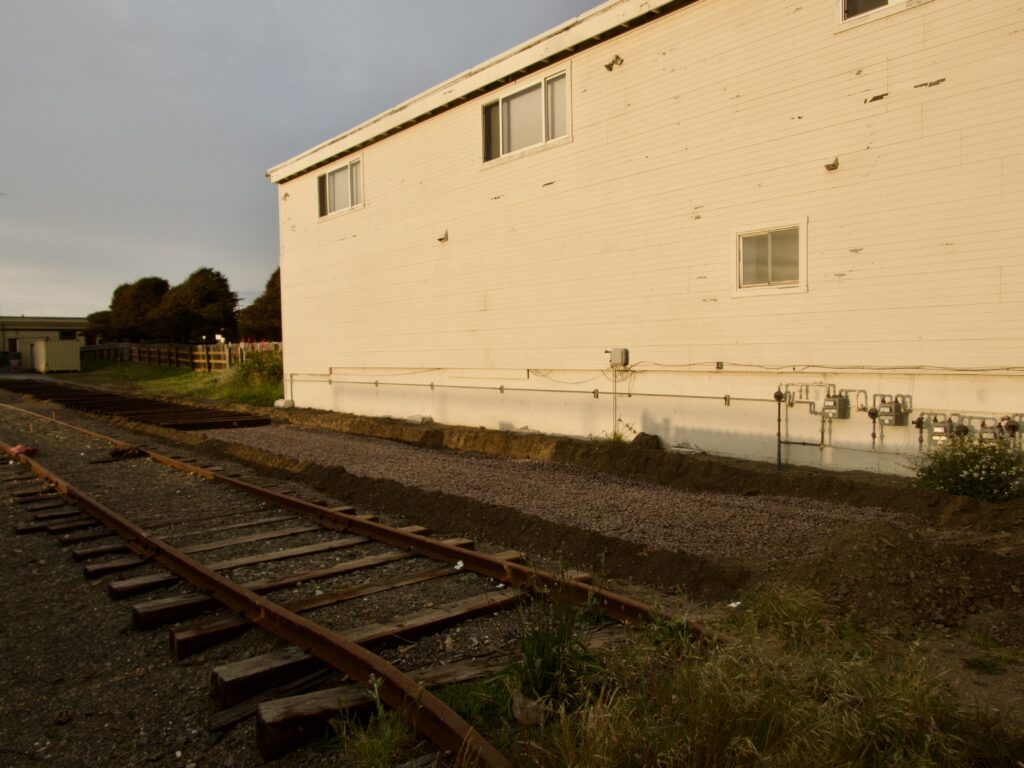
On Tuesday, the Skunk Train broke a city water main as they worked to put in the new tracks that trains from the station can come down to the company store on. It was quite a scene. We heard from several readers and went out and it had been fixed in about 3 hours.
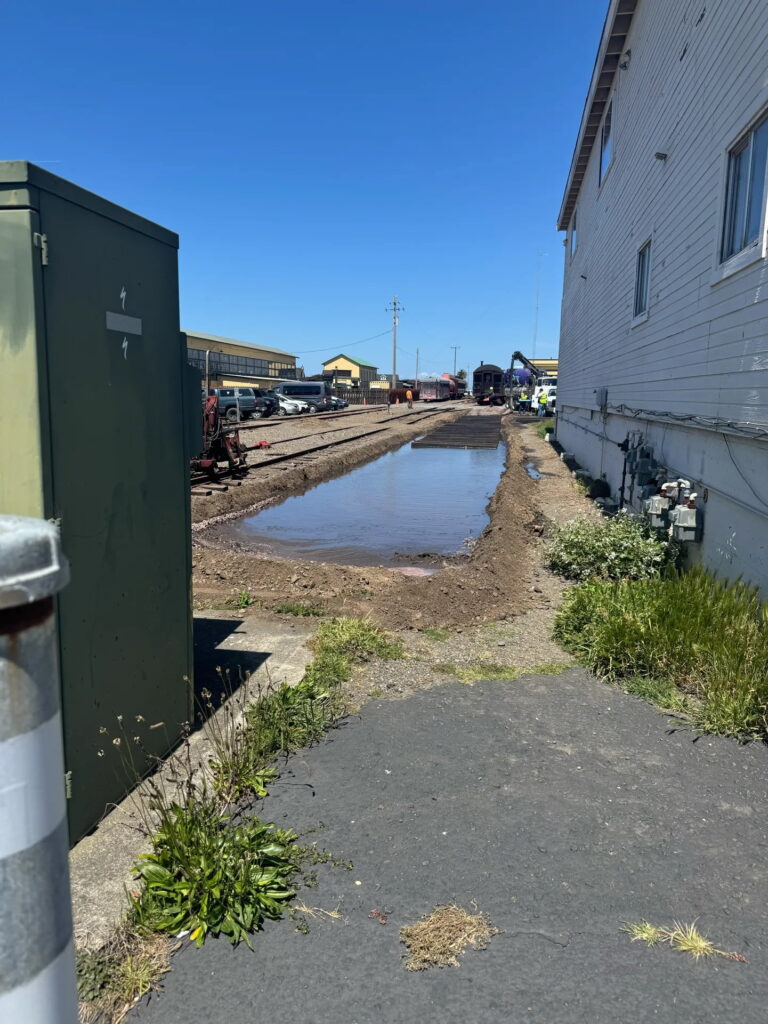
From Fort Bragg City Manager Isaac Whippy:
This afternoon, the City responded to a water main break behind the Company Store that temporarily impacted nearby businesses. We received the call at approximately 12:30 p.m., and our Public Works team was immediately dispatched. Crews identified a damaged connection in the water line, completed repairs, and restored full service by about 1:30 p.m.
“Based on our initial assessment, the damage to the water line was caused by work being conducted by Mendocino Railway in the area. We can also confirm that the City did not receive an Underground Service Alert (USA) ticket for excavation activity at that location.
The interruption was brief, but a few businesses in the Company Store area did experience a temporary loss of water during the repair.
We are continuing to review the incident and will determine any appropriate next steps.”
When we went to the scene, the workers said the main was shallower than info provided showed. It was a three inch, old line, but a water main nonetheless.
For the past month, Mendocinocoast.news has been tracking the quiet negotiations around the Union Lumber Company Store. When we first asked Skunk Train CEO and President Robert Pinoli, he said no sale had taken place but confirmed the company’s interest in the 1912 building. After speaking with a dozen people, we verified the pending deal and heard a range of concepts under discussion — including a miniature Skunk Train inside the store and changes to the current station — ideas circulating among stakeholders but not guaranteed to make the final cut. With the help of the reporting team of Cheeser and Brubacker, Frank sniffed out the new tracks that led up to the back of the Company and knew this was a done deal, along with some legal paperwork we got ahead of. No title change will be filed with the county till Friday.
Figueiredo opened the mini‑mall in 1998, leasing space to many gone‑but‑not‑forgotten tenants, including the Living Light Raw Foods Cooking School. Before that, the building had housed Daly’s and other upscale department stores, which moved in after the Union Lumber Company was sold to Boise Cascade and then Georgia Pacific. In the early 1960s Georgia Pacific renamed the Company Store Seafair, and operated that department store until the company decided to turn it over to a private concession. At one Time Seafair/GP used the Guest House as part of The Company Store. Later, it became Daly’s Department Store. When Betty Lou and Carl Hartzell moved to Fort Bragg in 1986, Daly’s was an old NYC style grand department store. It still had pneumatic tubes where messages and small sale products could be delivered from the Mezzanine floor above, where the grandest views and fanciest clothes were located.
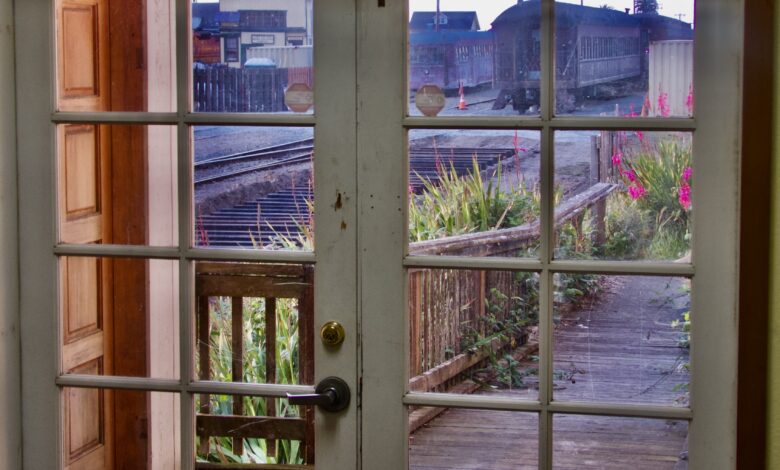
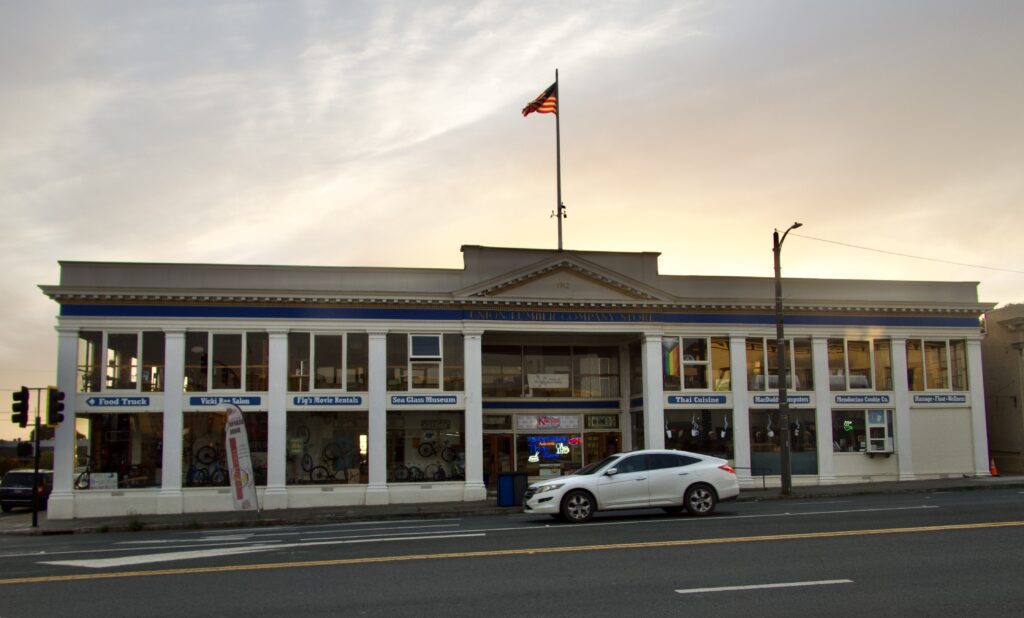
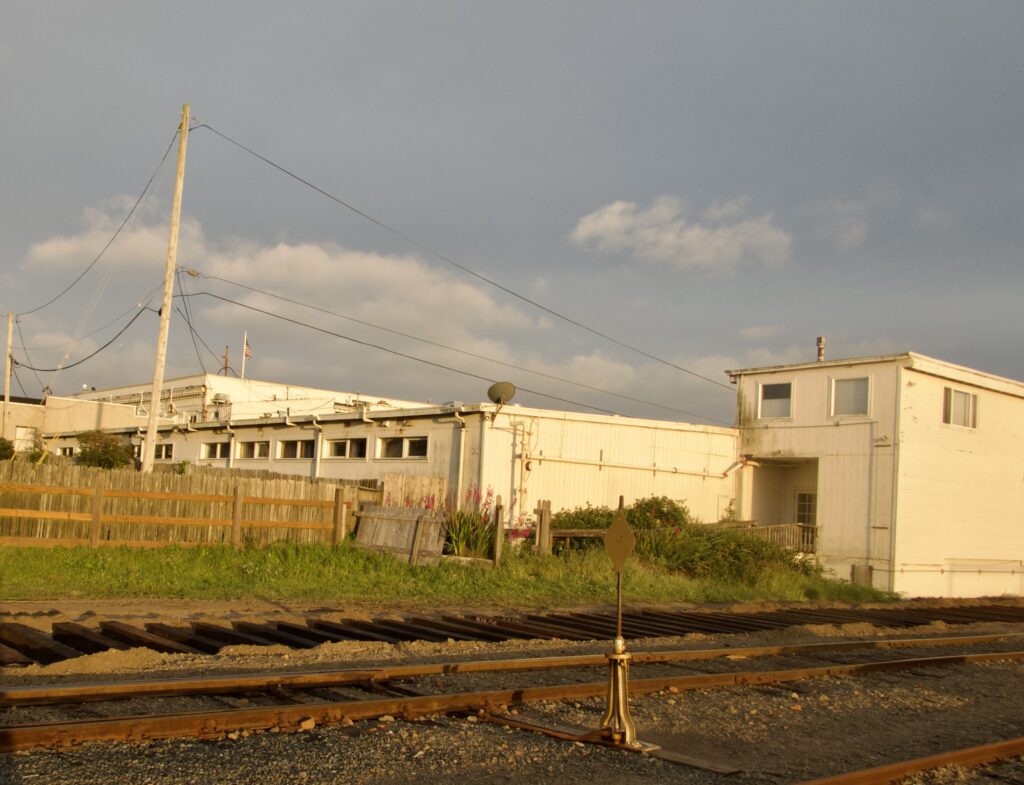
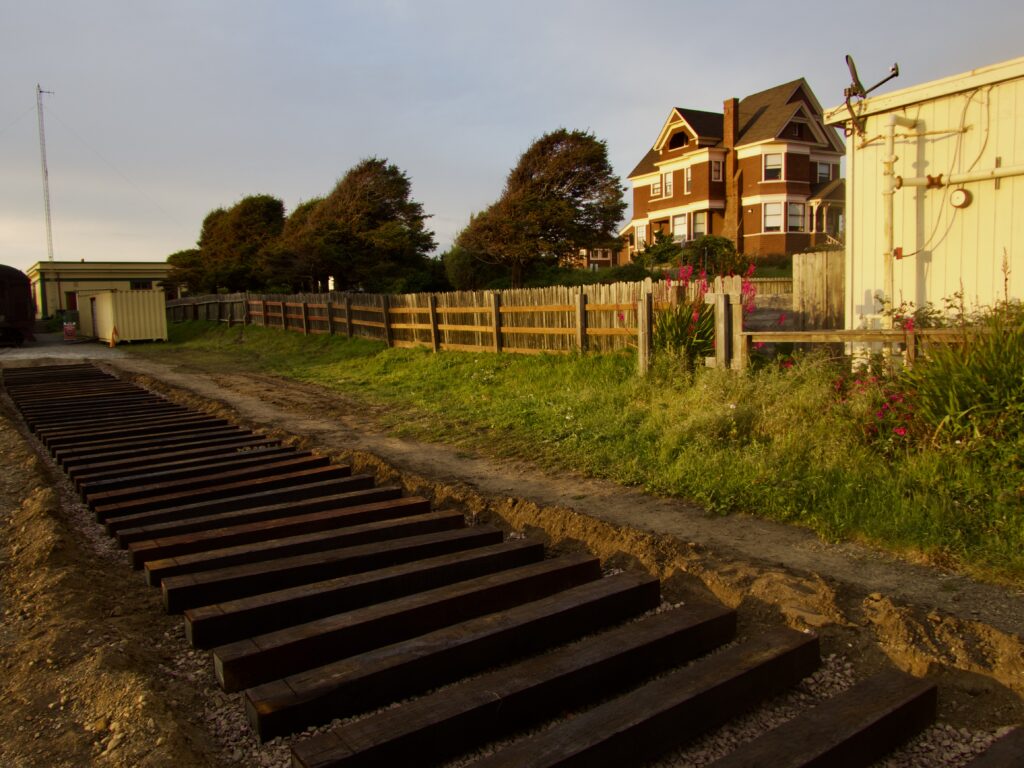
Mendocino Railway — the Skunk — is wasting no time preparing for its next chapter in the historic Union Lumber Company Store. By Monday, crews were finishing a track extension from the Skunk Station to the back of the building, where a new entrance will be needed to replace the aging one now in place. For the big restaurant upstairs, the window already bears the name of Five Brothers Steakhouse, which appears to be run by local individuals not affiliated with the old or new owners. Downstairs tenants beleive their leases will continue unchanged. Those businesses range from Mac Daddy and Mendocino Cookie Company to Rise and Be Well, Fort Bragg Cycleworks, and the Sea Glass Museum. Still, no one will know for certain until the railroad officially takes control. Mendocino Railway is a subsidiary of Sierra Railroad, which recently entered a merger with a larger firm. While most of the millsite is held by Mendocino Railway, county records show some parcels under a sister company, Sierra. The exact relationships among the companies — and the Hart family’s future role — remain unresolved. More clarity is expected after May 1. However, the Hart family has never announced anything or clarified the ownership structure now, although they have expressed thoughts here and there about what is going on.
The efforts to buy the Company Store began long before the recent merger. The property belonged to David Figueiredo and his mother, and he wrestled with the decision to sell. In recent years, he has gone on record in public forums, inviting the Skunk Train to acquire it.
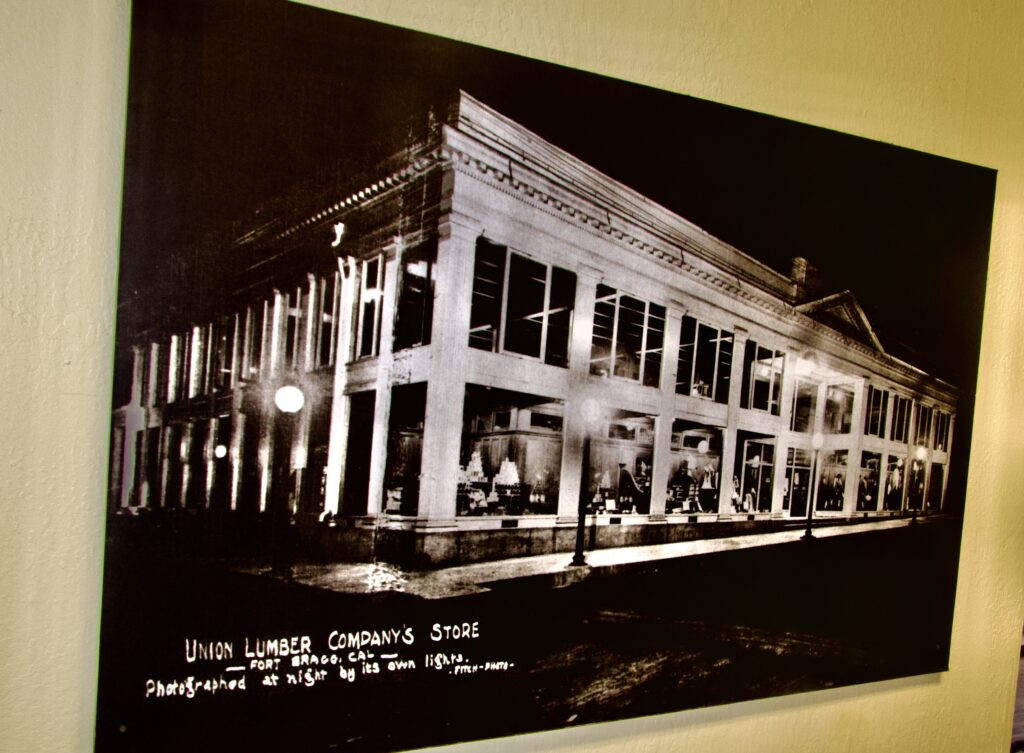
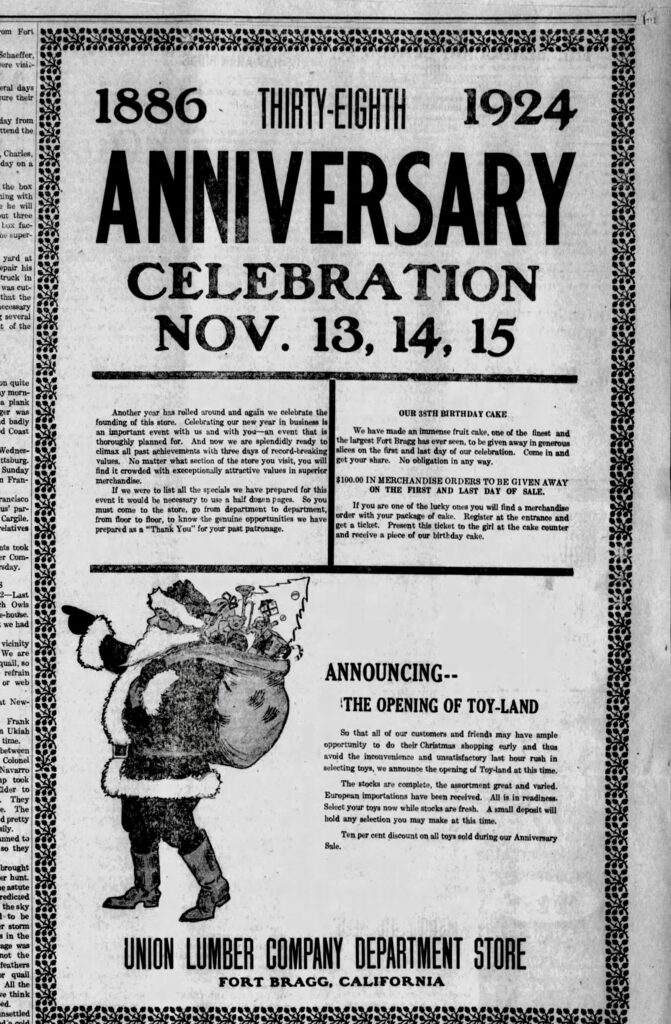
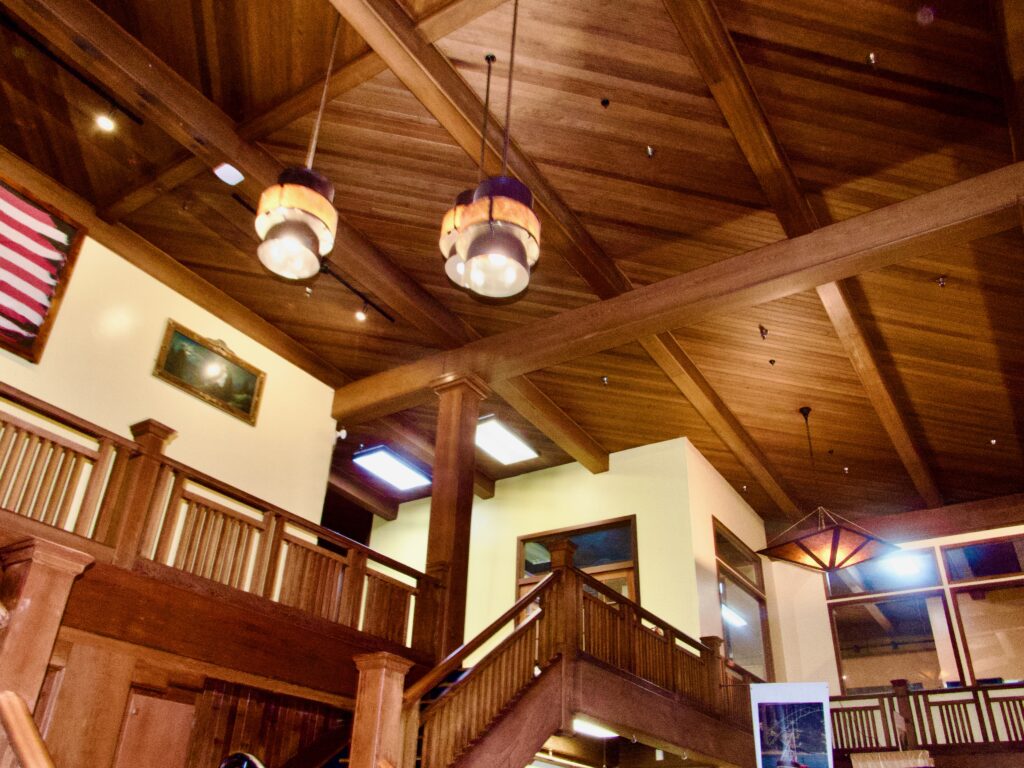
The present Union Lumber Company Store opened in 1912, showcasing crafted redwood and cedar cieldings and a pair of grand staircases at the front. In the back, portions of the floor trace even further back, carried over from the original Union Lumber Company Store built in 1886. Gilded Age chandeliers are probably the most striking feature inside. We got different reports on when they came.
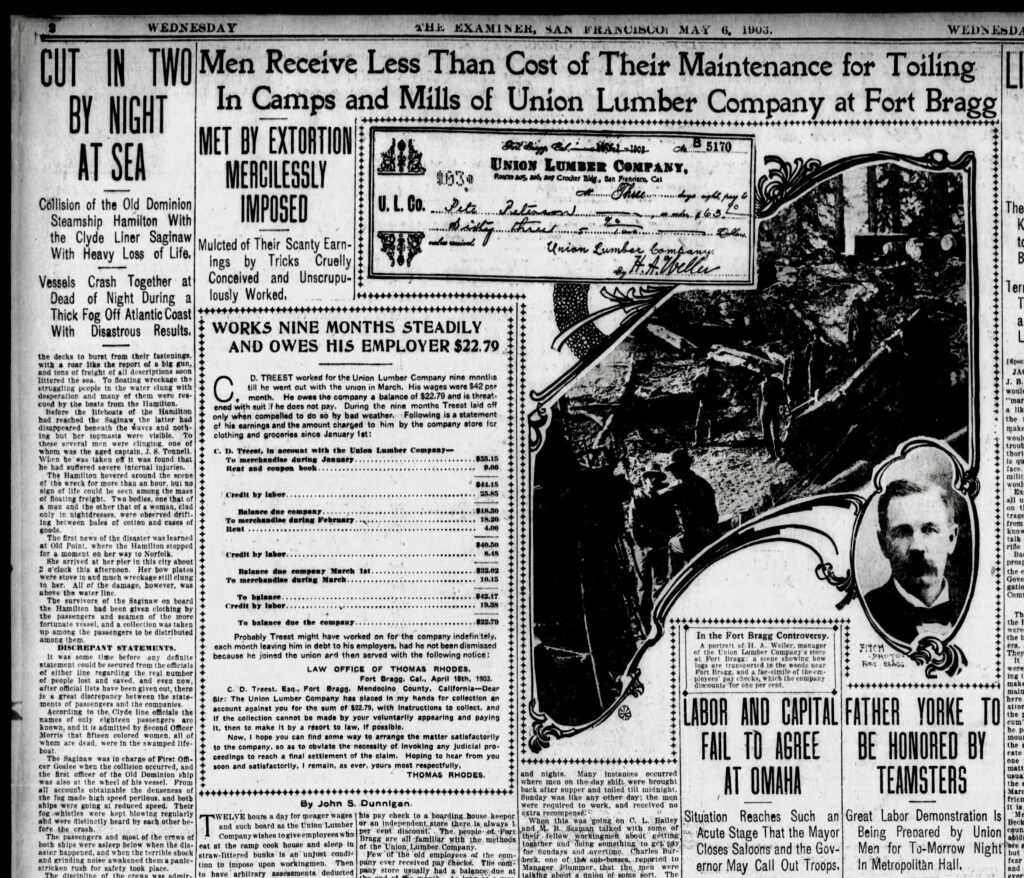
When it opened in 1912, the Union Lumber Company Store was hailed as the largest and most elegant department store between San Francisco and Eureka. It was a deliberate break from the past. Tennessee Ernie Ford made the company‑store system infamous nationwide, especially the way some workers were trapped in debt. What almost no one remembers is that Fort Bragg’s original company store was accused of the same thing. The earlier store, dating to 1886, had been thrust into the spotlight in 1903 when San Francisco Examiner reporter John Dunning published a blistering front‑page investigation accusing Union Lumber of driving some workers into debt through the company‑store system. William Randolph Hearst even printed a worker’s paycheck to show how the math worked. It was a time when newspapers routinely confronted powerful companies — a sharp contrast to the more cautious media landscape of today.
His reporting — controversial then, intentionally forgotten locally later — pushed the company toward reforms. In the years that followed, Union Lumber made visible efforts to rebuild goodwill, donating lumber and labor for Fort Bragg’s first hospital (today’s Gray Whale Inn) and commissioning a grand new store for its workers. With its chandeliers, staircases, and generous floorplan, the 1912 building was presented as proof that the old practices were gone. Union Lumber was at its zenith in those days, having been in an ideal position to sell lumber to rebuild not just Fort Bragg but much of Northern California after the 1906 earthquake.
The purchase price remains undisclosed, but David Figueiredo is now the former owner of a building inseparable from Fort Bragg’s millsite history — and now part of the Skunk’s expanding footprint there. The alignment of the Skunk, the millsite, and the Company Store echoes the configuration seen when Charles Johnson, then son Otis Johnson were the oligarchs of Fort Bragg.
The sale of the Company Store brings Fort Bragg full circle. The Skunk now controls the millsite and the landmark store that once anchored the company‑town economy. The building still looks much as it did in 1912, but its future is being rewritten in real time. What the Skunk chooses to do with this space — how it uses it, restores it, or reimagines it — will shape the center of town for years to come. Whether this moment becomes a turning point or simply the next chapter, the balance of Fort Bragg’s historic core has shifted, and the community is watching closely to see where the Skunk takes it next.
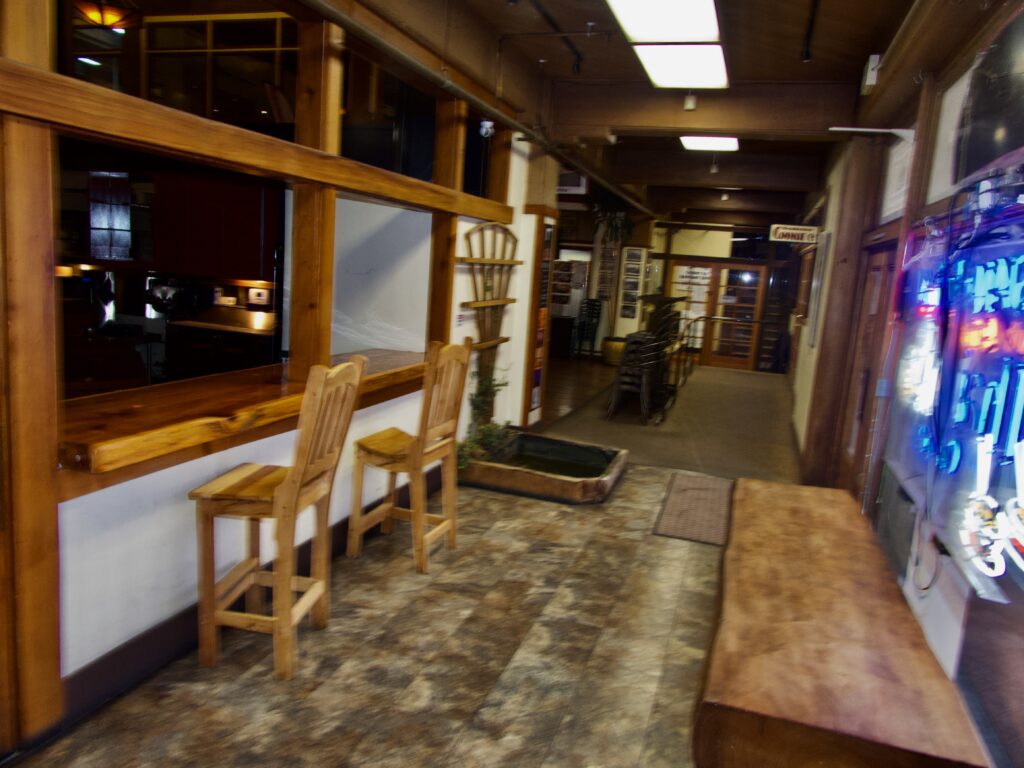
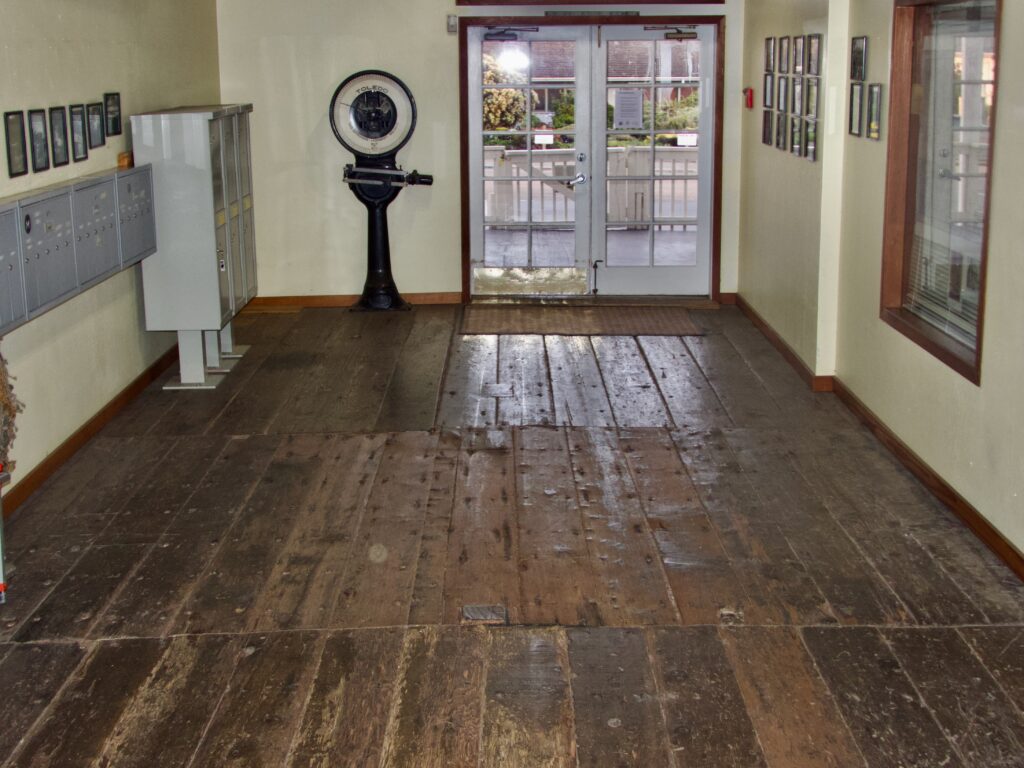
a rare surviving piece of 19th‑century craftsmanship.
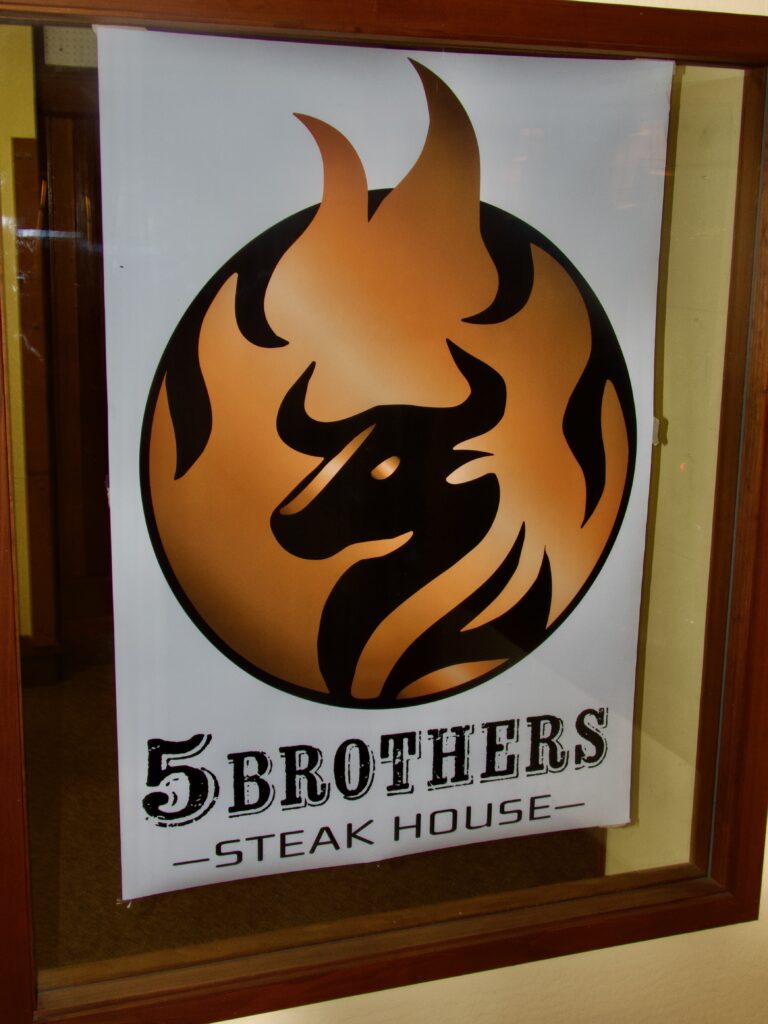
in the space recently vacated by Dijon, a seafood restaurant. We have been talking to the owner, Daniel Moreno, and reading his menu, and we are ready for it tomorrow. Yummmm! Ford Ranch beef maybe! Stay tuned.
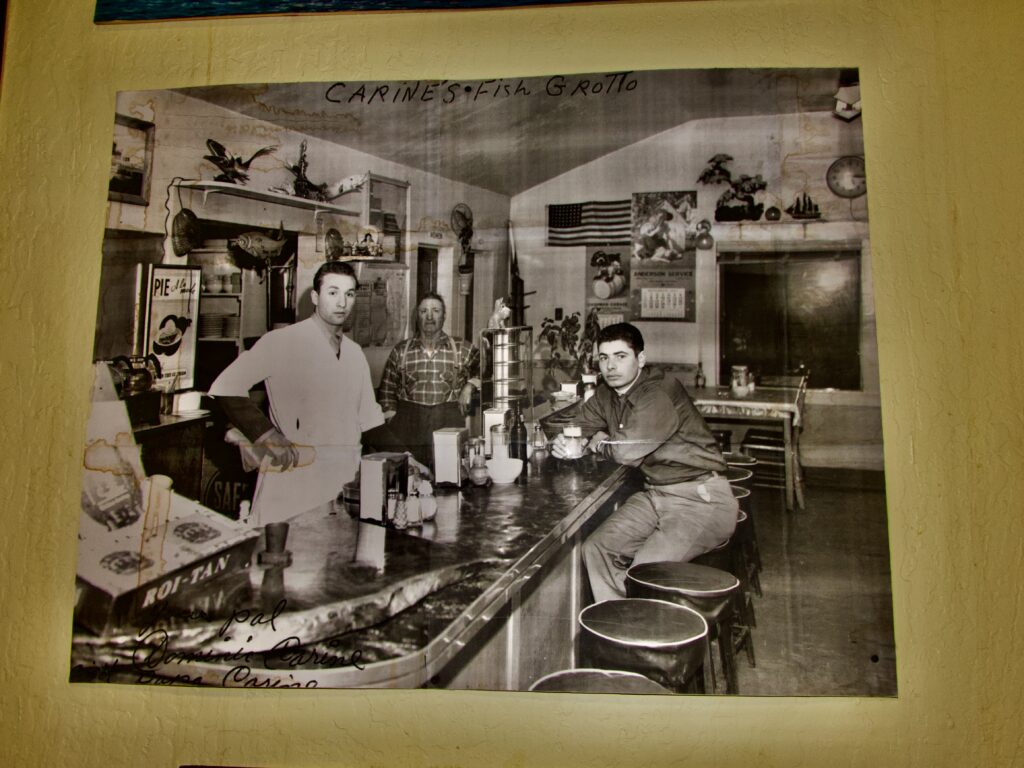
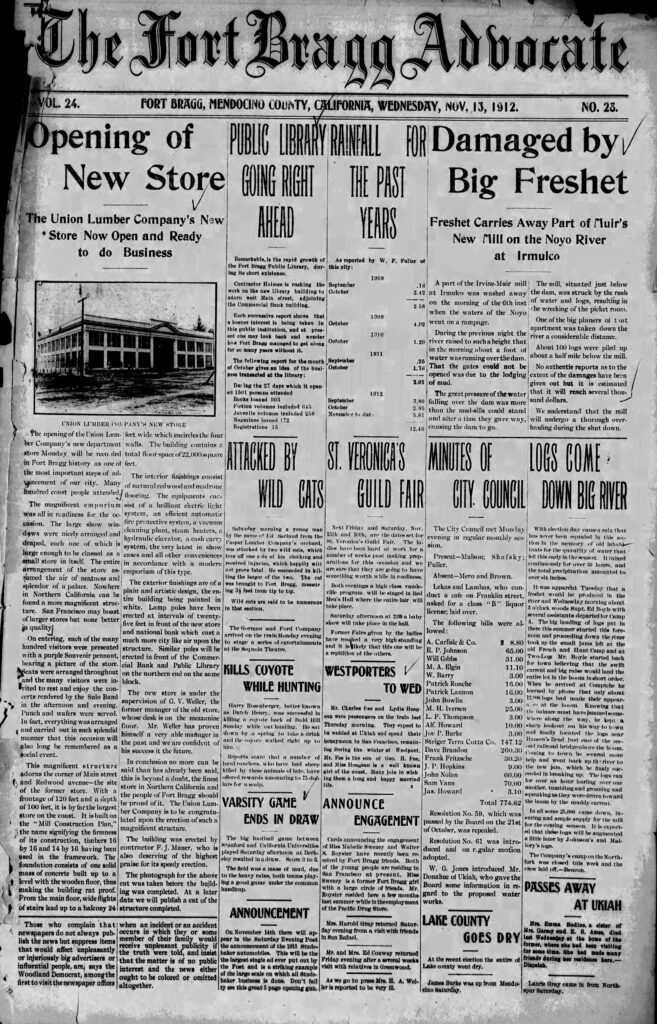
We would love to hear from anyone direct about this story, like where did the Native American statue go to? And what really are the plans?