Forest reform bill AB 2494 moving along; cutting ready to start in Jackson —. Take the Tour Tuesday before you decide! + What’s happening with the JAG and environmental protesters say WAIT!!
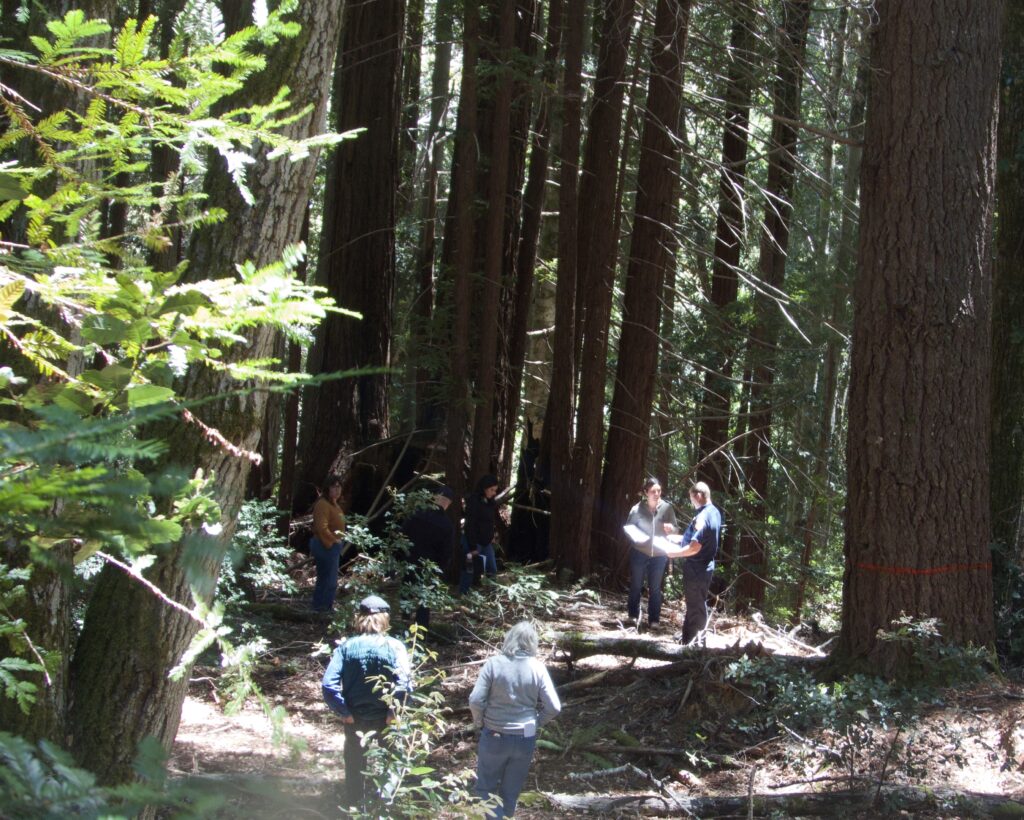
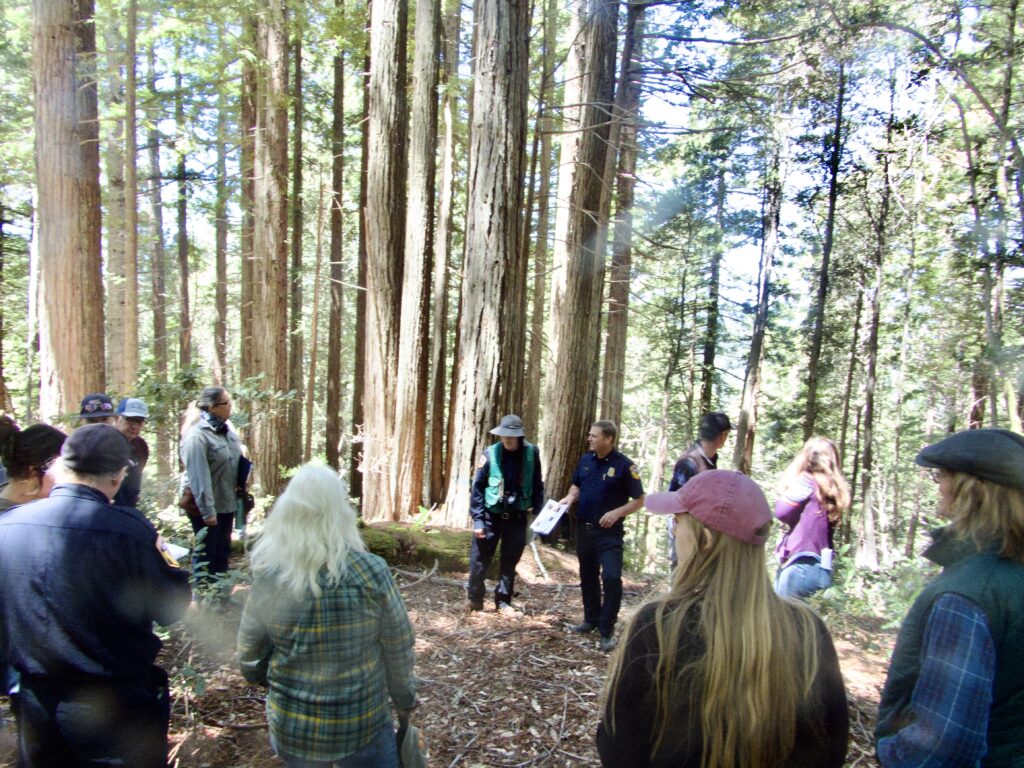
On Tuesday, all of you will have a chance to take a tour of the big redwood forest — an event we guarantee will rival any National Geographic expedition. Try it. Details on how to attend are at the very end of the article.
Cal Fire will be giving reasons why the imminent restart of logging is needed — after six years of an environmentalist‑driven halt to new cutting — is worth it for the climate‑change research and futuristic scientific knowledge they say will come from harvesting 1.5 million board feet of redwood and Douglas fir. They will bring scientific experts to answer your questions and show you exactly how these experiments work.
There will also likely be well‑informed environmentalists on the tour, people who have studied the same material and reached very different conclusions. You can ask questions of all of them, see the forest for yourself, and decide where you stand.
Your opinion matters here. Local environmentalists have exerted unique power not just in California but nationwide on logging — a last vestige of the old union/progressive movement. They shut this forest down from 2000–2009 and again from 2020–2026. Could they do it again? Should they do it again?
And the Save Jackson Forest Coalition has its own event — a rally at Fort Bragg Town Hall to protest the logging and to argue that Cal Fire is breaking its word. It’s set for Saturday, Aug. 15, at noon.
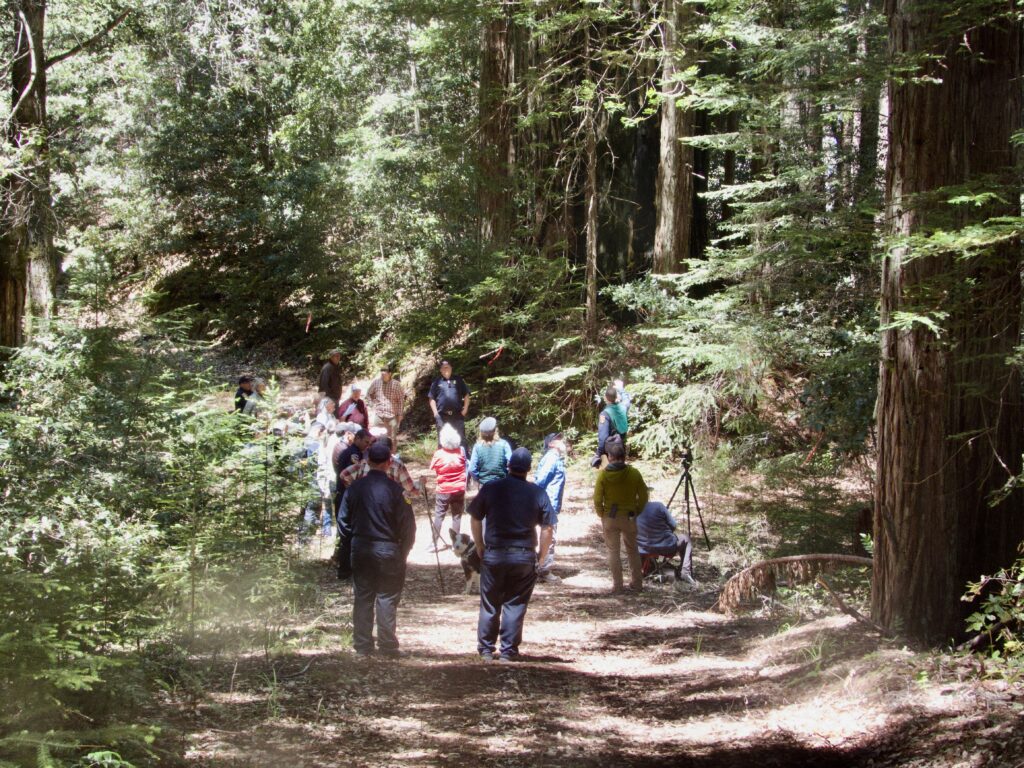
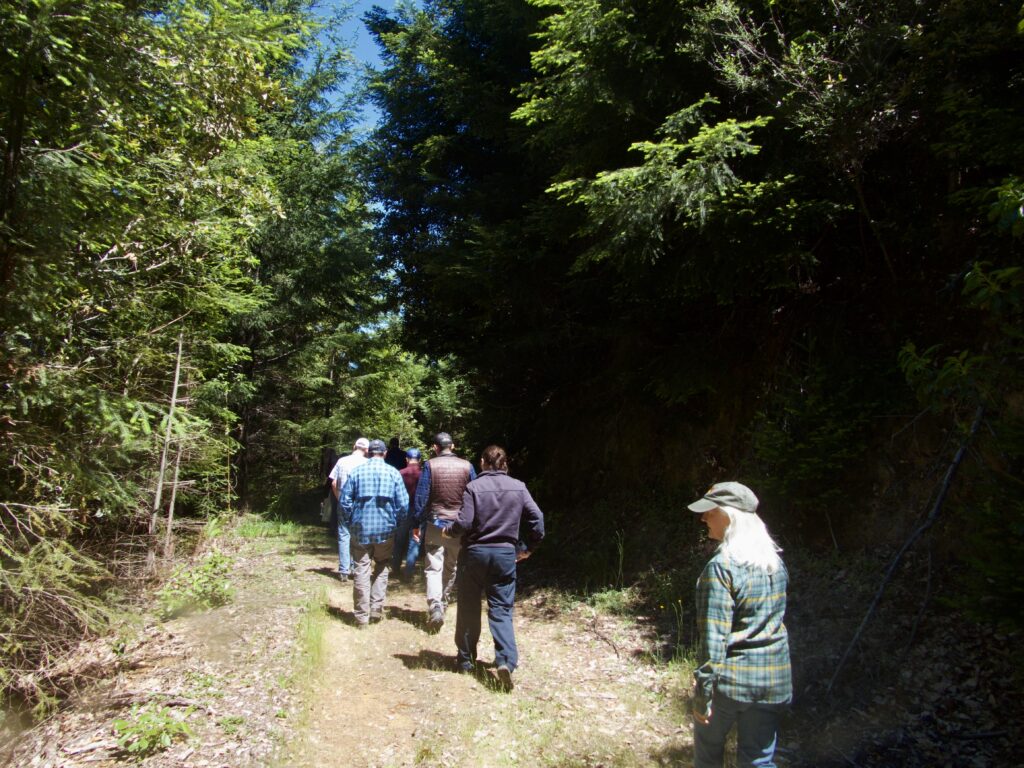
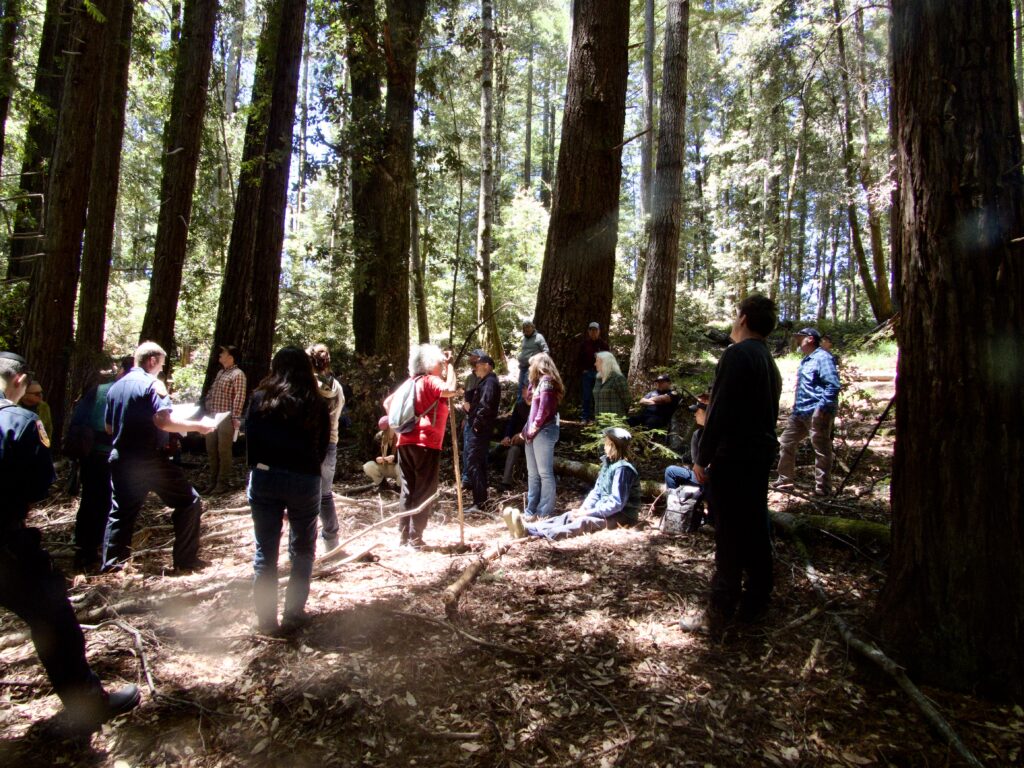
Frank has been on more than a dozen of these tours — perhaps more than anyone except a few of the Cal Fire staff themselves. Here, we present what we’ve seen and heard and give you an outline of what you would learn on the tour. But no written story, video, or photo can come close to walking among the redwoods, seeing and feeling the legacy of cutting that touched nearly every old tree in Mendocino County. You see how the forest still struggles from that past, and from a changing climate. And you hear how the terrifying future of wildfires and other climate‑driven changes might — or might not — be eased by the practice of good science.
On all these tours, people from different viewpoints have come up with radically different answers to the question of logging. But one thing conservatives, Cal Fire, and environmentalists all find undeniable is the fearful reality of rapid climate change.
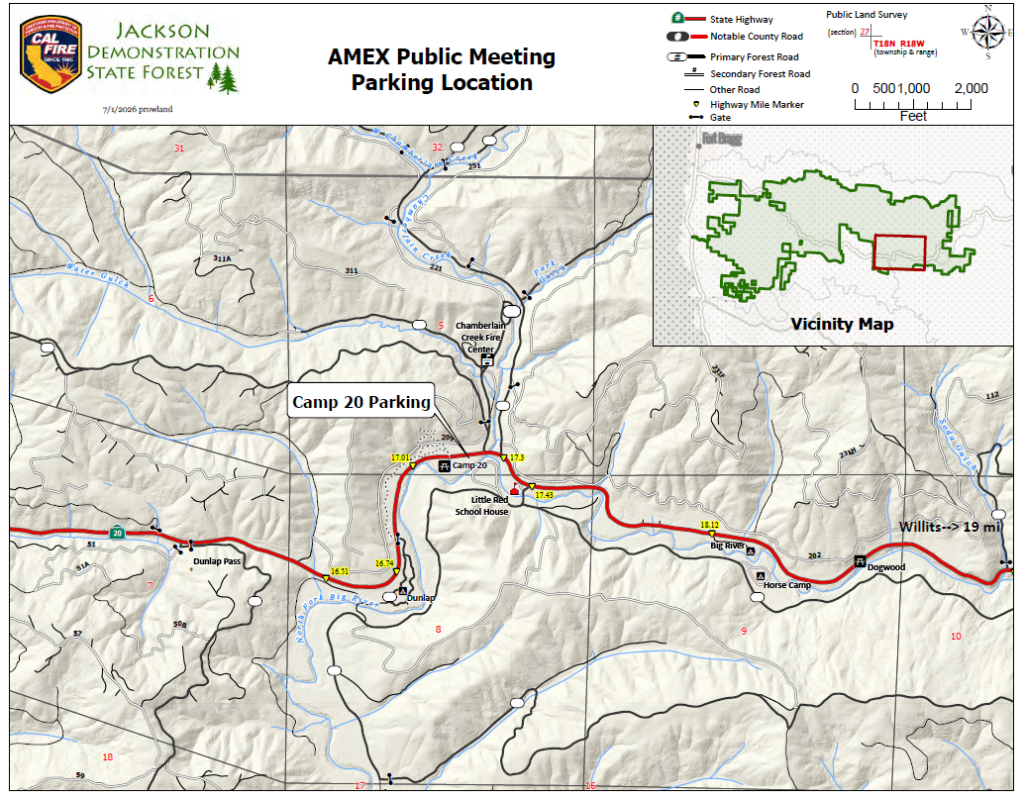
Weigh for yourself the relative value of magnificent second‑growth redwoods and Douglas fir versus the scientific knowledge Cal Fire says will be gained during the AMEX harvest, which is about to begin. The 484‑acre cut area sits above Chamberlain Creek Fire Camp, across from Camp 20 in Jackson Demonstration State Forest, directly opposite the Highway 20 rest stop.
Logging prep work was expected to start in July, then pushed to August, and now there is no definitive start date. We think something may be happening behind the scenes, and this is one of the questions worth asking on the tour. Although Oct. 15 is the end of the work window, if Cal Fire does begin the road work, they would still be in the forest afterward — checking whether the grading and road improvements are causing damage and stabilizing any problem areas.
We will present the science you’ll hear about if you take the tour, and then give you a very recent update on AB 2494 — the bill by Assemblymember Chris Rogers that began as a straightforward attempt to broaden the purpose of the Demonstration Forest System. Since then, it has been rewritten, re‑edited, and revised so many times that the current version is almost impossible to interpret. We’ll show you what it looks like now.
And this week, the bill was possibly shelved… or possibly not. The signals coming out of Sacramento are contradictory, and no one is giving a clear explanation. Whether that’s legislative confusion, political pressure, or something else entirely is one of the questions worth asking.
Next, we will examine the distressing lack of detail — and lack of any real process — in both the legislation and the current reality surrounding tribal co‑management of Jackson Forest. For years, state officials have spoken publicly about “co‑management” with local tribes, but neither AB 2494 nor Cal Fire’s present operations outline what that actually means in practice. There is no clear structure, no timeline, no authority defined, and no explanation of how tribes would participate in decisions about cutting, science, or long‑term stewardship.
The gap between the rhetoric and the reality is now large enough to be its own story, and it is one of the most important questions to carry into Tuesday’s tour.
At the end of the article, we give you an update on the Jackson Advisory Group (JAG) — the body environmentalists fought for years to create. When the JAG was finally established, logging was allowed to resume under the promise of genuine local oversight. But the state later stripped that authority away, effectively selling the community out because it did not like the idea of local autonomy.
We’ll walk you through how that happened, what the JAG has become, who sits on it now, and how you can get involved. The gap between what the JAG was supposed to be and what it is today remains one of the central unresolved questions in Jackson Forest governance.
WHAT’S HAPPENING RIGHT NOW WITH LOGGING
Contracts have been awarded to Mendocino Redwood Company and its cutting contractor, Two Brothers Logging. By any measure, the companies will receive a large volume of lumber at a very low price. But in exchange, they are required to carry out extensive scientific work while doing their logging — data collection, monitoring, and experimental treatments that go far beyond a standard timber harvest.
How those obligations are enforced, how the science is verified, and whether the low price reflects a subsidy for research or simply a giveaway of public resources are all questions worth asking on Tuesday’s tour.
“The total value we expect is about $300,000 from the entire harvest.,” Cal Fire’s Kevin Conway told the group on the last tour.
Mendocino Café owner Merrie Smith, looking up at the magnificent trees, said the payment sounded like a tiny amount of money for what was being taken. She compared it to the cost of remodeling a single‑family home — a striking contrast given the scale of the harvest.
“That doesn’t sound like a huge amount, true. This plan is about climate change and science really. We have $3.5 million in the research already,” Conway said. The harvest is projected to be 1.5 million board feet of timber, about 1 million of Douglas fir and a half million board feet of redwood. Conway explained that this ratio is designed to make an already predominantly redwood forest even more redwoody. He said the science shows redwoods to be the better tree for this setting and the changing future. Outside the control of Cal Fire, how MRC bids now relates to the way lumber mills have largely vanished and the ones that remain are highly specialized by species and even tree size. The trees will be trucked to three specialized mills — one in Cloverdale and two in Humboldt County — facilities equipped to handle large redwood and Douglas fir logs. The harvest would be in a 484 acre area, not all of which is accessible; perhaps 400 of those acres. Inside that 484 acres there will be 300 study parcels, each around 1/10th an acre or the size of a very large house footprint.
That would be 30 acres, where pretty much every inch of the ground would be studied and highly selective logging practiced. There will be about 7.5 acres clear-cut as well. This is being done to create new, open areas where the “transition” part of the experiments can be tested by planting an experimental forest designed to try a new approach, then compare that to the control (or unchanged study area) over time. Intense study happens only in the sample area of about 30 acres, with the remaining 480 acres being used for selective cutting, with three 2.5 acre clearcut areas as part of the transition experiment.
“We know that the climate is changing rapidly and that it is driving more intense fires, droughts, insect infestations, and diseases than we’ve seen in the past. The idea behind this experiment is: Are there things we should be doing now to prepare our forest for that future? So we’re looking at three different concepts for how a forest might be structured. We’ll talk about the measurements we’re taking, so that when those climate‑driven events inevitably happen, we can learn from them,” Conway said.
Cal Fire always brings a large contingent of uniformed men and women to these tours — scientists, firefighters, foresters — but Conway has been the one explaining the process and taking the heat for five years. He was recently promoted from his role as head of the Demonstration Forest System, and Justin Britton now holds that post; both men have been on the tour.
Cal Fire’s Jeremiah Stueterman is the Forester overseeing AMEX, he has impressed many with his scientific knowledge and ability to discuss the history and long term perspective of forestry. He explained that even in the roughly 450 acres where Two Brothers Logging will cut trees much as they would in any other Mendocino Redwood Company forest, the trees selected still match what Cal Fire wants for the science — within the parameters of what the logging company can take profitably.
“I didn’t think about “how much is this tree worth” when I went around marking trees. I looked at which trees would fit the criteria for the experiment.”
HOW THE SCIENCE WORKS
The scientific experiment you’ll hear about divides the 300 study parcels in this THP into four treatment types: Resilience, Resistance, Transition, and Control. Each parcel has been marked and monitored constantly for two years. In the three active treatments — Resilience, Resistance, and Transition — Cal Fire has already tested a range of ideas and interventions. The Control parcels, by design, remain untouched.
Each of the three active study types imagines a different future forest and is grounded in a distinct body of published studies by a leading scientist. Each treatment reflects a separate scientific theory about how a redwood–Douglas fir forest might respond to accelerating climate stressors.
Dr. Connie Millar began publishing the scientific theories behind the three treatment types in 2007, and her work has since been applied around the world — in the Sierra Nevada by Cal Fire, and in the giant sequoias, where the same University of Nevada–Reno research team that has been working in Jackson for the past two years made significant findings.
Each of the three experiment types you’ll see on the tour is designed to help forests recover from wildfire and survive accelerating climate change. The first type of study area is called a resistance treatment.
The CalFire team explained that as—“How can we prevent impacts to the forest from some of these disturbances?”
The second is called resilience treatment.
“Can we leave forest structure in a diverse enough fashion that some aspect of the forest would survive the disturbance, even if it might be significantly changed and still function as a forest?
For transition, they said:
“Are there things that we can learn now if we have a whole failure of the forest and we need human intervention to get a forest in the future?”
Some of the study areas are testing ideas that would have been considered radical not long ago — including introducing tree varieties and even entirely different species from hotter regions. The question behind those trials is simple and unsettling: Will a hotter Jackson Forest eventually need trees that evolved somewhere else?
That is one of the core uncertainties driving the experiment, and one of the most important questions to carry into the tour.
Those three concepts — Resistance, Resilience, and Transition (Control means doing nothing and is not a new idea) — didn’t stay confined to Millar’s early papers. They were adopted nationwide through a network of experiments known as Adaptive Silviculture for Climate Change, a collaborative effort now operating in many different forest types across the United States. Each site implements similar treatments, collects similar measurements, and then tracks how forests respond as real‑world disturbances hit — fire, drought, insects, disease. The goal is to generate comparable data that can guide future forest management.
“In 2015, we were looking at that and asking ourselves what we were doing to prepare our forests for climate change,” Conway explained.
Nadia Tase, Forest Health Research & Monitoring Program Manager with CAL FIRE’s Fire and Resource Assessment Program said California had lagged behind other Western states, where these climate‑adaptation concepts have been studied collectively since about 2009. While places like Colorado, New Mexico, and the Sierra Nevada moved early into coordinated experiments, California didn’t begin adapting the model until much later — one reason Jackson Forest is now playing catch‑up within the national Adaptive Silviculture for Climate Change network.
“We don’t have a network like that in California, so we engaged Dr. Sarah Bisbing at the University of Nevada, Reno and and her lab, which is really focused on the persistence of forests. This concept reveals how can we find forests that are at risk and do something proactive to make sure that we have them in the future.
“We started off in the Sierra Nevadas. We know that millions of acres of forest there is at risk like never before. You know it’s immediate. The threat is right in front of us, and so we have a network of plots that we started putting in in 2015, and finished implementing in 2020 in the Sierra Nevada, Tase said.
Tase described how her own hometown of South Lake Tahoe was decimated by one of the earlier fires that swept through and now conditions have gotten drier and more dangerous. The change has caused a catastrophic die-off of some tree species there.
Then in 2020, the Santa Cruz fires hit, alarming Cal Fire about the new potential for destructive wildfires in even incredibly resilient and often damp and cool Coastal Forests. Those Santa Cruz fires made Cal Fire think more that the kind of rapida and drastic change might apply to the Coastal forests as well and that brought the work here to Jackson.
1. More of the Science We Saw in the Forest — and What You Can Ask About on Tuesday
Big‑tree science — Studies show that a small number of huge redwood trees can provide biodiversity, overall forest health, fire protection, and even lumber production more effectively than twice as many slightly smaller trees packed closer together. Environmentalists argue that removing any big trees undermines forest recovery and the long‑term return of something resembling old growth. Conway and the scientists countered that when two second‑growth trees stand side by side, removing one can allow the remaining tree to become the true “forest mama,” gaining the space and resources needed to grow into a dominant, structurally important giant.
Fire behavior science — Fires in Jackson are driven almost entirely by the thickness of the ground brush; Conway said the big trees here do not carry canopy fires, and without heavy understory fuel, flames cannot climb. This study is testing different ways to keep that brush from returning. In some parcels, native plants like ferns are encouraged to take hold and out‑compete the brush. The question is how to promote those species so they can maintain low‑fuel conditions naturally.
Pesticide use — Pesticides, including “hack‑and‑squirt” methods are used in parts of the JDSF. If you’re concerned about pesticide use or want to understand why Cal Fire considers it necessary, Tuesday’s tour is the place to ask. Treatment consists of making small cuts through the bark of a living target tree and applying a limited amount of herbicide into those cuts. On JDSF, it is used selectively as a vegetation-management tool, including for treatment of small-diameter tanoak, Britton said.
“It’s a very effective treatment, especially we mostly use it on steep slopes and you know get those smaller trees,” Conway explained.
THE DRAMATIC HISTORY OF ACTIVISM IN JACKSON
Environmentalists have shut down logging in this forest twice in the 21st century. The first shutdown ran from roughly 2000 to 2009, after which a compromise was reached and signed by both local loggers and environmentalists. That agreement created the Jackson Advisory Group (JAG), intended to give genuine local oversight of timber harvests.
In 2011, the state upended that compromise. The JAG lost much of its authority and began approving every timber harvest Cal Fire brought forward. Jackson Demonstration State Forest, founded after World War II to practice scientific forestry, has produced important research — including the landmark Caspar Creek study launched in 1962 with the U.S. Forest Service, which continues to generate one of the most valuable long‑term data sets in the country.
But it was also clear that Cal Fire was in a rush to approve as much logging as possible, as fast as possible, and that some plans saw little meaningful study — not only in the late 20th century but again between 2011 and 2020.
Everything blew up again in 2020. Cal Fire likely overreached with the Caspar 500 plan, which proposed cutting trees very close to the most beloved and heavily used parts of the forest — including redwoods more than four feet in diameter that many locals saw as old friends. The plan sailed through with no protests and a unanimous JAG approval. Environmentalists later said the pandemic prevented timely objections.
Once people saw the scale and location of the cutting, anger exploded. Environmentalists — and much of the broader community — mobilized quickly, using tactics that were sometimes controversial or even dangerous, including standing near active felling sites, creating enormous risk and liability for the loggers on the ground.
They came out en masse. They shut the forest down again in 2020 and were able to stop any new timber plans from getting started.
Cal Fire adapted. They began writing timber harvest plans that incorporated fire, traditional Native practices, and newer scientific approaches. They offered tours that ran all afternoon and sometimes into the night. Frank went, watched, asked questions, and read thousands of pages of material. I recorded more than twenty hours of video and watched it all. I never published most of it. I got lost in the forest and didn’t tell you — the readers — enough about the trees. I got heavy spin from every direction, sometimes deceptive, sometimes just desperate.
The environmentalists love this forest, no question. But so do the scientists, and yes, many of the loggers. One local logging company has worked these woods for generations and considers itself a better steward than either the state or the activists. I’ve taken tours with MRC, Philbrick Logging, and others. Seen this way, it’s undeniable that the old‑time loggers did real damage — but in some privately owned forests, and even in Jackson, there was at least some thought for the future. Caspar Lumber Company, for example, was arguably the most forward‑thinking of the old giants.
Today, many loggers spend as much time conserving the forest as they do cutting it. On a Big River tour with MRC, we saw how they’re working to prevent an entire mountainside — destabilized by old logging roads carved straight into the slope — from sliding into the river. They can fix it, and they have to, because their land has no future value if it collapses. And we’ve also seen other companies that simply don’t care.
This is why we need to care. Put down the video games and cell phones and get involved in something so nonpartisan and so important — the future of the forest we all share.
Jackson Demonstration State Forest spans 48,652 acres, so this harvest represents roughly one percent of the forest. California has fourteen demonstration forests; Jackson is by far the largest and the only one ever shut down by environmentalists. It is also the one where the public has been most deeply involved. No other demonstration forest ever demanded a local board like the JAG.
But Cal Fire headquarters has consistently refused to grant true local autonomy. That’s why the State Board of Forestry tore up the JAG agreement in 2011, even after loggers and environmentalists had negotiated it with local Cal Fire staff. Sacramento did not want to cede local authority.
Local power — real community‑level decision‑making — has faded across much of the broader progressive movement, and AB2494 makes no effort to restore it in Jackson. The bill barely mentions local involvement at all, aside from a vague mandate for tribal participation.
Meanwhile, Jackson remains one of the most heavily used public forests in the state, with recreation ranging from camping, hiking, biking, and horseback riding to swimming, mushroom collecting, hunting, and picnicking.
2. AB2494 Moves along: No Local Control, No Native Process — JAG Would Still Remain
The big forestry headline in California this year has been AB2494. The bill has been celebrated loudly, but we don’t think many people are reading the fine print — or any print. AB2494 originally aimed to broaden the purpose of the state’s demonstration forest system and formally include Native American tribes in management.
Does it? Read on
The Fort Bragg City Council refused to endorse AB2494 because the bill was — and still is — extraordinarily vague. It contains no process for local management, no mechanism for community oversight, and not even a mention of the Jackson Advisory Group (JAG), the body environmentalists and loggers fought so hard to create and which has been the public’s only real window into how logging decisions are made in Jackson.
Justin Britton, the new head of the Demonstration Forest Program, gave us a clear answer on this point. The JAG is not excluded from AB2494 — but it is also not mentioned anywhere in the bill. That raises the real question: will the JAG still have any meaningful role or reason to exist?
“The confident, short answer to your question is yes – the JAG would still serve as an advisory body to CAL FIRE and BOF for projects happening on JDSF, Britton said.
“Nothing in the current version of AB 2494 appears to dissolve or remove the Jackson Advisory Group. The JAG is an advisory body to CAL FIRE and the Board of Forestry and Fire Protection on JDSF management-plan review, implementation issues, and related policy matters. If AB 2494 were enacted, CAL FIRE and the Board would need to evaluate any necessary updates to regulations, management plans, or advisory processes, but the bill itself does not eliminate the JAG.
THE CURRENT STATUS OF THE BILL
AB2494 was placed in the “suspense file” by a legislative committee on Aug. 3. Any bill estimated to cost taxpayers at least $50,000 is automatically sent to the suspense file.
CalMatters reported last year that the suspense file is sometimes used to quietly kill bills without public debate. suspense file is used to secretly kill some bills. But that does not seem to be the case here. While many bills do disappear into oblivion, a hearing is scheduled for Aug. 18 on AB2494. We hope locals can lobby to make the tribal mandate mean something more and for a local mandate and specific direction to be incuded.
AB2494 WAS A GREAT IDEA, BUT WHAT DOES IT ACTUALLY DO?
When AB2494 was introduced by Assemblymember Chris Rogers, it allowed logging only when it served other missions — recreation, climate‑change research, and similar public purposes. That is no longer true. The bill was quickly edited to restore logging as a primary purpose, no longer required to be subservient to other uses. Cal Fire has often argued that everything in Jackson must ultimately serve logging, though that interpretation has shifted over the years to fit agency goals.
One significant change in AB2494 is a mandate for tribal co‑management, which would make that role permanent. As things stand now, the tribal mandate created under the Newsom Administration may or may not survive beyond it — we simply don’t know.
And sadly, the tribal “mandate “in the bill is much too vague in our estimation.
“(g) It is the policy of the state to respect California Native American tribal sovereignty and to seek opportunities for comanagement and integration of local indigenous traditional ecological knowledge in forest management.”
WTF? “Respect,” “seek opportunities”? This sounds like language in a treaty with tribes written by President Andrew Jackson. Why not something specific or at least something real like “it shall be established law that Cal Fire shall not proceed with a harvest until they have tribal co-management in place, including presenting public documents on what they took to the tribes and what specific guidance they got back. This may exclude specific locations and the names of tribal advisers involved but must reveal the names of the tribes that have been consulted with”
The tribal mandate in AB2494 is not only extremely vague — it has no defined process. That means the entire structure would once again be left to Cal Fire headquarters in Sacramento to interpret and implement, with no requirement in the bill for openness or public transparency. Activists have repeatedly called on Cal Fire to state their goals and their intended outcomes for tribal co‑management and to make those public. So far, that has not happened.
Many activists say the process is a sham. What is clear is that it is not a public process, and far more could be done. We are disappointed the bill did not require that.
State Legislature editing has made a mess of the bill. If you can read AB2494 in its present form and make any sense of it, you are smarter than we are.
Please do so — and explain.
Click on the blue writing to witness this mess.
Whoa! Just try to make sense of this bill after all the editing you can see here.
While some of the original intent was edited out, this bizarre paragraph remains in the bill:
“(f) (1) As a loan to the Department of Fish and Wildlife for activities to address environmental damage occurring on forest lands resulting from marijuana cultivation. Not more than five hundred thousand dollars ($500,000) may be loaned from the fund in a fiscal year pursuant to this paragraph. This paragraph shall become inoperative on July 1, 2017.” Huh?
OTHER APPROVED TIMBER HARVEST PLANS IN THE JACKSON FOREST
A key reason environmentalists have objected to the JAG is that it approved every timber harvest plan presented to it — though one plan was shelved at the height of controversy when consensus could not be reached. But to us, that criticism misses the larger point: the JAG, environmentalists, and others were able to give extensive input throughout the process, and to participate in long, detailed field tours.
This superb local public process — led by the JAG — EXISTS IN NO OTHER DEMONSTRATION FOREST IN CALIFORNIA. While others do have a public process including the THP process and the ability to take any issue to the California Board of Forestry, only the Jackson has the JAG and the genuine reflective and interactive process the JAG offers. Its real failure is that so few people outside the Save Jackson Forest Coalition and the JAG ever took advantage of this extraordinary opportunity to examine the past, present, and future of the most important economic resource in our region, and one of the most important demonstration forests in the world.
Four timber harvest plans are now in process, with the first being the AMEX plan at Camp 20 — the one you’ll see when you take the tour. All four have been approved by the JAG and, in the past, would simply have been cut with no further public input. Cal Fire has now begun offering post‑JAG‑approval tours, like the one happening Tuesday.
#2 A THP for an area above Caspar Creek. (We are looking for more info)
The “Fireberry” Timber Harvest Plan — originally named the Pyrosilviculture THP — is a planned forestry and prescribed‑burning project in the Old Mill Farm area, deep in the heart of Jackson Forest about eight miles out Highway 20 from Fort Bragg, on the south side of the highway.
Lastly, there is the Camp One area THP, the most recent plan approved by the JAG. It sits on top of the hill — the small mountain above the Noyo River and the Egg Take Station. And finally, there is another THP in the area of Camp 8.
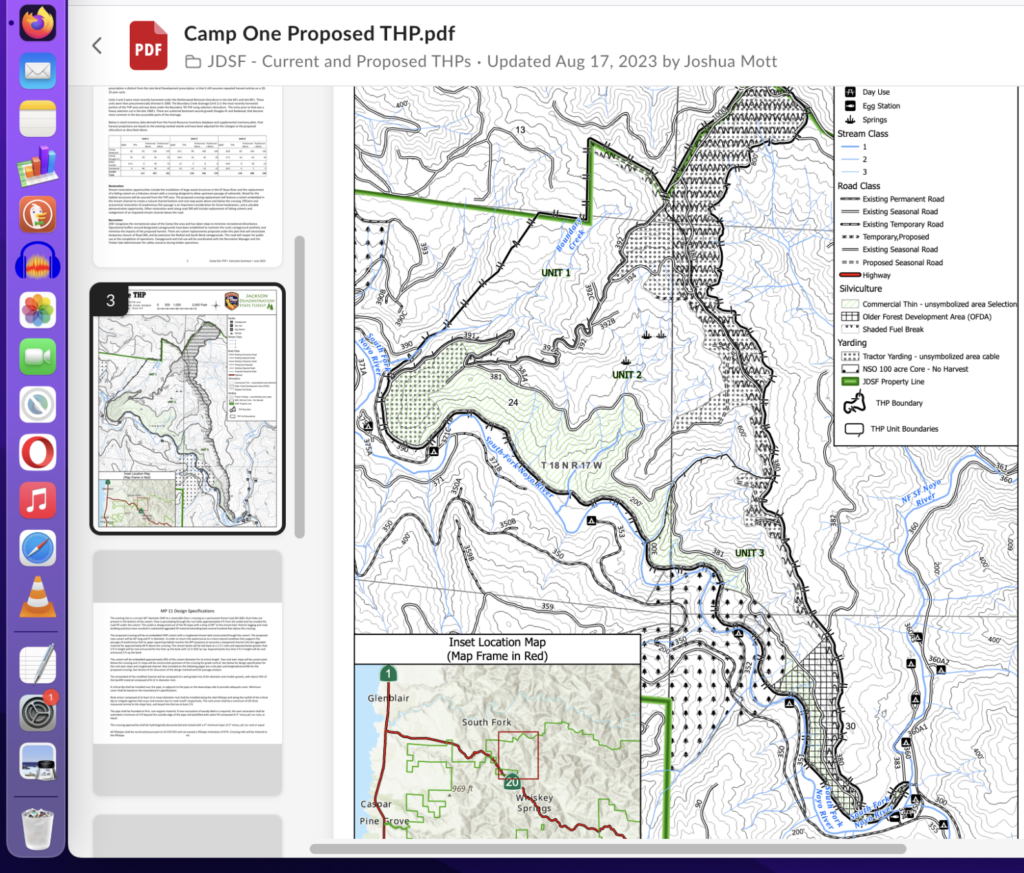
The timeline for the other three? “The other projects are in various stages of development and any guessbon those timelines would be speculative at this point,” Britton said.
THE MANDATE TO CO MANAGE WITH INDIGENOUS TRIBES
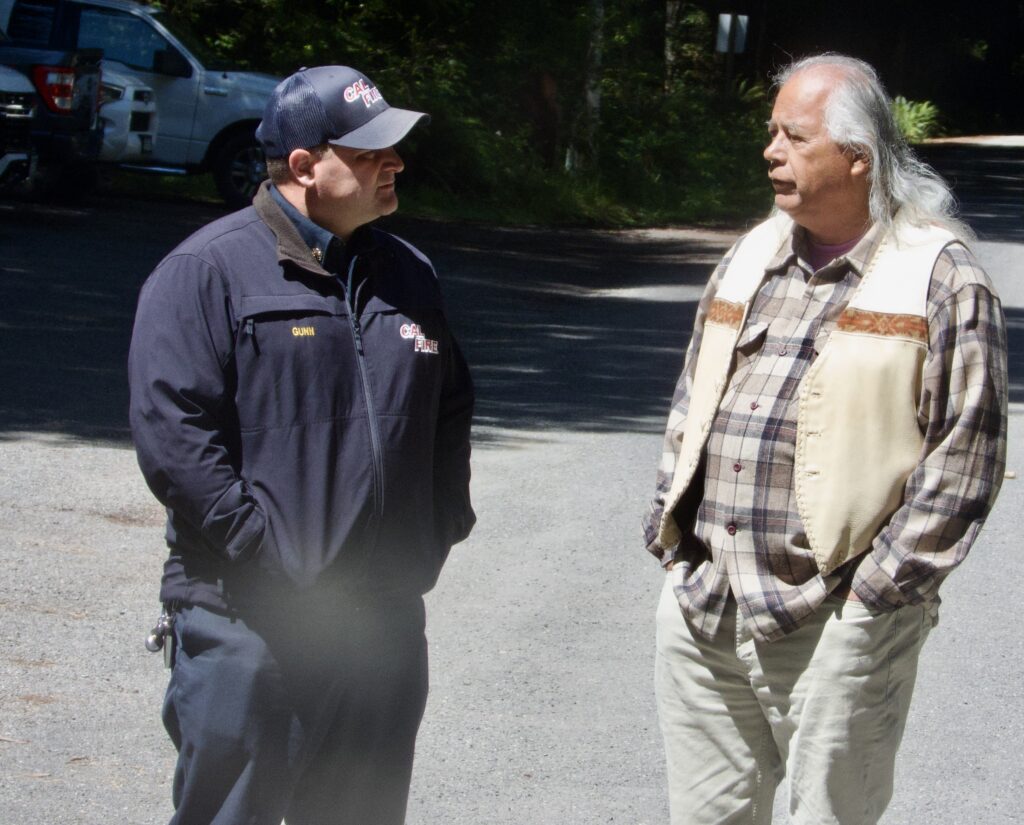
Cal Fire’s Kevin Conway and Justin Britton spent five minutes not answering our questions about tribal input on the AMEX THP. We’ve been through this before — the same pattern has played out at numerous public meetings where Conway faced fierce criticism over secrecy from environmentalists, including two members of tribes involved.
“We have these confidential conversations and they lead to specific actions but we are unable to give the specifics because the conversations were confidential,” Conway said.
When I pressed them for specifics — anything tribal connected to this harvest — they pointed to the burning of tanoak acorn groves. These burns scorch the trees in a way that increases acorn production for tribal gathering. They said they could share that example because there is a public record documenting tanoak burning for acorns.
I asked whether any of those groves exist in this THP. They confirmed no, but even that answer came reluctantly.
Where are the groves? I asked
“In a place the tribes have access to,” Conway said.
While this may sound almost comical, the underlying problem is serious: nobody has ever laid out a legal process for Cal Fire to follow. Gov. Gavin Newsom’s tribal co‑management mandate came with no specific process, and AB2494 also lacks any defined structure — yet it repeats the same mandate. AB2494 is critically important if tribal co‑management is to continue beyond the Newsom administration, which ends at the end of this year.
But the bill’s weakness is that nobody on the left pushed for specifics — not for local government, not for local residents, and not for tribes. That leaves Cal Fire once again responsible for inventing a process in Sacramento and passing it down locally.
Cal Fire has refused to identify which tribes they are negotiating with, but says they contacted every tribe they could find listed and asked for input. They provided that master list, which includes both non‑recognized tribes and tribes recognized by the state and/or federal government. It is known that at least the three major local tribes — Round Valley, Coyote Valley, and Sherwood Valley — all of which have deep history and strong claims in Jackson Forest, have been involved.
Polly Girvin has attended recent tours and said she is once again the tribal representative for Coyote Valley. She is not Indigenous, but her late life partner, Priscilla Hunter, was an elder, leader, and former leader in the Coyote Valley Band of Pomo Indians. They were removed as spokespersons by their own tribe at one point, with Hunter strongly blaming Cal Fire misinformation for that outcome. Girvin told one recent tour she is now back as spokesperson, continuing Hunter’s lifelong advocacy on environmental and other issues. She opposed a different harvest on a tour in May or June, but we do not know her position on the AMEX THP.
This matter is too big a subject for this story, and we plan to bring more information in a follow‑up.
WHAT IS HAPPENING WITH THE JAG?
The June Jackson Advisory Group meeting ended with a unanimous vote in favor of a timber harvest plan that likely won’t occur until 2028. This was the final meeting for chair Amy Wynn and for John Anderson, a top executive with Mendocino Redwood Company.
Mike Miles, Director of Forest Planning and Conservation for Mendocino and Humboldt Redwood Companies, has applied to replace Anderson. The JAG is now seeking three people to fill open seats.
Below is a Question‑and‑Answer exchange with Justin Britton, head of the Demonstration State Forest program.
Q — What is the process for getting Michael Miles approved to the JAG? (Kevin told me yesterday he was the sole name they had at the moment.)
A — JAG members are selected through an open solicitation and nomination process. Members are appointed by the CAL FIRE Director and are subject to confirmation by the Board of Forestry and Fire Protection. Any pending appointment would not be final until that process is complete.
Q — What is the process of picking a new JAG chair? Is that done by the state fire chief or the Board of Forestry?
A — The JAG Chair is appointed by the CAL FIRE Director and must be confirmed by the Board of Forestry. The JAG itself selects the Vice Chair.
| Al Lawrence | Licensed Timber Operator | |
| Doug Albin | Biologist | |
| Michael Jones, Vice Chair | Forest Researcher / UC Cooperative Extension | |
| George Hollister | Small Private Forestland Owner | |
| Marc Jensen | Recreation Advocate | |
| Chris Blencowe | Registered Professional Forester |
Q- Is there a minimum number required for the JAG to meet?
A-Under the JAG Charter, the group is intended to have 6 to 13 members, and a quorum is one person more than half of the current sitting membership. Without a quorum, the JAG cannot vote or take action, but it may continue informational discussion, Britton said.
A HUGE PILE OF FIREWOOD WILL BE GENERATED BY THE AMEX THAT YOU CAN HAVE
Cal Fire is offering a public firewood component in this THP, although the details have not yet been worked out. Tanoak and other trees will be cut into firewood lengths and brought to the edge of the road within the AMEX.
With quality seasoned hardwood in Mendocino County currently selling for about $300 to $600 per cord, and seasoned oak often around $380 per cord delivered, this is a meaningful benefit to the community — especially for families who rely on wood heat or who simply cannot afford today’s high cord prices.
INFO ON THE TOUR ON TUESDAY
Tuesday, August 11, 2026 — 4:00 p.m. – 6:00 p.m.
Location: Camp 20 (mile marker 17, Highway 20) (map below)
Call (707) 964-5674 or email JDSF@fire.ca.gov to RSVP
RSVP encouraged, but not required
The field-based tour will provide an opportunity for members of the public to learn more about AMEX, ask questions, and hear directly from scientists and CAL FIRE staff about the purpose of the project, the planned forest treatments, what visitors may see during operations, and how the project will be monitored over time. Participants should be prepared for field conditions, including uneven ground and variable weather. Sturdy footwear, water, and weather-appropriate clothing are recommended.
Tuesday, August 11, 2026 — 4:00 p.m. – 6:00 p.m.
Location: Camp 20 (mile marker 17, Highway 20) (map below)
Call (707) 964-5674 or email JDSF@fire.ca.gov to RSVP
RSVP encouraged, but not required
SAVE JACKSON FOREST COALITION’S RESPONSE TO CAL FIRE RESUMING LOGGING

RALLY FOR JACKSON FOREST — STOP THE LOGGING, PASS AB 2494
When: Saturday, August 15 — 12-2pm
Where: Fort Bragg Town Hall, CA
CAL FIRE broke its word. It’s time to hold the line.
After the 2020–2022 protests at Jackson Demonstration State Forest, CAL FIRE promised to pause new logging until the Forest Management Plan was updated. In December 2025, they broke that promise — approving the AMEX Timber Harvest Plan (THP 1-25-00044-MEN) for nearly 500 acres near Chamberlain Creek, days after public comment on the new Forest Management Plan closed and months before any final plan exists.
Now CAL FIRE is moving on Camp 8 South too — more logging, more roads, more damage, before:
- The 2026 Forest Management Plan is finalized
- A real co-management agreement with tribes is in place
- CAL FIRE fixes the road-building practices that have damaged cultural sites for decades — something its own archaeologist told it to do back in 1999
- The Legislature and Governor finish acting on AB 2494
AB 2494 would change everything.
This bill would redefine how California’s demonstration forests are managed — putting ecological restoration, climate resilience, and Traditional Ecological Knowledge ahead of commercial timber production. It has passed most of the Legislature and could be signed by the Governor as soon as September.
CAL FIRE shouldn’t be locking in more logging and road-building at Jackson while the Legislature is still deciding how Jackson should be managed.
WE ARE DEMANDING:
✦ An immediate halt to the AMEX THP and all further logging at Jackson Demonstration State Forest
✦ No new Timber Harvest Plans until the Forest Management Plan, tribal co-management, and AB 2494 are resolved
✦ A real road maintenance and cultural site protection plan — over 25 years overdue
✦ An independent archaeological survey of Jackson Forest, not one run by CAL FIRE
✦ Governor Newsom’s signature on AB 2494
JOIN US IN FORT BRAGG ON AUGUST 15
Bring your family, your neighbors, your voice. This is our forest, our history, our future.
Organized in solidarity by tribal nations and allies working to protect Jackson Demonstration State Forest.
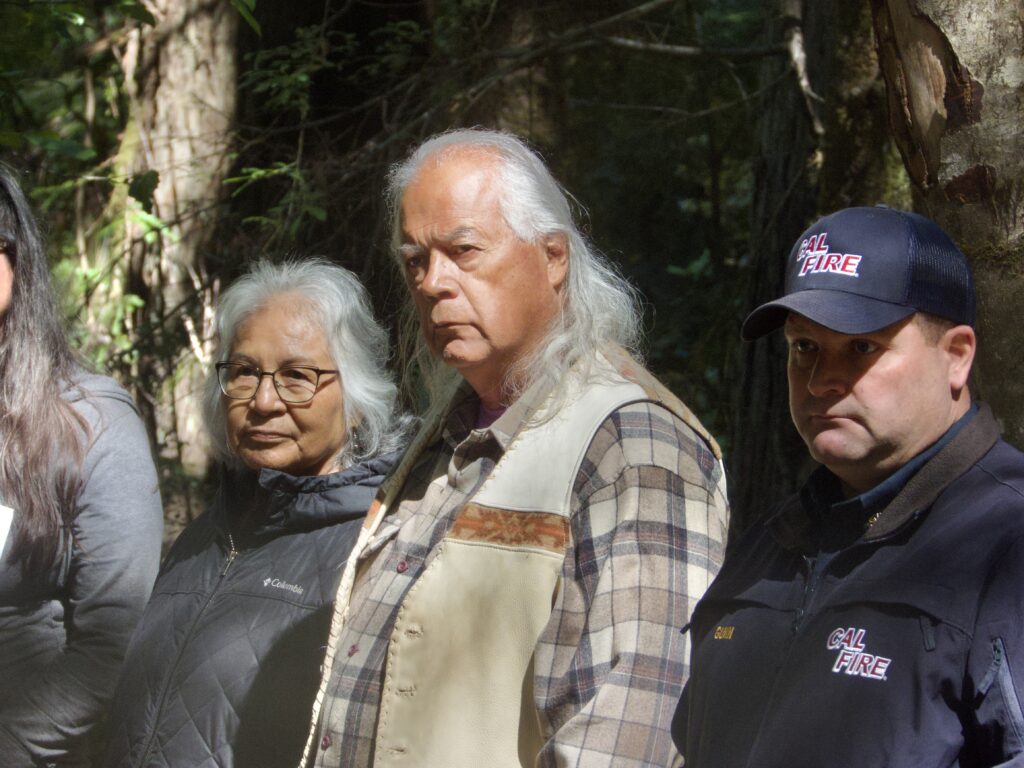
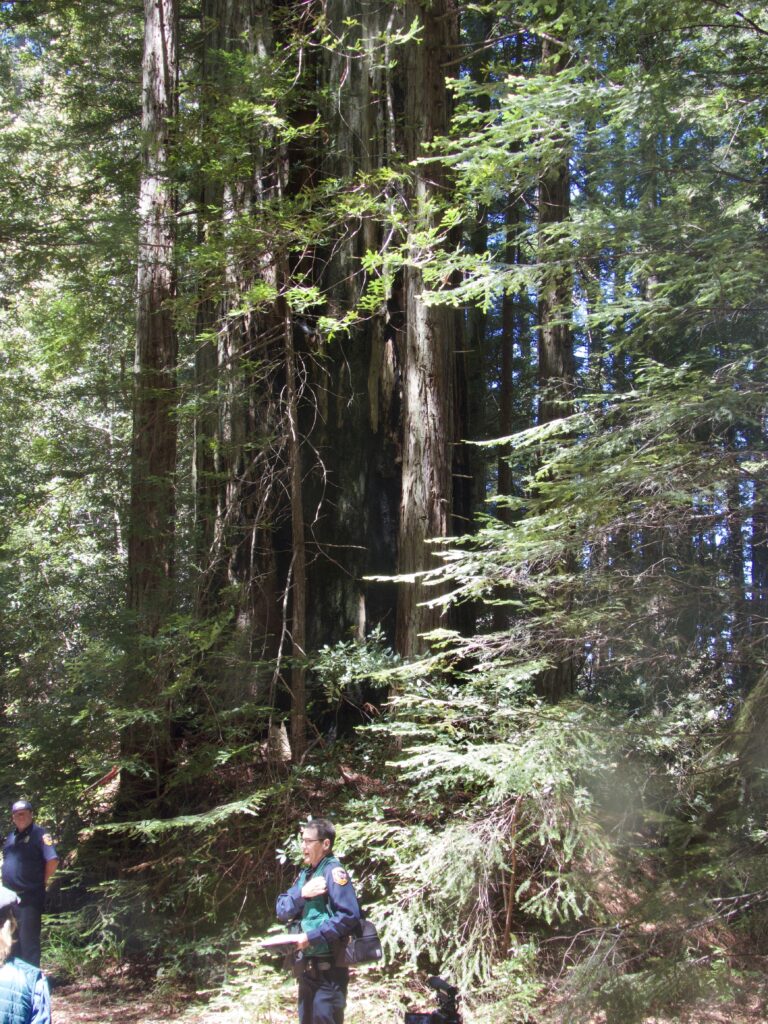
After we had published the above, we got a press release from Naomi Wagner at Save Jackson Forest. She has a lifetime of experience in this and has fully participated in the process.
THE PRESS RELEASE
PSA for immediate release
Contact: Naomi Wagner 707 459-0548
Aug. 17, 2026
RALLY FOR JACKSON FOREST
STOP THE LOGGING — PASS AB 2494!
JOIN US AT FORT BRAGG TOWN HALL ON AUGUST 15
12:00-2:00pm
Fort Bragg, CA- CAL FIRE broke its word. It’s time to hold the line. After the 2020–2022 protests at Jackson Demonstration State Forest, CalFire promised to PAUSE new logging until the Forest Management Plan was updated. In December 2025, they broke that promise — approving the AMEX Timber Harvest Plan (THP 1-25-00044-MEN) for nearly 500 acres near Chamberlain Creek, before the 2026 Forest Management Plan is finalized, a real co-management agreement with tribes is in place and the Governor acts on AB 2494.
AB 2494 would change everything. This historic bill would prioritize ecological restoration, climate resilience, and Traditional Ecological Knowledge over industrial timber production.
CalFire shouldn’t be locking in more logging and road-building at Jackson while the
Legislature is still deciding how Jackson should be managed.
We demand:
- An immediate halt to the AMEX THP and all further logging in Jackson Forest
- No new Timber Harvest Plans until the Forest Management Plan, tribal co-management, AB 2494 are signed and implemented
- A real road maintenance and cultural site protection plan — over 25 years overdue
- An independent archaeological survey of Jackson Forest
- Governor Newsom’s signature on AB 2494
Bring your family, your neighbors, your voice. This is our forest, our history, our future.
Organized in solidarity by tribal nations and allies working to protect Jackson Demonstration State Forest