Mendocino’s kings and queens of the skies return for spring lovings and sushi
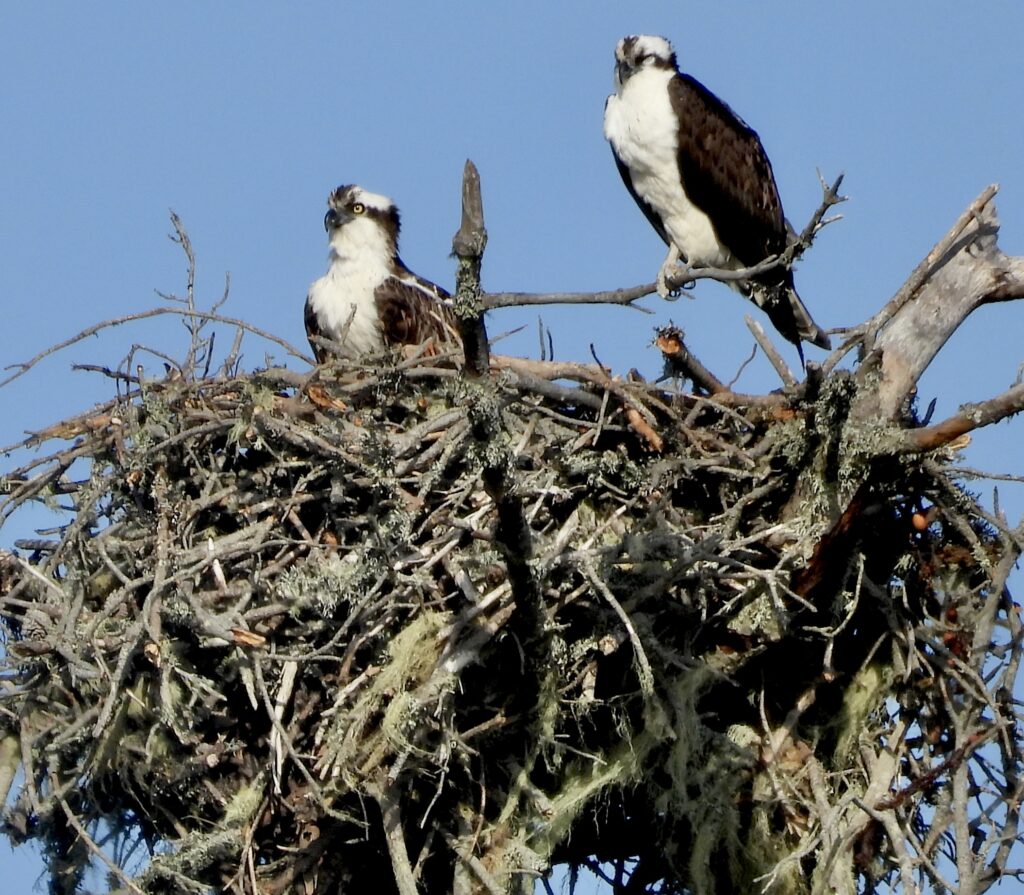
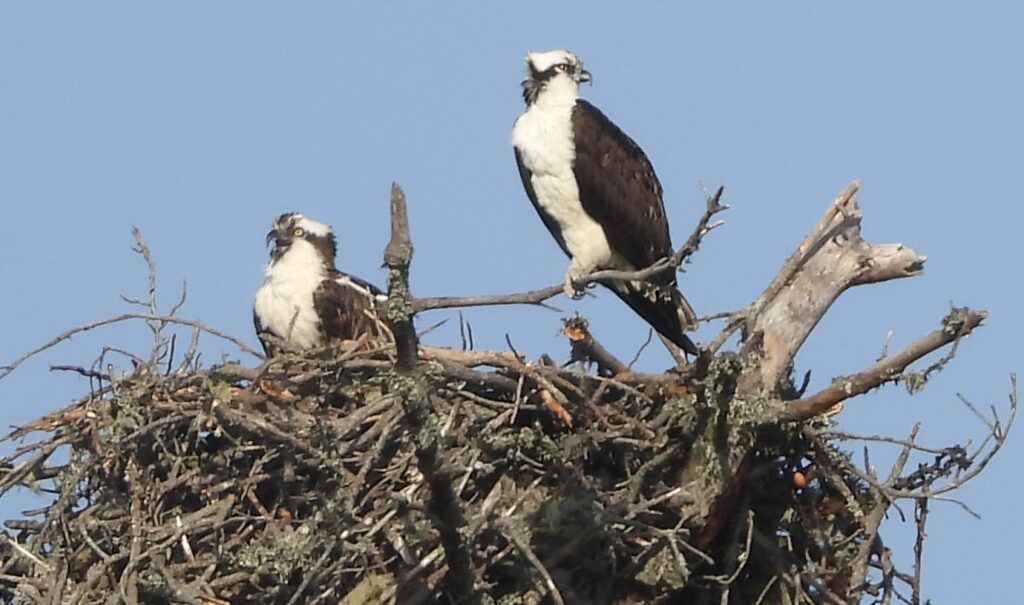
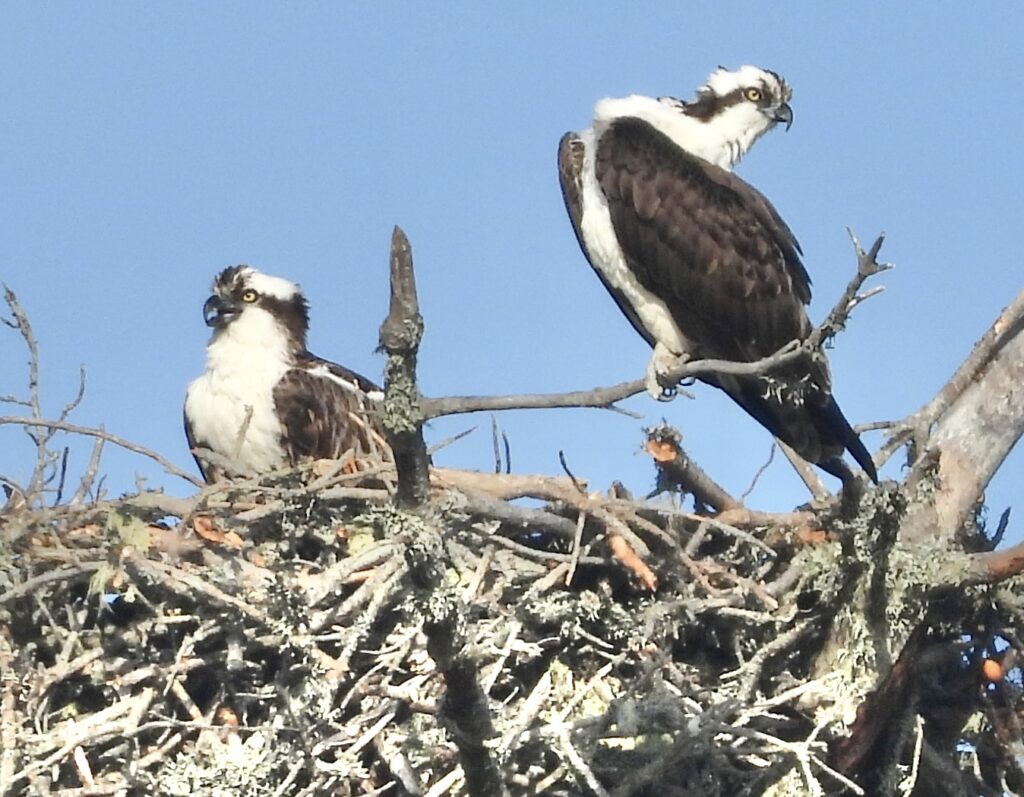
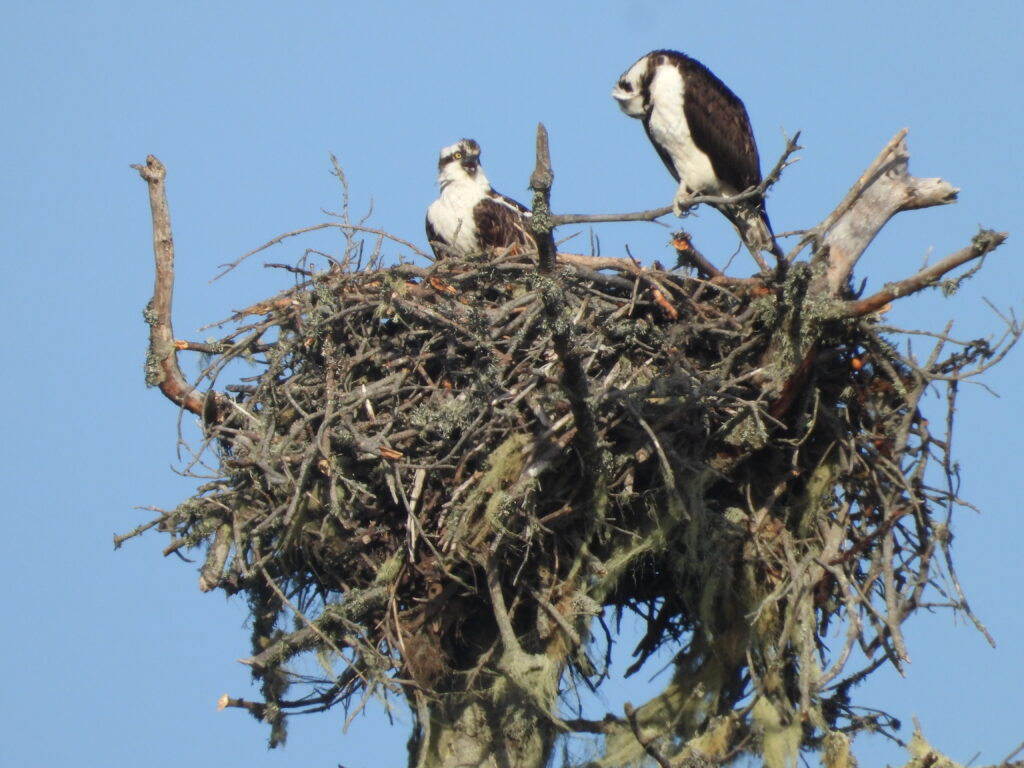
Brutus and I have two new friends in Caspar. George and Gracie the ospreys. A young couple that just moved into their parent’s massive treetop nest house. They were calling to each other as one stayed at the nest and the other flew off and brought back stuffing for the nest. Ospreys are literally coming home in many cases. They are taking up nests that they and their parents and grandparents may have worked on. Osprey, sometimes called seahawks or fish eagles, are neither hawk nor eagle in reality, they are ospreys. They are known to be better at catching fish than hawks, who have to use their beaks to do so. Ospreys have two backwards toes that aid in catching fish on the fly. One scientific study found that the osprey he studied caught a fish in an average time of 12 minutes. (That’s about as much time as I spend untangling my line before my first case). Eagles also use their feet to catch fish, but aren’t quite as nimble as osprey. Eagles, ravens and other birds will often watch an osprey catch fish, then plot to steal the prize.
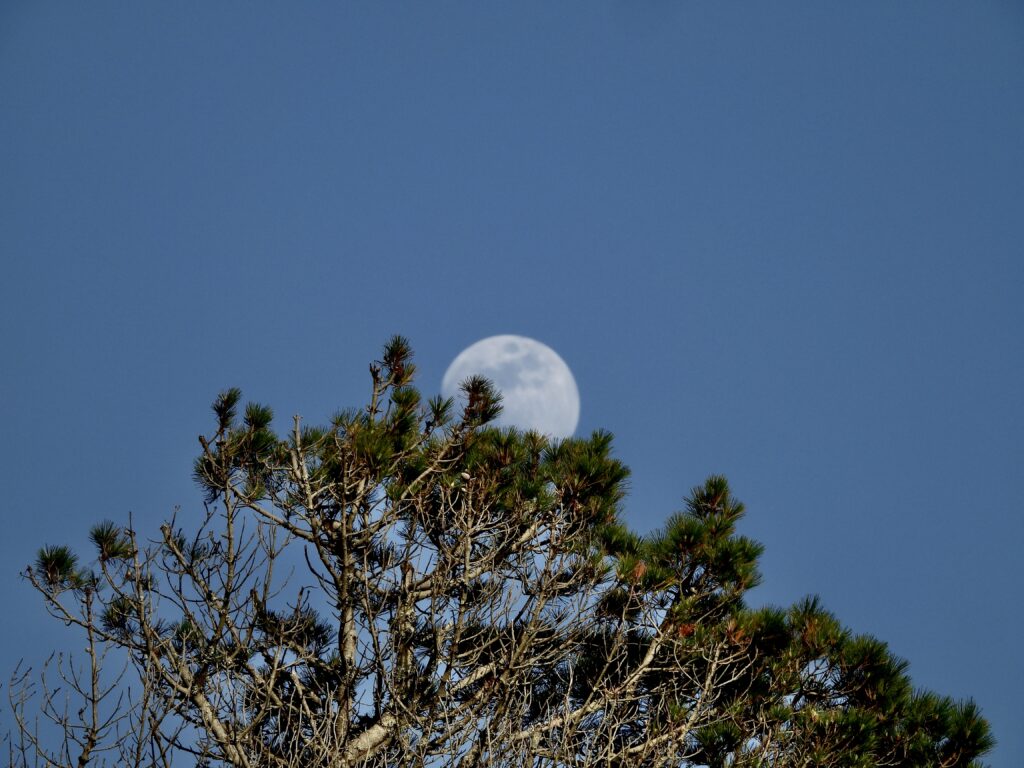
All of this really did happen in the space of an hour right by George and Gracie’s nest. The moon came up behind the tree next to theirs, or at least from my angle.
Osprey have never feared humans much, making them one of the most successful of raptors till after World War II. In the 1950s-1972 osprey numbers, along with other heavy birds like the pelicans and bald eagles, plummeted due to the use of the pesticide DDT, which made bird egg shells paper thin. With big birds, sitting on the nest meant broken eggs. DDT hits the birds at the top of the food chain the hardest, as it concentrates in the bodies of insects, then whatever eats the insect, all the way up. The fish that pelicans and osprey ate were loaded with the pesticide. Banned in 1972, osprey numbers started to climb again.
Osprey were decimated in the Central Valley, where lots of DDT was used. Many osprey, like the Pomo and Yuki peoples of old, would winter over the hill and dine on the bounty of the sea in spring and summer.
While osprey can be seen here year round, scientific studies I found say these couples migrate here, most often from Central and South America! Some come from California’s Central Valley. Mexico and Chico! The same places the people come from who love Fort Bragg!
I LOVED to hear the sound of osprey when I had my big chicken farm by the sea. All the other chicken-eating hawks would run away when the osprey flew over. And the osprey doesn’t eat chickens. They will snatch a rat now and then or a rabbit, but seem to eschew eating other birds.
Osprey mate for life and will often return to the same nest year after year, meeting there like two lovers returning to the Heritage House. When they get back together at the nest, they will often air dance in joy. These two didn’t do that. He seemed to be bringing seaweed or lichen to the nest. Being a poultry man I can tell they were making joyful cries to each other. She would yell for him each time he flew off then he would give a yell upon return and they would sit together in the nest. While osprey are usually the baddest bird in Mendocino County, a biologist told me that osprey up 10 mile River had to find a new nest when a pair of bald eagles came and kicked them out.
There is always somebody bigger and badder than you.
In Sonoma County, the Department of Fish and Wildlife documented a bobcat climbing the tree and eating one of the parents on the nest.
This was certainly a couple. I couldn’t tell which was the wife and which the husband, so I picked George as the one bringing the seaweed and stuffing for the nest and then falling asleep while Gracie was talking.
I wrote a dialogue for them
George, you are not sleeping while our nest is unfinished are you?
Gracie., who is that over there? What is that horrible noise?
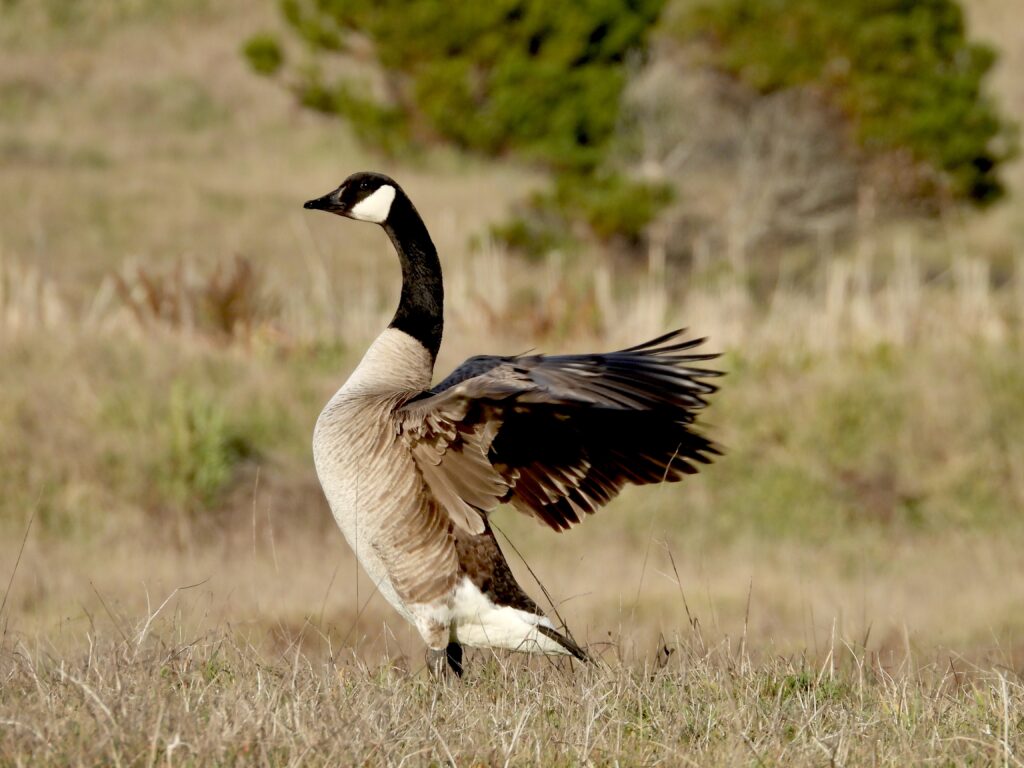
It’s a goose, George.
Hey Gracie can you turn your head backwards like this????
George, a pack of wolves is coming! What do we do?
Gracie, its an ambulance
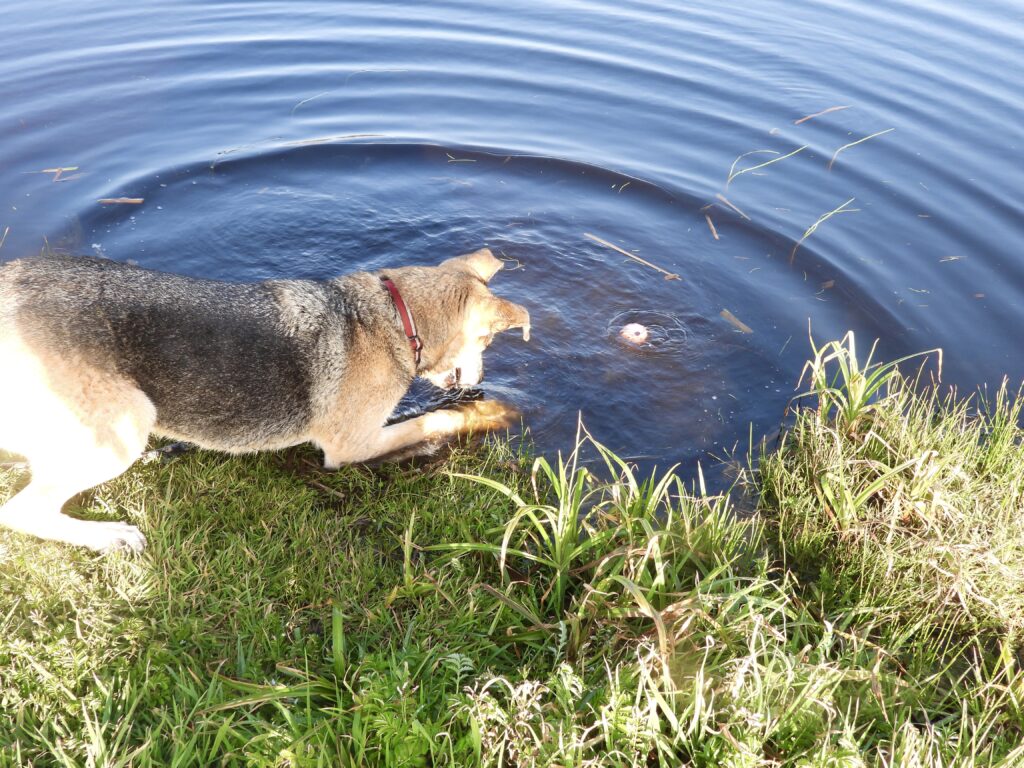
Gracie, what is that swimming in that pond? Is it a bobcat?
Its a dog George, bobcats dont swim.
Hey Gracie, look what I can do with my head? I bet you can’t do this!
George, are you sure you are ready for a family?
George are you listening to me? Say goodnight Gracie.
Ill be bringing you more adventures of George and Gracie as the year progresses…
Ship strike likely killed beached young fin whale
MENDOCINO CO., 9/17/24 — A team of researchers armed with long knives, scalpels, and other surgical instruments descended on 10 Mile Beach north of Fort Bragg Monday. A juvenile female fin whale, measuring 40 feet in length, had washed up on the beach. Before the team from the Marine Mammal Center in Marin County began its cutting and measuring and sampling, intestines were seen 30 yards south of the carcass while blubber was found 30 yards north. She was likely killed when hit by a ship, the leading unnatural cause of death among fin whales.
“The preliminary cause of death for this whale is ship-strike blunt force trauma. She was in excellent body condition and had no evidence of preexisting illness,” said veterinarian Pádraig Duignan, director of pathology at the Marine Mammal Center.
Prior to the necropsy, the fin whale is inspected early Monday. A rope was tied to the whale and also to a large piece of driftwood, apparently to mark the carcass if it were pulled out to sea. (Frank Hartzell via The Mendocino Voice)
Fin whales can live more than 100 years and aren’t fully mature until age 25 or more. They are the second largest animal on earth, following their distant cousin the blue whale.
The carcass had much to teach scientists, The Marine Mammal Center team conducted a full necropsy, working in ankle-splashing water in the early afternoon and on the beach until dark, as the tide continued to go out. One scientist said this was a once-in-a-lifetime opportunity to study a recently deceased great whale. The carcass had not begun to stink but horrid smells emerged as they opened up the dead mammal. Volunteers from the Noyo Center for Marine Science helped with the fast-paced study, with some people cutting and others taking pictures or sampling.
Shalina Peterson, a curatorial assistant at Cal Academy of Sciences and a volunteer necropsy technician at the Marine Mammal Center, pauses her work on the female fin whale carcass. (Frank Hartzell via The Mendocino Voice)
The word was soon out on social media, and people arrived throughout the day to photograph the scene. Several set up chairs on the bluffs to watch the fascinating work. On another bluff, eight vultures in a row watched, waiting their turn, while others circled above.
Some were horrified by the sight. Scott Taubold of Fort Bragg came upon the necropsy during his morning bike ride. He went home sad, saying he couldn’t even bring himself to take a photo of the dead whale and the researchers.
Eight people work simultaneously to perform the necropsy on the fin whale in windy conditions with whitecaps on the ocean and fog on the distant coastline. (Frank Hartzell via The Mendocino Voice)
Whales stay with their mother for up to two years. Although this whale was barely bigger than a “toddler”-aged fin whale, consider this whale more like a teenager. “She was a juvenile animal and not likely dependent on her mother any longer,” Duignan said.
Much has been learned in recent years about fin whales, which were hunted from estimated highs near a half million individuals down to less than a fifteenth of that total, with numbers remaining high only in the Southern Ocean. They migrate toward both poles in the summer and toward the equator in winter. They tend to group in mid-ocean breeding grounds, a behavior that is still being studied. Scientists have found that trimmer male fin whales sometimes outswim heavier blue whales and breed with female blues in the breeding season, creating a hybrid species.
Shalina Peterson and other workers from the Marine Mammal Center in Marin County dissect the distinctive white pigmented fat of the fin whale. The whale swallows a huge volume of water and then blows the water back out through the baleen, trapping the food while the water flows out. (Frank Hartzell via The Mendocino Voice)
Their songs have become a scientific sensation in recent years with many trying to understand single-note repeating articulations. They and blue whales make the lowest frequency sound of any animal on earth. Full-blood fin whales can be distinguished by their dorsal fin (hence the name), which is shared by their only other cousin, Bryde’s whales, which are not found off California. Their most obvious feature is their two-color body and head, with alternating patterns of gray and white. Scientists were cutting and bagging the uniquely dazzling white baleen on Monday afternoon.
Strong winds made whitecaps just offshore from the whale stranding. (Frank Hartzell via The Mendocino Voice)
The fin whale is listed as endangered under the Endangered Species Act and depleted under the Marine Mammal Protection Act. This is primarily because of the low population numbers in the Atlantic Ocean off the eastern United States, where it has been intensively studied. The population numbers have not been studied as much off the West Coast, where it is believed to be doing better.
The fin whale population today is estimated to be 14,620 to 18,630 in the North Pacific; 3,590 to 6,300 in the western North Atlantic; 10,500 in the eastern North Atlantic; and 85,200 in the Southern Ocean. Fin whales’ habit of mass feeding on krill in the Southern Ocean has created conflicts with the fishing industry. Japan announced this summer that its whalers plan to hunt fin whales again in the Southern Ocean, creating outrage in the world environmental community. Greenpeace activists on ships battled Japanese whalers for decades, in addition to whalers from Norway and Iceland, the only other two countries still whaling. Whaling caused many whale species to go extinct and all others to be pushed to the brink before whaling began to be heavily regulated in 1946 until almost all whaling stopped in 1986.
Ship strikes are the number one cause of fin whale premature deaths worldwide, according to scientific studies. Fin whales are uncommonly seen along the Mendocino Coast, while gray whales create an annual show in March and December as they wend their way back and forth from their Baja breeding grounds to their Arctic feeding grounds. No other whale species have predictable or near-shore routes. Gray whales top out at about 40 feet, the size of the young fin whale that washed up. Fin whales can reach 80 feet when mature. Blue whales can occasionally be seen, along with more common but unpredictable humpback whale sightings. Before 2005, there were rumors of orcas but no confirmed sightings. Then an orca pod started taking regular trips south, and orcas are seen every year by a few lucky people who happen to be looking when that one tribe of killer whales is passing. A sperm whale, the third largest whale, washed up on the Mendocino Coast two years ago. Sperm whales, the only predator whale among the great whales, are very rare in this part of the world.
The Marine Mammal Center usually sends out teams when marine mammals are alive but stressed or beached. Seals and otters are taken to their headquarters in Marin County for veterinary care. Assistance in getting back into the water is sometimes rendered for larger animals such as sea lions. Since 1975, the center has rescued more than 24,000 marine mammals along 600 miles of California coastline and the Big Island of Hawaii, according to its website. With a volunteer force numbering more than 1,400 and a strong donor base, the center is able to respond to marine mammals in distress.
Scientists and volunteers started work on their necropsy while waves were still splashing against the fin whale carcass. They worked all through the day as the tide receded. (Frank Hartzell via The Mendocino Voice)
Duignan said he had heard of another young fin whale washing up this year in Southern California. “The Marine Mammal Center has been doing whale necropsy response for almost 50 years so we have definitely done fin and blue necropsies before,” Duignan added. The scientists left little of the whale behind, but people continued to come to the beach until dark on Tuesday. It is a federal crime to remove the body parts of an endangered species.
The Marine Mammal Center was quickly on the scene of the fin whale beaching on Monday. The Center responds sometimes more than once per week to marine mammal injuries and strandings on the distant Mendocino Coast. (Frank Hartzell via The Mendocino Voice)Scientists and volunteers started work on their necropsy while waves were still splashing against the fin whale carcass. They worked all through the day as the tide receded. (Frank Hartzell via The Mendocino Voice)
A look inside the history and the politics of the Jackson Demonstration State Forest
THE JACKSON DEMONSTRATION State Forest was controversial from the day it was purchased in 1947 from the old Caspar Lumber Company. The government taking over private property can create suspicion, especially in those red scare days.
At the time, big lumber corporations from the Deep South and Pacific Northwest were clearcutting newly purchased lands in California. The old-growth timber resource of Mendocino County was almost entirely harvested. Replantings were either not done or were done in a nonscientific way, threatening the ecological and economic forest and causing alarm in universities, science and government.
Caspar Lumber remained one of the few large operators that was locally owned, with a famous annual family picnic. It was relatively responsible, practicing some selective logging in an age of bulldozer clearcutting.
Then came the creation of California’s demonstration forest system with four big land purchases by the state in the late 1940s. The Caspar Forest as it was known was sold to the state and renamed the Jacob Green Jackson State Forest to honor Caspar Lumber’s founder and later renamed again to Jackson Demonstration State Forest (JDSF).
Milling operations at the Caspar Lumber Company in the early 20th century are documented in framegrabs from undated film. (San Francisco Maritime National Historical Park, CC0)
Jackson Forest came with the promise to be a nursery to millions of trees for all lumber companies to plant. Under government ownership, logging continued with an open bidding process that was new to local timber companies.
The public expected access to the new public lands, which was often difficult because of ongoing timber harvests. Old newspaper accounts reveal disputes among timber companies, off-road enthusiasts, and adjacent property owners. Walking the forest, ghosts of these grudges are still visible, with huge rocks placed to block a road or a fence wire entangled in a wall of trees to stop a rival user from going too far.
Oceanfront property acquired through a trade
In 1972, State Parks gave up one of the best stretches of timberland in the JDSF in a trade with timber company Boise Cascade. Boise got 978 acres of 20 million harvestable board feet of timber in exchange for 658 acres of oceanfront real estate, most of that being the north end of MacKerricher State Park in Fort Bragg. The trade also gave the public agency 70 acres that comprise the Mendocino Headlands, the entire oceanfront area west and north of the town of Mendocino.
It’s hard to envision the coast now without the long beaches and dunes of MacKerricher or the spectacular headlands. Even today, environmentalists think the planet got the best of that deal despite the big redwoods that were lost. The dunes and the bird nesting and breeding and resting rocks on the headlands are considered critical environmental reserves.
Lupines bloom at Mendocino Headlands on May 15, 2001. The 70 acres that comprise the headlands was acquired by the State Parks system as part of a 1972 land swap that gave 978 acres of harvestable timberland to the Boise Cascade company. (Sharon Mollerus/Flickr, CC BY)
But clearcutting elsewhere in the county had dire environmental consequences. The Coho or Silver Salmon was the prime fish of the Mendocino and Sonoma County coasts until intense logging silted the rivers and streams. The ferocious fish was put on protected lists, and all fishing of it has been banned in California. In some cases, environmental agencies hastened the Coho’s decline, with misguided policies like attempts to clear streams of mud, when in fact stream clutter was needed that would allow spawning areas to develop naturally.
“Scientific” logging continued largely unquestioned in the JDSF through the ’80s until the dramatic rise of the local environmental protest movement, precipitated by what they saw as the excesses of timber cutting by many companies, including Charles Hurwitz and his Maxxam Inc. in Humboldt County.
With the old growth almost entirely gone in Mendocino County, the last stands in Humboldt County became much more valuable and suddenly passionately defended. This culminated in Redwood Summer in 1990, when protests all over the region grew to international notoriety, with environmentalists doing tree sits and chaining themselves to trees. Some were accused of employing sabotage like filling tractor engines with sand and even imbedding tree spikes in trunks. Leading environmental activists Daryl Cherney and the late Judi Bari were injured by a car bomb in a still-unsolved case. It all boiled over with a showdown between loggers and environmentalists in the middle of downtown Fort Bragg that was featured in a famous photo in the Santa Rosa Press-Democrat, showing waves of people coming at each other from opposite directions in a loud and angry standoff.
Environmentalists flex legal muscle
Environmentalists began disputing timber harvest plans all over, especially on public lands like the JDSF, where they claimed the California Department of Forestry (CDF) was a mere servant of timber companies. Legal actions that started in the late 1990s challenged laws that allowed CDF-Cal Fire to skip environmental impact reports and use their own Timber Harvest Plans to get through the revered and feared CEQA process (California Environmental Quality Act).
Opponents managed to stop all logging in the JDSF during most of the first nine years of the 21st century. A compromise created the Jackson Advisory Group in 2008, and the JAG was allowed to review and modify timber harvest plans.
But a few years later, the State Board of Forestry, which oversees Cal Fire and state forest lands, nixed much of the authority the JAG had. Critics said the board stripped the JAG of authority to regulate the harvest plans. Demonstration Forest Program head Kevin Conway and JAG members say many changes continued to be made voluntarily with JAG input. But the JAG never said no after 2011 to a timber harvest plan, and it was composed mostly of people from logging backgrounds.
Over time, the term “Indians” was replaced by “Native Americans” and Indigenous; CDF became Cal Fire; and climate change became a major question with forest carbon sequestration as a possible answer. A $100 million-plus carbon credit industry emerged in Mendocino County, with at least one Tribe among those taking the lead on this new way of using the forest. The biggest timberland owners became nonprofits like The Conservation Fund and the Redwood Forest Foundation Inc. (RFFI), which both also log the forests they preserve. Environmentalists pushed to broaden the JAG to include more community members. That compromise was made but local environmentalists like Bill Heil and Anna Marie Stenberg continued to view the JAG as a “rubber stamp” for Cal Fire.
Fire crews perform a prescribed burn to reduce fuel in the Jackson Demonstration State Forest on May 30, 2024. Following devastating fires throughout the state over the past decade, Cal Fire is taking measures to make forests more environmentally friendly and less fire-friendly, like removing invasives and cutting slash into small pieces. (Cal Fire/Flickr, CC BY-NC)
Then in the second decade of the 21st century, big fires raged and killed many people in Santa Rosa, inland Mendocino County, Paradise, and more, drawing more eyes to the JDSF, especially piles of slash left behind by “scientific” logging. Cal Fire became more communicative. On a recent forest tour, a Cal Fire forester described all the measures to make slash more environmentally friendly and less fire-friendly, like removing invasives and cutting slash into small pieces. At least one longtime critic on that tour said they hadn’t known the extent of the work Cal Fire did to make the slash safer.
From 1900 to 2020, tribes that had historic claims to the land were not offered a hand in the actual management of the forest. They were invited to participate in various initiatives over the decades but found the rules often changed with each state governor. Big initiatives were announced with little follow-through. For First Nations, government promises needed to move beyond press releases to have any meaning.
Involving the Indigenous community
The fires made many people talk about the need for Indigenous input. Many people concluded that if First Nations had been given a role, forests might not be as cluttered and dangerous. Although the practice varies widely, Indigenous people worldwide, including in the JDSF, used brush control and other effective fire prevention methods, which had been pushed aside in the modern rush for the cash flow from logging.
In 2020, Cal Fire proposed one of the most ambitious Timber Harvest Plans ever, just after the pandemic started. No opposition came, and Cal Fire proceeded to bid the timber on a “Caspar 500” plan, which proposed cutting big redwoods close to sprawling rural properties in the unincorporated community of Caspar, long known as a retreat for hippies and musicians famous and otherwise. Also in 2020, Newsom issued his directive that the state find a way to co-manage with tribes, Statement of Administration Policy Native American Ancestral Lands.
A bullet-ridden Witness Post (an archaic term for a survey marker) in the Jackson Demonstration State Forest (JDSF) lies shot up on the ground in Mendocino in an undated photo. The sign bears witness to a 75-year battle between landowners, California Department of Forestry, Cal Fire, environmental activists, recreational enthusiasts and loggers. (Frank Hartzell/Bay City News)
When Cal Fire started marking the trees to be cut in the Caspar 500, a protest movement not seen since Redwood Summer came bursting into the forest. And this time, Native people and leaders of one prominent tribe were involved. People chained themselves to trees again. They went out into the forest where timber fallers were working, risking trees falling onto them and causing logging companies to stop work. Security guards were posted and patrolled 24/7.
As quickly as the saws started up, protests interrupted the work and cutting was halted.
Today, there is no timber harvesting. A co-management process is underway that gives new authority to Native Tribes, but which is also criticized as an effort to restart timber harvests.
Cal Fire and the JAG have moved meetings out of the boardroom and into the forest more often, where they are hashing out how logging, climate change and co-management can work.
Otter we bring back sea otters? US Fish & Wildlife seek input at Fort Bragg open house June 26
FORT BRAGG, 6/24/23 — Topics to avoid in Noyo Harbor include religion, politics and… sea otters.
Fishermen argue that bringing back otters would destroy the local abalone, crab and urchin industries. Environmentalists say otters belong off the Mendocino Coast and could make its entire ecosystem healthier.
This same debate over whether otters should be brought back to the Mendocino Coast has raged hot for a half century. Evidence now shows that both sides could be right.
Fast forward to 2023, with the abalone population decimated and the purple urchin taking over vast areas of tidepools and nearshore seafloor. Would sea otters make this bad situation better or worse?
That’s a question that the United States Fish and Wildlife Service (USFWS) would like to get input on at an open house in Fort Bragg on Monday from 12 -3 p.m. at the Discovery Center at Noyo Center for Marine Science, 338 N. Main Street.
At the open house, there will be stations set up where people can get information on the federal process, the otter and related species, challenges to the offshore ecosystem, the Noyo Center, how to comment, and ways to keep up on what’s happening. There will not be speeches by the public.
It is one of 16 open houses being held in June in the coastal Pacific Northwest. This is part of a federal process to study the broader impacts of reintroducing the sea otter to areas of its range where it has been extirpated for more than a century. There is no plan currently to bring back otters to the Mendocino Coast. The focus for now is on the California coast south of the San Francisco Bay and the state of Oregon.
There have been recent efforts to move otters north from where they live in Central California, but those have been thwarted by an increased great white shark population, now a major factor in all otter plans. Great whites don’t even eat otters, they bite them and spit them out. Also, the area between Monterey and San Francisco doesn’t have sufficient offshore rocks and islands that otters need to march north, federal studies show.
This map, shared by the United States Fish and Wildlife Service, shows the current and historical ranges of the Southern and Northern sea otters off the lower 48 states. Southern sea otters have reclaimed about 13 percent of their historical range, including the mainland coastline from San Mateo County to Santa Barbara County and San Nicolas Island, in Ventura County. Before the fur trade, sea otters as a species ranged more or less continuously along the North Pacific Rim from Hokkaido, Japan to Baja California, Mexico. Sea otters most closely resembling today’s southern sea otters occupied the southernmost portion of that range — from at least as far north as Oregon to the species’ southern limit at Punta Abreojos, Baja California. (USFWS image)
What happened to otters?
Otters are not the only members of the weasel family largely killed off by the fur trade. Another effort is underway to put the Pacific Fisher cat on the threatened species list. And a recovery plan for endangered Humboldt Martens may be released. Point Arena beavers are currently an endangered species but their status is being reviewed.
Russian fur trading ships led the way in the 19th century in annihilating the sea otter, a weasel that lives entirely in the ocean and eats huge amounts of invertebrates, including crab, abalone, clams, mussels and oysters.
Starting in the 1700s, the fur trade killed off sea otters in a half circle around the globe from Hokkaido, Japan to Baja California. All maritime nations participated, indulging in an unrestricted worldwide sea otter massacre that pushed the species to the edge of extinction throughout its range by 1911, when only thirteen small, hidden populations of a few dozen individuals survived. At the peak of trade, most of the furs were exported to China, where otter pelts were prized among the upper classes and otter clothing was a huge fad.
Japan, Canada, Russia, and the USA signed a treaty in 1911 that banned sea otter hunting. By then, the otters were all gone anyway: No otters survived in the continental USA apart from one hidden population off Big Sur. The treaty also stopped all open water seal hunting, at a time when seals were also being hunted to the point of near-extinction.
Fur hunters killed off most of Northern California’s forest weasels, including martens and fishers. They also killed much of the mink and beaver populations. What hunters didn’t take, logging of forest habitat did. But river otters managed to survive, and are a common sight in inland creeks and rivers and along the Mendocino Coast. People often think they are seeing a sea otter because river otters like to hunt in the ocean as well as in rivers. River otters fish in the ocean, but their fishing trips are much like those of humans — one afternoon is enough. Because they lack the thick coats of their sea otter cousins, the ocean is too cold for them to live there full time. Sea otters are nearly twice as big as river otters.
California sea otters are a distinct subspecies called Southern Sea otters, smaller than the Northern Sea otters that live from Oregon to Alaska. There is also the Russian or Asian Sea otter. These three subspecies live in a continuous arc and comprise one of only two species of otters that live in the ocean, the other being the Marine otter of Chile and Argentina, which is really a river otter that adapted to the ocean and can go both ways. There are river otters on every continent but Oceania and Antarctica. River otters eat fish, invertebrates and also birds, including domestic ducks and chickens. Sea otters feed almost exclusively on invertebrates, not fish or birds.
Southern (state of California) sea otters often rest in groups called rafts. Unlike other marine mammals, sea otters do not have a blubber layer to keep warm. Instead, they rely on their fur and burning calories, which means they eat about a quarter of their body weight each day to keep that calorie count up. If people get too close while a sea otter is catching a much-needed nap, the otter will dive or swim away, burning up those hard-gotten calories. (Photo courtesy Lilian Carswell and the United States Fish and Wildlife Service)
Why did the hunters pass on the river otter?
River otters were never wiped out because they are too hard to find, their ranges too spread out and their fur not as valuable. Cal Poly Humboldt (State) University has a river otter counting and assessment program driven by citizen science. This reporter has participated in the program as otters visit the pond on my property in Cleone on a semi-regular basis. “The river otter (Lontra canadensis) is a key bio-indicator of the health of our environment as they sit at the top of this water-based food chain,” according to a summary of the Humboldt effort by professor Jeff Black. “Unlike most otter habitats around the world, it is thought that the Pacific north coast still supports a thriving otter population,” said Black’s online page. Black also studies the Humboldt Goose, the Barnacle Goose and Stellar’s Jay.
A river otter is seen eating a bird on an offshore rock at Seaside Beach north of Fort Bragg in May of this year. (Frank Hartzell-The Mendocino Voice)
Sea otters have the most dense fur of any animal, with as many as a million hairs in a square inch of their pelt, protecting them from frigid seas but making them highly desirable as fur even today. Adult human heads, for example, have roughly 100,000 hairs total even before hair loss. Sea otters are among a small number of animals known to use tools, diving to obtain both rocks to smash with and a shelled invertebrate to crush.
What will happen at Monday’s open house?
The open house follows up on a federal assessment of returning otters to Northern California and Oregon, a plan passed into law by Congress last year. The law demands a deeper study into whether this unique native species should be reintroduced to its range. The process, completed in summer 2022, found that bringing back otters would benefit all species — with the possible exception of human fishermen.
The assessment states, “On the basis of our evaluation of the biological, socioeconomic, and legal aspects of reintroduction, we conclude overall that the reintroduction of sea otters to northern California and Oregon is feasible. The ultimate success of reintroduction, however, would require additional work to overcome some challenges, particularly in the socioeconomic sector.”
Otters have already been reintroduced and made comebacks in Russia, Alaska, most of Canada and Washington state.
A second, seemingly contradictory, one-year federal process is underway, to remove the threatened status that California sea otters have enjoyed since 1977. Federal regulators found validity in the urchin industry’s claims that the California (Southern) sea otter has recovered, despite being absent from most of its range. Information will be released following a one-year study that concludes in late August: Federal Register: Endangered and Threatened Wildlife and Plants; 90-Day Findings for Four Species
How can these two processes be going on at once?
The urchin industry successfully argued that the biggest threat to sea otters — spills from offshore oil drilling — has been largely eliminated in California due to bans on additional drilling areas and safety practices in the California offshore drilling process. For many years, it was feared that one oil spill like the one that happened in Santa Barbara in the 1970s could wipe out most of the recovered otter population. Otter numbers have passed the 3000 count in Central California, a number set as the target for their return.
“In 2018, the southern sea otter population index exceeded 3,090 for the third consecutive year, meeting the threshold for delisting consideration. However, that number has fluctuated, not risen, since,” the assessment states.
Reasons the California sea otter may be kept on the threatened species list include lack of genetic diversity and the much smaller area they now live in than their traditional range, the entire coast. Although this is a different federal process, members of the public are encouraged to ask about both at the Open House.
The reintroduction of the sea otter proves to be an even more controversial topic than bringing back wolves. Those involved say bringing back otters to their entire range is more on a par with reintroducing the grizzly bear. California grizzly bears, which once numbered more than 10,000, were all exterminated by Spanish and American settlers between 1848 and 1922.
At that time, scientists and fishermen believed California (southern) sea otters were extinct. Today’s population of California sea otters are the descendants of a single colony of about 50 otters discovered near Bixby Creek Bridge in March 1938 by Howard G. Sharpe, owner of the nearby Rainbow Lodge on Bixby Bridge in Big Sur.
The massive die-offs of Northern California and Oregon giant kelp forests, primarily caused by hungry, out of control urchin populations, led to the starvation of the abalone and declines of other nearshore species. Studies have now shown that otters could help keep kelp forests alive. Another important role that otters play is keeping sea grass healthy. Seagrass beds have also suffered huge declines, as well as the fish, mollusks, and crustaceans that live in them. Seagrass beds have been weakened by ocean pollution, followed by destructive slugs —which sea otters eat and thus restore the life-giving seagrass, which also sequesters a large amount of carbon.
How much could sea otters help an ocean compromised by a century of reckless pollution and overfishing? The Biden Administration’s assessment seems stuck on finding an answer in conventional wisdom about the environment — either make it off-limits to humans or allow fishing.
Could environmentalists and fishermen both have it wrong about sea otters? Yet scientific studies have shown that humans were a key part of the environment for 10,000 years of harmonious living between otherwise seemingly incompatible species such as abalone, crab, and sea otters.
Native Americans were the stewards of sea otters and their invertebrate prey for millenia, only to see the fur traders and European settlers annihilate the majority of mammal species they had lived with and hunted sustainably.
The otter population has exploded in Alaska since it was reintroduced there in the 20th century, crimping the crab fishery and causing some Natives who had favored reintroduction to rethink their positions.
The U.S. Fish and Wildlife Service does not make any recommendation in this report as to whether reintroduction should take place. That will depend on many factors, including input such as at Monday’s Open House in Fort Bragg. If the initiative were to move forward, additional information and input by local communities, environmental groups, fishermen and others would be needed to help inform any future reintroduction proposal, a summary of the process states.
Meanwhile, a serious effort is underway that could bring sea otters back to Oregon. That is led by the nonprofit Elakha Alliance, but no similar public effort is underway in California.
There have long been reports that the Monterey Bay Aquarium will seek to restore otters to San Francisco Bay as soon as feasible. These efforts are encountering less resistance from fishing organizations than in the past, backers say.
A sea otter eats a crab in Monterey Bay. The otter’s need for huge amounts of food every day has made the ocean-going weasel unpopular with the fishing industry. (USFWS photo)
If sea otters returned to the Northern California coast, there would be big impacts on crab fishing, abalone populations and sea urchin numbers, scientists and fishermen agree. But recent scientific studies have hinted that if the sea otter does not return, the kelp forest might not recover.
European settlers hit the entire California ecosystem like an atomic bomb, killing off dozens of land species like the plentiful pronghorn and tule elk within a few years of their arrival. Stream-fouling logging and widespread development reduced the salmon to a pittance and endangered local Coho salmon. Abalone were killed off everywhere but north of San Francisco. They survived as a delicacy when only recreational harvesting, not commercial, was allowed from the 1950s forward.
But the cascade of problems created by imbalance became evident in 2013 when the starfish population was hit by wasting disease. This led to the die-off of starfish including the Sun Star, which had been the predator that controlled sea urchins after the fur trade killed off the sea otters. Urchins destroyed the kelp forest, a resource as significant as redwoods. This caused death down the food chain, including wiping out most of the abalone population and ending that lucrative and delicious recreational fishery, which was closed five years ago with no sign that abalone fishing will ever come back.
Now there are urchin barrens where kelp forests rich with mussels, abalone, fish, crustaceans and a wide variety of life once prevailed. These creatures are slowly starving to death, but that could take decades. In the meantime, even the otters will not eat these urchins, as they have no food value. There are efforts by divers up and down the California and Oregon coast to clear these urchin barrens. Comments provided to the federal sea otter process show many think the answer may be otters. Sustainable Native hunting kept many creatures that live with humans from overwhelming all the rest. Modern civilization has finally caught up with Native practices, such as managing forests with periodic fires. Could otter hunting be needed to bring back the balance?
Biologists and government authorities in Alaska actually revived the fur trade to limit sea otters until that was banned by the Marine Mammal Protection Act (MMMA) in 1972. Alaskan crab fisheries have been decimated by sea otters. Natives in Alaska and Canada have rights to take sea otters but not sell pelts. Some say a hunting season would be needed for otters to coexist with California and Oregon invertebrate fishing.
The assessment passed into law by Congress, the law which led to the open house on Monday, points out the MMMA creates other problems for otter reintroduction, such as an extremely difficult process to adjust and move and “take” the otters once released. Many otter reintroductions have gone awry when otters went looking for their old homes. The Monterey Bay Aquarium is using a process of taking orphaned otter pups and rearing them in captivity without exposure to humans, then releasing them in the wild. From 2002 through 2015, 37 rehabilitated southern sea otter pups that had been raised at the aquarium were released into Elkhorn Slough, an estuary off of Monterey Bay, and closely monitored as part of a special study. This has shown greater promise than relocating homesick adults, but could run afoul of the MMMA.
“The pups were purposely reared with non-releasable female sea otters as surrogate mothers to ensure they were properly socialized and learned essential skills,” the assessment said.
Great whites attack and kill many sea otters but spit them out, apparently not liking the taste after mistaking otters for seals. In fact, many studies have shown the California sea otter has not been able to migrate north from Monterey toward San Francisco Bay for two reasons, great white attacks and lack of enough offshore rocks. Otters don’t live well on straight coastlines and the assessment concludes places like Sonoma and Mendocino counties probably never had a lot of otters and probably won’t support many in the future. In fact, the assessment found that San Francisco Bay, with all its inlets and hiding places, could support more otters than all of the Northern California coast.
Josie Iselin, author of The Curious World of Seaweed, and other books, said objections by the fishing industry may be overstated. She said invertebrates like crab and abalone can live in deeper water, where otters may not be able to dive. How deep otters dive is another unknown. While otters have been observed diving as deep as 250 feet, most don’t go more than 50 feet deep to forage. Abalone are found to a depth of about 150 feet, while crabs can go as deep as 300 feet. But each variety of otters and invertebrates have different habits. More than 150 species of prey have been identified, but otters’ food varies from place to place. One reason there is a desire to broaden their range is to make them more resilient to a wider variety of foods and habitats.
Many answers are emerging about the interrelationship of all the intertidal species and their value to each other and the future of the fisheries and the planet. At a scientific conference in Oregon on the sea otter plan held in October of last year, most of the discussion was not about sea otters but all the creatures that make up the kelp forest. This reporter attended by Zoom. One presentation focused on whales and the surprisingly important role whale feces play in the ecosystem. Scientific studies made since the 1970s documented the steady decline of the kelp forest due to overfishing, extraction of invertebrates, minerals and uses ranging from war games to undersea cables. This didn’t seem as alarming until the system collapsed due to temporarily warmer waters and starfish-wasting disease. But just bringing back the starfish won’t fix a collapsing pyramid.
Iselin has coined the term “resilience mining” for the extractive process that ocean resources have undergone. Putting back just one species in a drained system isn’t usually enough.
“We have had resilience mining from these resources for 100 years. Now, how do we put it back in?” Iselin said in an interview.
The government assessment estimates that the total cost of sea otter reintroduction will range from $26 million to $43 million over a 13-year period. This estimate includes pre-reintroduction habitat evaluation (three years), acquisition and release of sea otters (releases of wild captured otters over five years and/or surrogate reared otters over 10 years), habitat and population monitoring (10 years), and postmortem and oil spill response programs.
“The reintroduction of sea otters to Northern California and Oregon would result in significant conservation benefits to the species, in particular to the threatened southern sea otter, and to the nearshore marine ecosystem,” the assessment concludes.
There is also an effort underway to protect fishers, an inland weasel cousin of otters. Mendocino’s forests are home to rarely seen fishers, including at times on the coast. The U.S. Fish and Wildlife Service today agreed to reconsider whether West Coast fishers in Northern California and southern Oregon warrant protection under the Endangered Species Act. Fishers are relatives of mink, otters and wolverines, and live in old-growth forests. The Service has until Aug. 21, 2025, to decide whether to protect them after a successful legal action by environmentalists.
The Humboldt marten, a type of fisher, was thought to be extinct until a population was discovered in 1997 and again about a decade later. The Humboldt Marten is a subspecies of the Pacific Marten, which is not endangered.
There is also an effort underway to review the status of the federally endangered Point Arena mountain beaver, a rodent but also hunted nearly into extinction. That five-year process concludes this year but no updates were available. More information here: Species Profile for Point Arena mountain beaver(Aplodontia rufa nigra)
In confusing vote Ft. Bragg Council halts formula businesses inland, allows in coastal zone — to outlaw feeding ravens, other animals — will open lobbies, return to in-person meetings
FORT BRAGG, 4/13/21 — In a bizarre split decision, forced by procedural requirements, the Fort Bragg City Council on Monday night voted to enact an emergency moratorium on formula businesses for inland areas of the city, while voting against creating a nearly identical moratorium for areas of the city in the coastal zone, during a Zoom meeting that lasted for more than three hours.
Two emergency ordinances were put on the agenda last week to accomplish the goal of delaying formula business approval until the city can complete its criteria for dealing with this type of business. Two ordinances were needed, rather than one, because land in the coastal zone also requires sign off from the California Coastal Commission.
The emergency ordinance for the coastal zone area would have applied to Grocery Outlet’s application in the Coastal Zone area, planned for the end of South Franklin Street. But with no emergency moratorium in place for the Coastal Zone, that application will now proceed normally through the permitting process.
The inland area moratorium puts a moratorium on the Dollar General Store planned for South Franklin and Maple streets. Those are the two formula business applications currently before the council. So-called “formula businesses,” which include franchises and other types of chain stores, have been controversial locally. Fort Bragg is one of very few communities that has retained a majority of locally owned businesses, while franchises have taken over most communities. Locals have fought off many plans for formula business over the years, from K-Mart decades ago, to more recent denials of Grocery Outlet (which reapplied at the new location) and AutoZone, which was denied in January 2020.
Both chain stores are in the midst of their application process with the city. The new moratorium, which applies to Dollar General, allows the city to continue to move forward with the application process for that business and any other formula businesses that might apply, but wouldn’t allow final approval until after the 45 day emergency moratorium, which can be extended or canceled by the council at any point. There is no moratorium for the Coastal Zone areas.
The inland/coastal split happened partly for procedural reasons. The Council voted 4 to 1, with Mayor Bernie Norvel dissenting, to enact the inland area moratorium. Then Norvel excused himself from the discussion of the Coastal Zone moratorium , saying he lived near the Grocery Outlet. Because an emergency moratorium requires 4 votes, the second vote needed to be unanimous. Councilmember Marcia Rafanan, who had supported the inland ban, quickly indicated she would vote against the ban for the coastal zone. She did, resulting in a 3 to 1 vote in favor of enacting the second moratorium, which was the equivalent to a “no” vote since four “yes” votes were needed to pass.
The emergency moratorium vote came after a year-long process, which was delayed by the COVID-19 pandemic, in which the Planning Commission defined formula businesses and recommended the plan that was halfway accepted by the council Monday night.
Councilmember Lindy Peters argued in favor of both moratoriums so that the city could give developers a consistent target and provide a consistent set of rules to applicants.
“A lot of people might change their minds about this issue if it was a Trader Joe’s that was coming, rather than Dollar General. But see, we as councilmember decision-makers and ordinance crafters, we can’t be selective,” Peters said.
“I have seen developers put a lot of money into a project, expecting to get approval, because they feel as though they followed exactly what they were told by our planning and development department. And then in the end, the project gets shut down,” Peters said. He said the council needed to set up a process that developers could rely on and be “off to the races.”
Vice Mayor Jessica Morsell-Haye supported taking the time to make it clear what the community and city want in new applicants
“I think we need to hit pause and make sure that we can really finish it up and give folks a clear direction about the metrics we’re going to be using to determine whether these businesses that are coming in are going to be beneficial to the community at large. So I do support [the moratorium],” she said.
Mayor Bernie Norvel opposed an emergency moratorium to give the city time to create rules that would apply to businesses that have already been in the application process.
“I think it’s bad business. And I think it’s government at its worst to put a stop to something without really an end date. So I am absolutely not in support of a retroactive moratorium,” Norvel said
“The policy isn’t the issue. It’s the out of the blue, retroactive moratorium that in my opinion appears to be to stop these businesses. And I’ve got a real problem with that,” Norvel said, before the 4 to 1 vote that created the emergency moratorium for the inland areas of the city.
Councilmember Marcia Rafannan pointed to the popularity of the Grocery Outlet proposal after Norvel left the meeting and the vote turned to the Coastal Zone application.
“I do not see the need for having a moratorium for Grocery Outlet for the coastal zone. It’s already tough anyway to build something there, and Grocery Outlet has been in the process for a while now, and the public sounds like they need it and want it. So, yeah, I’m not in favor of the moratorium,” said Rafannan.
Other matters
In another matter, the council decided to draft an ordinance to ban the feeding of wildlife in city parks. The feeding of ravens and squirrels has threatened other wildlife and the ravens and squirrels themselves, the council heard. Ravens are creating problems with wildlife all over the nation, as their populations have grown as they have adapted to humans better than most birds They are among the most intelligent of animals on earth and hunt collectively for the young and eggs of other birds. Ravens have killed off endangered turtles in the Southern California desert and pushed snowy plover nearer to extinction in the Pacific Northwest.
Tim Bray, president of the local Audubon Society thanked the council for addressing the problem.
“I would just reiterate that it is serious and has negative consequences for the ravens and the squirrels themselves, and even more so for some of the other species of wildlife in particular, our iconic black oystercatchers that nest and raise their young on the rocks just offshore,” Bray said.
The council gave staff direction to draft an ordinance that would allow local fines. They also directed new signage and education efforts. It is already against state law to feed wildlife.
City Manager Tabatha Miller said the city had sworn in three new police department members: Jarod Frank, Antoinette Moore, and volunteer Patrick Smith, who will act as chaplain.
Miller also told the council that city hall will reopen on Tuesday, along with the police department lobby, both to go back to normal hours. City hall will be closed on Wednesdays, with the police department lobby to be closed on alternating Fridays. Temperature checks will be done on people entering the lobbies and masks will be required.
Both were closed to walk in traffic during the pandemic. The police department will start doing fingerprinting services again next week, a service needed by local employers and job applicants, among others. Miller further announced May 10 is planned to be the first live city council meeting since last summer, when one meeting was held for the busiest council meeting of the year, on the name change issue. Prior to that, all the meetings since March had been held remotely.
“One of the challenges here is we’re still going to plan on having some version of a hybrid, so that those members of the public and even potentially members of the city council or staff who are not comfortable attending a live meeting will still be able to use the Zoom platform,” Miller said.
“The seating will be limited. We’ll probably have a third of the seats that we normally have. It’s being set up by our public works department now,” Miller said.