Big crowd turns out to support off roading track at Summers Lane reservoir site- process just starting
A big buzzing crowd of off-road motorcycle fun lovers showed up and begged the Fort Bragg City Council to make their long-time dream come true and develop an off-road riding track as part of the recreational amenities to be developed with the three new reservoirs off Summers Lane.
We at Mendocinocoast.news think this is a terrific idea that the city must make work!!
The area from about a mile east of Highway 1 along the north side (mostly) of HWY 20 is already used as an off-road biking area. Creating a 20-acre track among the square mile of scrubby forest being developed would actually reduce the damage done by bikers riding through timberlands and other unofficial venues.
The Council voted 5-0 to put the idea of an off-road track and possibly a tube track into the EIR for the development of the new reservoirs and recreation amenities the city wants to build on 582 acres of land it purchased from the Mendocino Coast Recreation and Park District.
But this comes with a huge caveat. The bike riders need to form a non-profit or a contract process for a company to do a very big job- make sure environmental damage, damage to the neighbors’ property and law and order are followed. They need to help keep this new entity from scaring, intimidating and destroying the environment and hikers, horseback riders, and kids on bikes, all of whom also deserve to benefit from using. They also need to keep out dirt bikes with the super noisy mufflers and be very much into fire prevention. The Redwood Shooters have been very active in curtailing bad shooting behavior in Jackson. We need more of that!
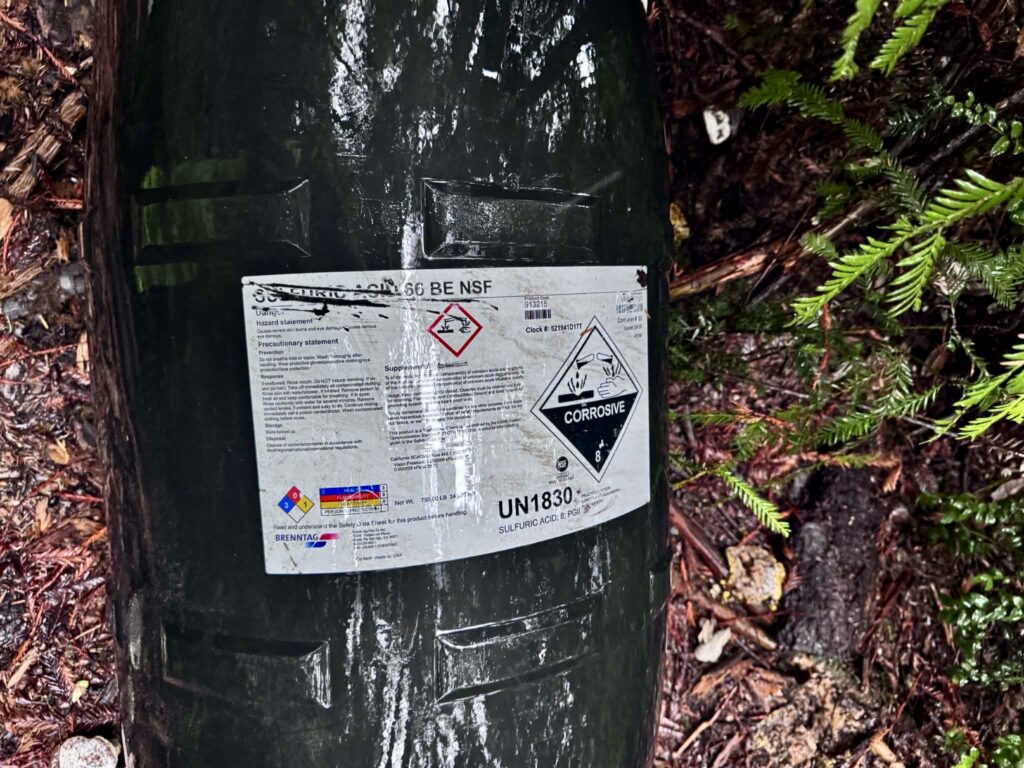
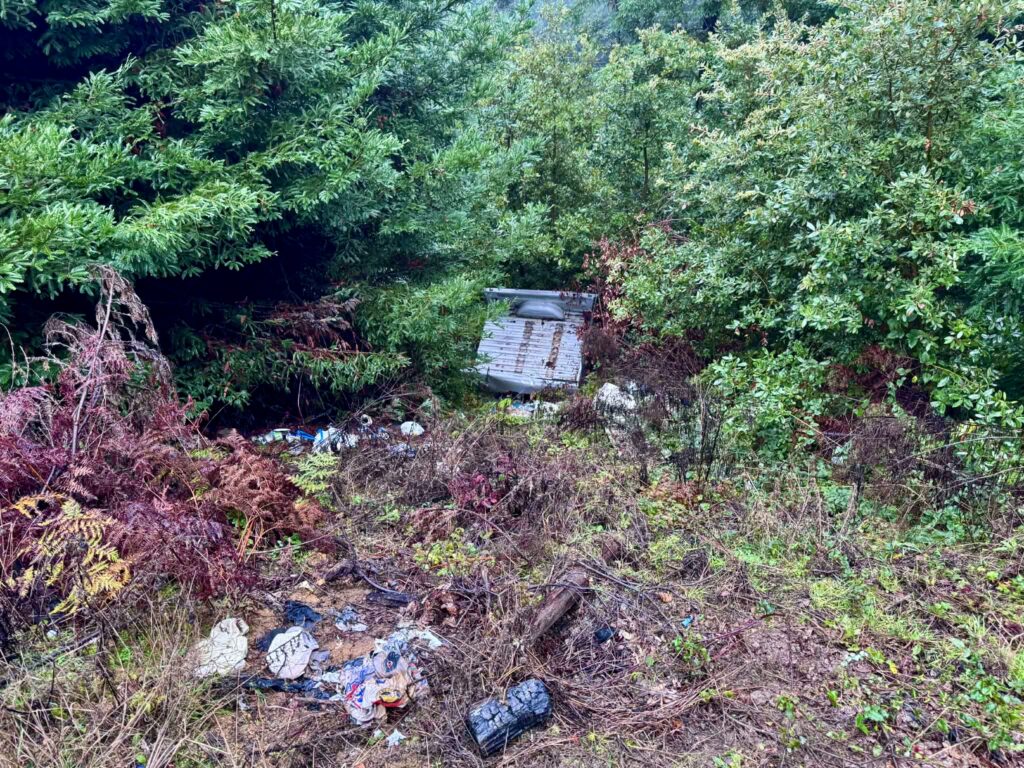
This is one of the sulfuric acid barrels that some jerk threw out into the public forest, part of a wave of trash dumping that has forced Cal Fire to close the main road through the western part of Jackson forest. .If you know who did this, call the sheriff’s office and also call us. We could sue whoever did this if no charges are brought. We have to stop this kind of crime if we want a track.Cutting an old growth redwood tabletop from a roadside stump is a crime. It’s one that cannot be done without a vehicle, skill, and good power tools. Closing the main road through Jackson may stop this and keep those with limited mobility out. The guy sells these and everybody knows it. It has to stop. Help from those who want responsible use (like those who backed a dirt bike track at Monday’s meeting) is needed.That’s a discarded pickup bed thrown into some beautiful rhodies. Closer to the road, a bunch of horrible, gross stuff was dumped. Who do you jerks that do this think is going to clean this up? Why aren’t more people who love recreation and the outdoors involved with turning these bozos in? Join Mendocinocoast.news. Report!! Sue them!
Let’s do and keep involved with the council process!
The council was not there to say yes or no to a dirt bike track as part of the reservoir project. The meeting was intended for the council to put checks next to ideas of what might be included in the Environmental Impact Report for the project.
The council members were all for it. City staff had told the council that it would be best to check yes next to any idea they might want, because to add an idea back in later might result in a new EIR having to be done, greatly increasing the cost. The current EIR contract is approximately $600,000
So the council enthusiastically put the track in as a possibility. They did not want to put sports fields into the EIR. Councilmembers said fields were badly needed but would demand water and they did not want to commit new water at the site. Speaker Jacob Patterson had supported the dirt bike tracks because they did not require water. Council member Lindy Peters seized on this idea as well and said that was why he couldnt support anything that requires grass and irrigation.
“I think it goes without saying that this town is starved for activities in general, especially for youth,” said local resident Ross Koski
Koski said he was going to politely decline the admonition of no applause during public comment to show how strong the support for an off road was at the meeting.
“Mayor Godeke, you did say you didn’t want people to applaud or make noise, but I would remind the room that the city council seemed a little confused about why people are here, and it is our first amendment right in a public meeting to express ourselves however we like.”
Koski then turned to the big crowd “So maybe if everyone who’s here who wants this to be developed into an off road vehicle track, just let the City Council know.”
A huge round of cheering followed from the full house at Town Hall. They were out in force and for the track. But its true, if somebody had been in the crowd who was against it, they might not have felt comfortable speaking. There have been opponents over the years and they will come out in the process for sure. Several people with property adjacent to the reservoir acreage spoke in favor of a dirt bike track.
Godeke said the admonition was optional and was designed to prevent people on any subject to be able to speak without feeling intimidated by a crowd.
This was the admonition he issued at the start of the meeting, which the council has pretty much always said.
“We would also appreciate if, applause is avoided, because that can be intimidating for people who have different points of view. And we want to be welcoming to all kinds of points of view. So if we can limit, if you, if you want to acknowledge, you can also, you can always do that kind of thing, but it’s better not to better not to applause.”
Fort Bragg resident Will Harris, said he is a professional geologist, a certified engineering geologist, and for the better part of 20 years, worked with California State Parks to design sustainable trails for motorized recreation, spoke strongly in favor of putting plans for an off-road track into the environmental impact report for the proposed reservoirs. Harris said he had looked at the site and it was ideal for a track from all points of view.
“ I found it to be an ideal setting. Also, the topography is varied and hilly, which means it’s mostly out of the pygmy forest, which is an important point to bring up or to consider It’s a great opportunity for Fort Bragg, I think it’s a great opportunity for the families. I’ve seen how beneficial responsible motorized recreation can be for families and for kids.”
Resident Aaron Vargas said creating a legal track would be a great idea in an area now already being used for off-roading.
“That is a motorcycle track now. We’ve been off-roading out there since before I was a teenager. I learned how to drive a stick shift out there. I went motorcycle riding yesterday. I went by so many signs that said ‘no motorcycles allowed’ that it was ridiculous. There is not one legal place to ride a bike off-road around here, period. I mean, so for the kids now growing up, to be able to go off-road, there’s nowhere here that’s legal. The gates are locked, we can’t go anywhere.”
Here is the petition being circulated. In one day, 632 people signed it and Frank made 633. We don’t generally join causes as journalists, but as Aaron has worded it, its completely what we need and is non political.
This is the petition shared by Aaron Vargas but its not his petition.. He didnt start it but he signed it and passed it on. Marina Gonzalez started it, we want to contact her, but we know Aaron and read it and signed it too.
While we support an off road dirt BIKE track, which is what the crowd was there to support, we do want to add we don’t support off roading by “adults” in pickem up trucks with 4xr4 and four on the floor. There are several guys like that who have made most of the trouble for everybody. None were at the meeting. We know who they are, right? Are we scared to turn them in? We are not. We are doing it right now. If we could get the problem under control, perhaps the fun could be expanded to include other types of kids and car competitions.
Let’s not pretend this area has not been trashed! The city put pieces of the old Noyo Bridge along Summers Lane because the trashing problem got so bad. The loss of privileges and the locked gates come from irresponsibility by a few people, ruining everything for everybody else. But we the public, have to stop those people. The authorities can’t do it without us. Report them. Sue them. There are only a few of them. Many of you reading this know who they are. We can tell you if you don’t.
Someone at the meeting had what we thought were two excellent ideas- looking into the Skunk Train as a partner for a dirt track and looking at the Wildwood Campground area. Wildwood has been radically spruced up lately and troublemakers kicked out and a cleanup underway. We were going to write a story about that. Maybe they would be a great landing place-sponsor for the track? This is long term stuff so we think everybody should be involved and needs to be involved. The person who brought up looking into the Skunk and Wildwood said she didnt mean it that way, so we are happy to take credit for these ideas without anybody else. This entire area is right, except for pygmy forest parts, for this. Wildwood is a 65 acre parcel and Redwood Timber Company backs up to Wildwood and if we had a plan, such a thing might be sold to them! We shall talk to them soon, they deserve some press for the cleanup they have done in any case!
Currently, there is a pollution catastrophe in Jackson Forest, including people throwing out sulphuric acid barrels, shooting across roads, old growth stumps sliced up for talbes and throwing out mountains of trash. The main road through Jackson Demonstration State Forest had to be locked. Biologists and firefighters are having to spend much of their time as trash collectors. And where is the public? Let’s get these dirt biking lovers involved with helping keep Jackson Forest clean. Do what some of us already do. Take pictures, turn them in! Frank has investigated trailers and other trash dumped and found not much public interest. Frank also found there are about 6-10 people doing almost all of this. This needed dirt bike track would make life better for kids. It would enhance our town. Our tourist base is perfect for this amenity, being from Chico, Gridley, Yuba land, Sacramento and such in large numbers.
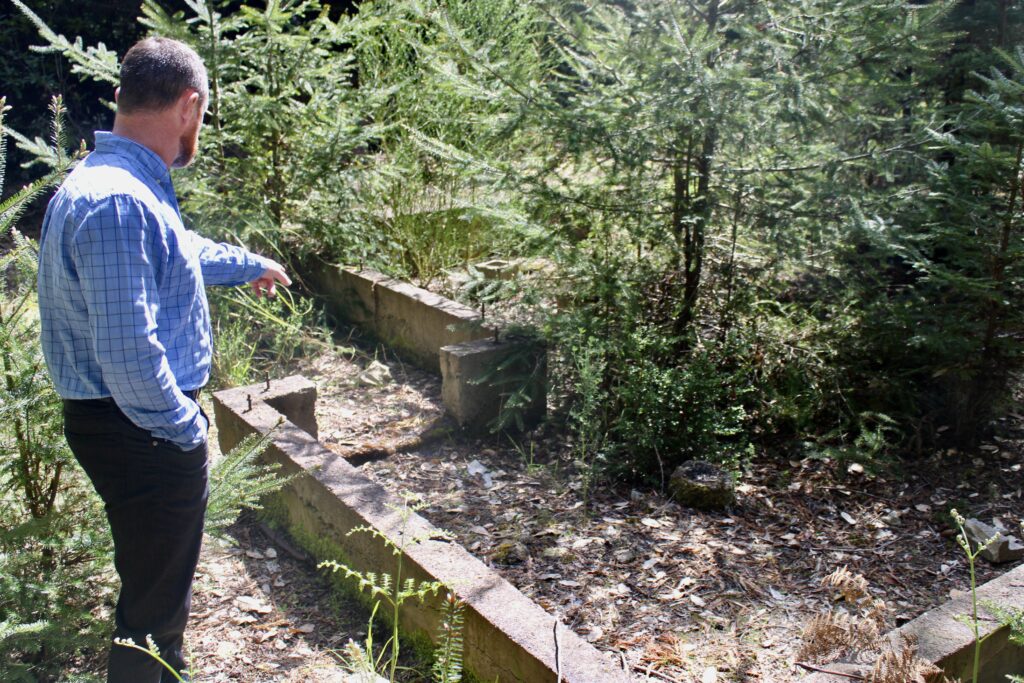
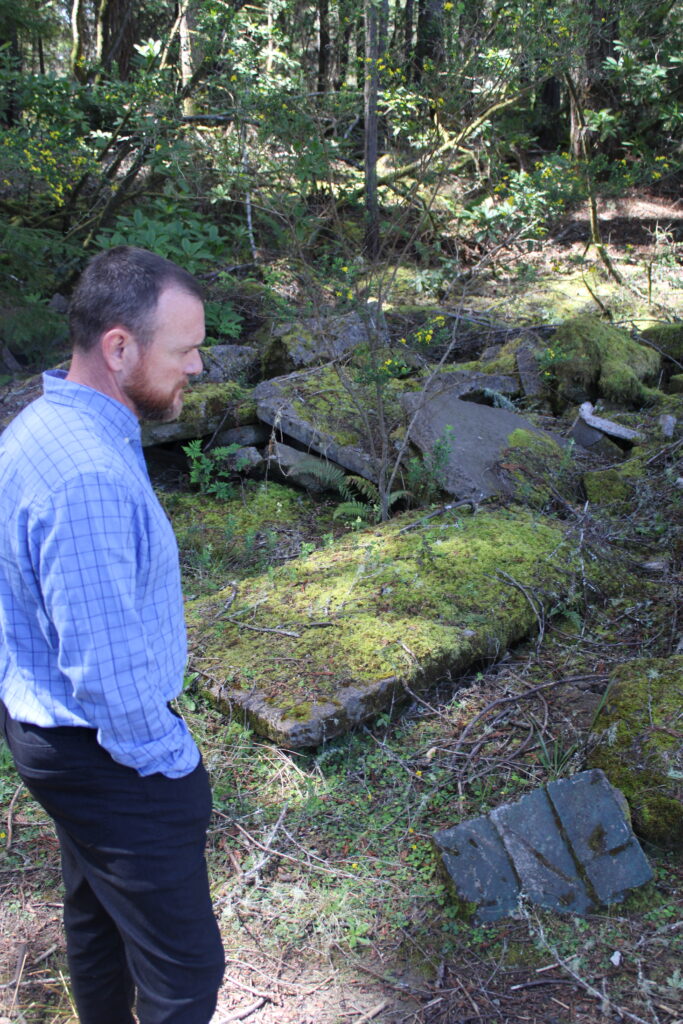
But it will also make an awful mess if we don’t have a vigorous group of local residents to provide eyes on the area and track down the jerks and sue them if need be. (We could do that right now if some of you wished to help.). Below, we provide some shots of the area, including an old building and on the right, city public works head John Smith next to some of the many concrete blocks from the old Noyo Bridge and other places that were used decades ago to keep the creeps making a huge mess out. Things were badly out of control. The area is now used for dog walking on a daily basis by the Mendocino Coast Humane Society, so this is not the part of the 500+ acres where the track should go, there is plenty more land away from here.
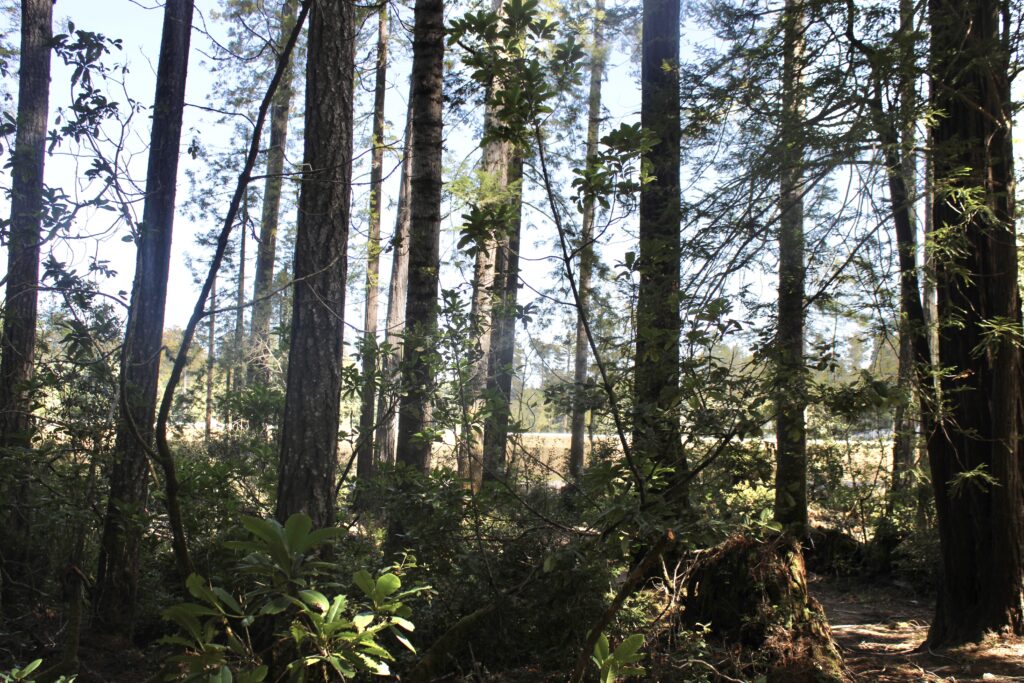
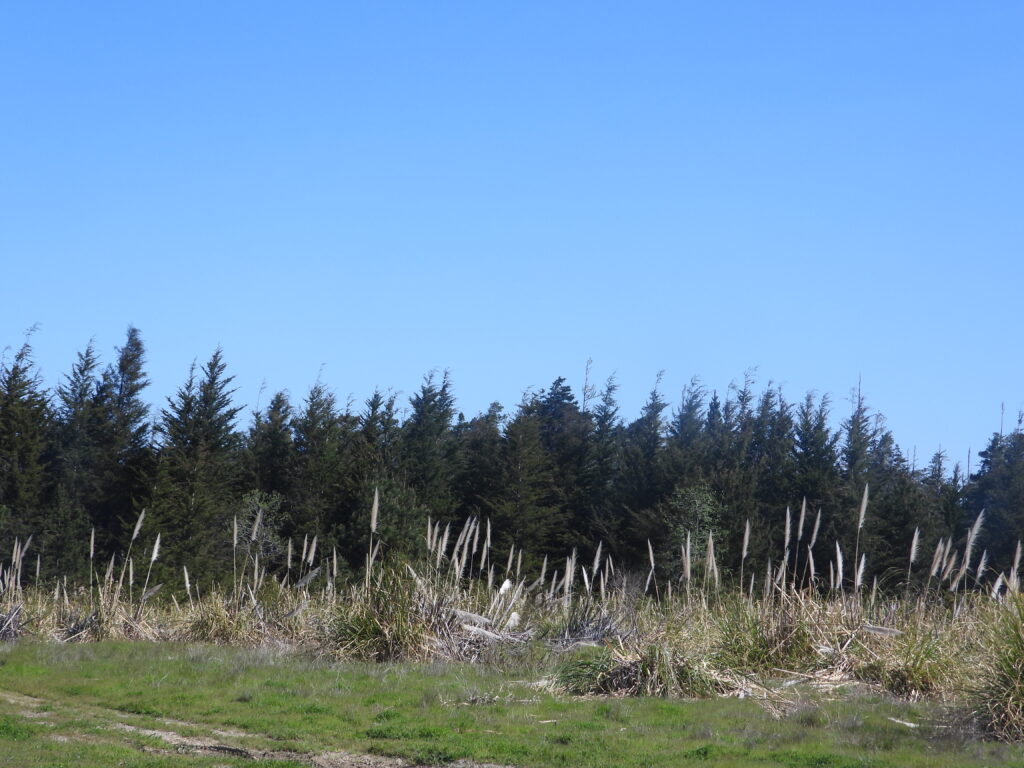
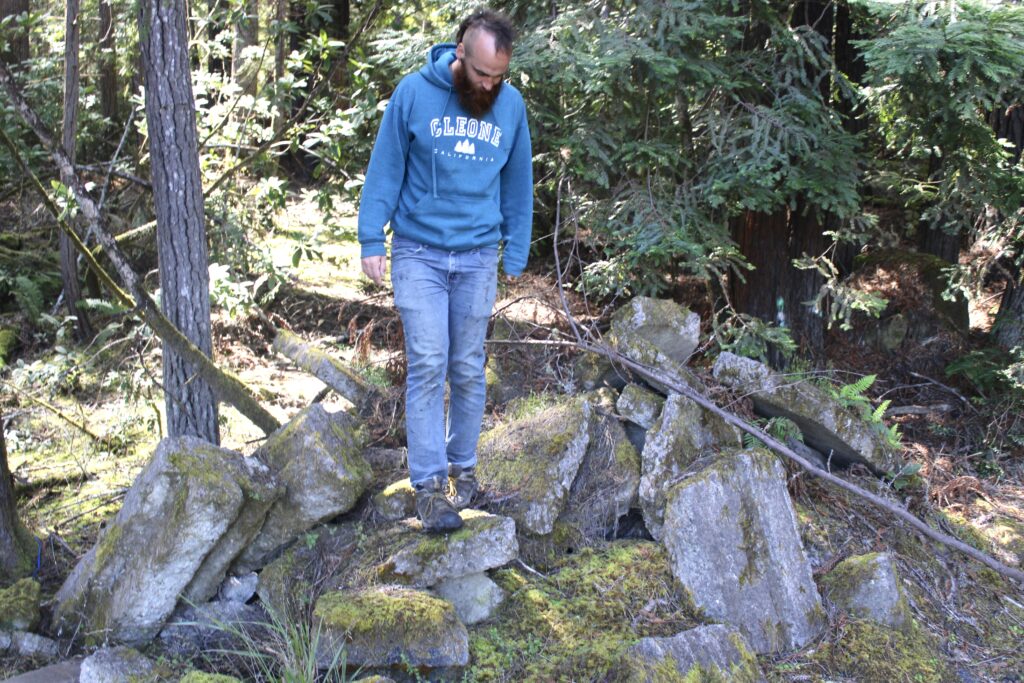
There are large open areas on the land, much of it covered with Pampas grass as shown. A new track group could work with the city and grants to elimiinate the pampas grass and build a track out there at the same time. This will likely take years, but is worth doingNephew Joel Hartzell took the tour back in 2023 with Smith and Frank. Here is more of the bridge pieces that have kept people from drivng giant 4x4s through the forest there, as was happening with great destruction. The dirt bike boosters don’t want this kind of thing! They want a place for kids to have fun
The city has to allow the new group of track enthusiasts and butt kickers for trash dumpers to take in money and police the area. It cant be all free and the city can get some too. An off road track is a great idea but not if people are going to come out one night and then let the council do the rest. There is a long history of commitment to the issue by off roaders. Some have been discouraged that the original golf course and the original off road track on the same property fell apart with nothing happening after many years of planning and meeting. But dont quit now! Its a great idea but it wil take hard work by busy familes. Don’t count us in to this cause, Frank is too big for off road bikes and we’re too old anyway!
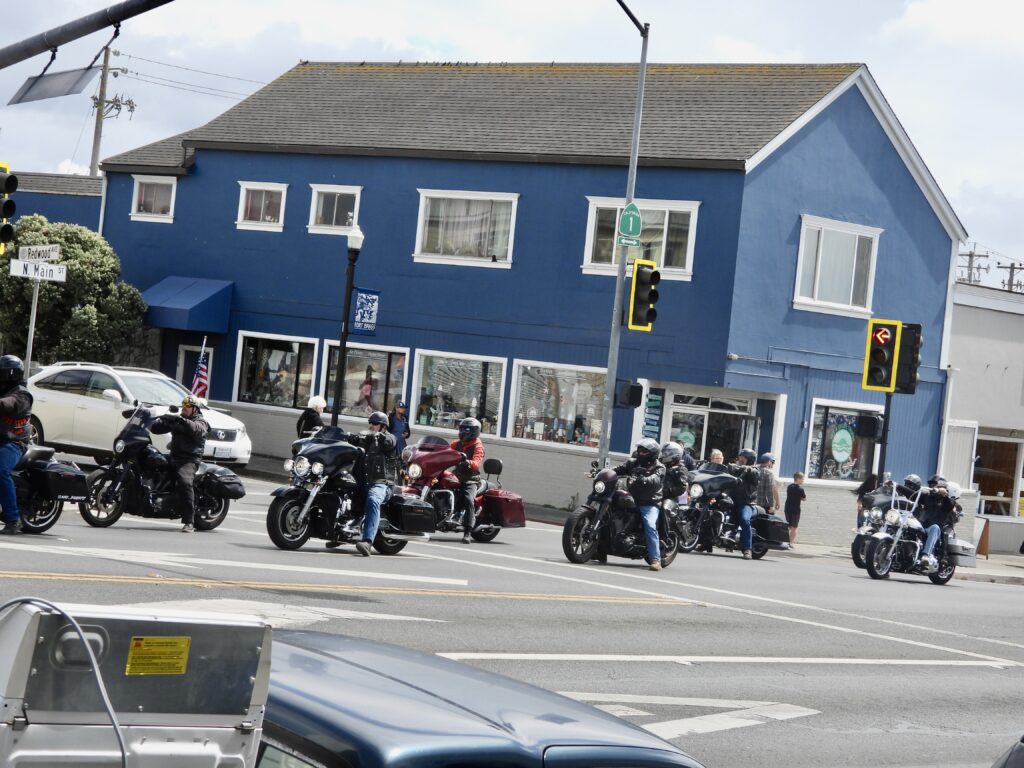
The Mendocino Coast is a great place for boating but we are all missing the boat in not promoting the fact this is one of the greatest places on earth for motorcyclists, on road, off road, antiques. The famed motorcycle club Wino’ Crew started here in the 1940s. That awful ride over Hwy 253, Leggett Highway, 128 or Highway 20??? That is fun on a bike! Motorcycle clubs have huge meet ups here in September. There is a huge summer event for dirt bikers on private property, or used to be for many years. Here are some pics of motorcycles I have shot.
87 housing units proposed at Todd Point
Fort Bragg Planning Commission awaits first look at the project next Wednesday, March 12
In a town starved for affordable and worker housing, the biggest private housing development project in years will be on the agenda of the Fort Bragg Planning Commission on Wednesday, March 12.
The plans are for 87 housing units on 2.7 acres behind the Fort Bragg Outlet store, just south of the Noyo Bridge on the west side of State Route 1 and just north of the Emerald Dolphin Inn.
The project proposes a 107-car parking lot for seven different housing units and asks the city to raise the maximum height of units allowed from 28 feet to 38 feet to serve three-story units. The city is also being asked to allow smaller outside decks than currently allowed.
Eleven percent of the units would be affordable to very low income families.
Akashdeep “Kosh” Grewal is the developer. The property had appeared to be headed to becoming a gas station before this was proposed. It was sold in 2022 to Kosh Petroleum of Roseville. Kosh Petroleum is owned by Kosh Grewal, according to a public records search.
The proposed project would include six studio apartments ,36 one bedroom and 45 two bedroom units. Amenities include an outdoor playground and two outdoor courtyards.
The developer promises extensive landscaping and improvements to Harbor Drive and frontage road. The applicant has requested these three inclusionary housing incentives, an increase in the height limit from 28 feet to 38 feet, a reduction in capacity fees to offset storm water improvements, and a reduction in balcony size from 100 square feet to 50 square feet, The address is 1151, South Main Street.
There are ocean views from the roadway that would be impacted by 38 foot tall housing units. What you see in the picture is clouds on the ocean horizon, not the ocean itself.
The Fort Bragg Planning Commission is an advisory body to the city council. Their job is to study planning, zoning, water and environmental issues and then approve or disapprove the project. The applicant can appeal the decision to the City Council. In the case of a project this large for Fort Bragg, the council would certainly want to weigh in.
This project could also be appealed to the California Coastal Commission, as it would block limited ocean views from State Route 1.
California Gov. Gavin Newsom has pushed through law that make it much harder for cities to deny affordable housing and workforce housing. The city of Fort Bragg has sought to build workforce housing in this area on a different tract of land. It would be very close to the college and close to the town’s medical facilities, while still walkable to downtown Fort Bragg. This might necessitate a safer crossing of State Route 1 for those on the west side of the highway. Those who cross Noyo Bridge on foot on the west side going north and wish to go any further now find they have made a big mistake.
There will be a follow up story on this development this week.
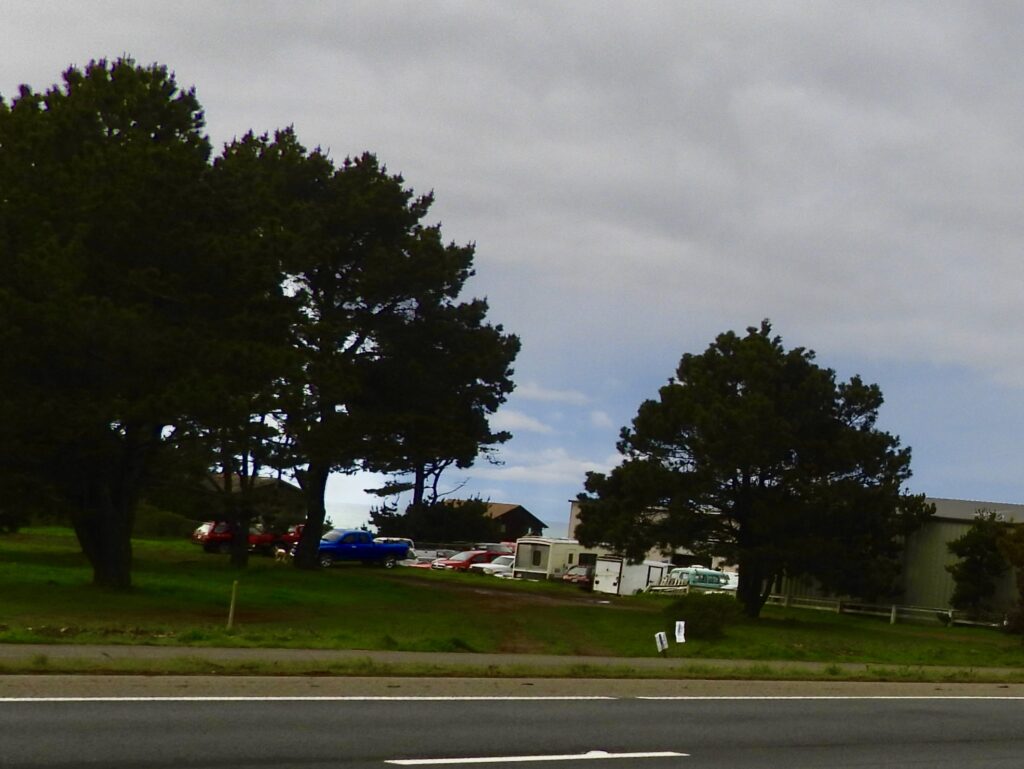
Travelers on the highway might get a peek of the ocean through these trees, if they didn’t rear end the car in front of them trying to do so. The trailers and equipment shown are on the adjacent property.
Did Skunk and City go too far in creating development agreements with mediation process?
Fibbing by Georgia Pacific, environmental extremism and Skunk-city squabbles may be put in the past, but should hotel, trolley, housing be in the future?
After years of meetings about how we would all use somebody else’s property at the old Georgia Pacific millsite, we actually have a meeting on Tuesday where our input will count. The city is one partner in creating newly thought-up development agreements. And the city has to listen to public input.
When the mill finally closed operations in 2002, it set off more than 20 years of squabbling that consistently divided the community in how to move forward. Someone on the right suggested a Walmart. Someone on the left said we should turn it all into a park and plant redwood trees. Georgia Pacific, the owner of the property at the time told one of the biggest whopper lies in history when their spokeswoman repeatedly said the milliste had pollution not much different than one would find “at the average gas station.” This was obviously more than an understatement and gave many the impression they had much to hide – which turned out to be true.
Native history is provided along the Coastal Trail. The city and Skunk should create real opportunities for the tribes to create something on the South end of the millsite.
One has to wonder why the city didn’t take the property right then by eminent domain.
Let’s remember though that the millsite has not just sat untouched for 23 years. The city has become the hero for leading the process to develop the Noyo Headlands Coastal Trail, opening up property closed for more than a century into a park with some of the most spectacular views on earth.
The city of Fort Bragg and the Skunk Train have been meeting since late last year in private arbitration to try to resolve their ongoing lawsuits. The legal fights are mostly a debate over whether the train was a real passenger and freight train or just a tourist ride. If found to be a working railroad, the Skunk wouldn’t have to obey city and coastal commission rules.
There are lots of choices to be made right now about the future of the centerpiece of Fort BraggThis is how relaxing it is to sit on the whale bench, shown at the top fo the story.
The plans call for an upgraded and expanded train station. The zoning would allow residential development both north and south of the Skunk Train station and a hotel-conference center to the north. The pond area behind the Fort Bragg Fire Department would be kept wild all the way down to the city sewer plant. The south part of the property would have light industrial zoning as well as some highway commercial. The southern end of the Millisite is where the “Fort Bragg reservation” is and the only place Natives were not ousted from. It would a great spot to have something exciting done by the tribes.
Brutus surveys the millsite from the rock the Native people named…..And this is what he sees. Since this photo was taken in 2018, the Skunk and the city have both made big progress on improving the property at the heart of Fort Bragg.
Almost everything on agenda to discuss at Tuesday’s meeting could have happened years ago without legal squabbling if everyone had put their big boy pants on. This process should already be well underway.
According to the gentleman in charge of the local railroad, including Chris Hart and Robert Pinolli, and the City even if the Skunk was found to be a “real” railroad that exemption would only apply to the train station and tracks. It would not impact any of the developments everyone will be talking about on Tuesday.
As an official arbitration provided by the court to try to settle this matter, the meetings between the city and the Skunk were all private. Since they are not legally binding court hearings, they are free to do what they want but was the city being true to the public process? They used those meetings to come up with a framework for development agreements, which technically are not what was at issue, at least beyond the Skunk’s station. Development agreements are often reported on as being a developer’s best friend, as they carve something in legal stone that can’t be upended easily by NIMBYism (Not in my backyard) lawsuits, and changes to the city council and the local economy. In the end, they are often the best friend of the community, not the developer, because the developer can’t easily use them as a way to do scams like shell game bankruptcies and playing the political winds. Using arbitration to draft development agreements was a stretch. Since the political wind has blown further and further rightward since Ronald Reagan was president, this may be the last and best chance to put environmental protections of any sort in.
The fact we are to the point of having this Tuesday meeting is good news overall. The use of development agreements has opened the doors for all of us to tell the city what we want! With the approach being used, the public now has more actual say so than ever before. Because the development agreements deal in a public agency, this is no longer a debate over how private property is used by private owners. The Skunk and the City working together shows they are both more serious than ever and gives the public a right to say what WE want in this public-private partnership.
My story in the Mendocino Voice in 2018 gives a great picture of the site.
Back in 2018, Marie Jones, the city planner most responsible for the mill site and coastal trail and such, gave a presentation on all the input and issues up to that point. I hope Marie Jones is involved in the future.
Please see how much of the millsite is paved for example. Aren’t there many better places for a park? Take Surfwood or South Caspar or my neighborhood in Cleone first. All with actual ocean habitat left. I’m not serious about making any of those places a park, but all would be infinitely better than throwing Fort Bragg’s future away. We all have to work and live folks! The milliste cannot be made into a park. This is the one place for industry and housing we have. The community has been active in this process for 20 years, led by groups like the Noyo Headlands Design Group and Grass Roots Institute. Now is the time to reign in the extremes.
Frank’s big questions. Please ask these on Tuesday!
1.What about the indigenous people? What will their role be? Were they at all represented in the city-skunk negotiations? All of Fort Bragg and much of the Coast was once an Indian reservation. The Natives have a right to be partners and to have a portion of this. There is no such thing officially as the Fort Bragg “reservation” but that is of course what locals call the tribal and private property native area south end of the Millsite. Any special rezoning to create housing needs to be open to them and should move beyond that small area. It is a needed mitigation
2. Who will be in charge of this on city staff? There are some good and not-so-good possibilities. A good one would be if Marie Jones be available to help. Let’s find the best people and not dump this all on the city manager.
3. How much of this can be changed by public input and how much would violate the legal solution? What did the city give up and what did the Skunk Train step back from in this arbitration? It’s important to remember none of this is legally binding, as that doesn’t happen until the court rules on the arbitration. Until now, the millisite has been private property, first Georgia Pacific, then GP owned by the Koch Brothers, and now the Skunk Train owns it. But with the Skunk and the city hammering out a framework together. We DO have the right to tell the city what we want from them. This will likely lead to a thing called development agreements. These also allow public input to the point they are signed. Let’s ask tomorrow if this is in the works?
Long ago, the owners of the lumber mill allowed a brothel to be built on an island off the millsite. The brothel burned down, leaving these remnants. The women of the town were behind the arson, according to legend.
4. Can we please make this a center for innovation?
There is a vacuum tube technology for powering trains., invented by the late Max Schlienger of Ukiah.. Let’s work together to try something new and innovative like that on the mill site.
5. Can we make sure from the outset that a local bank, either Savings Bank or Community First Credit Union be the financier of this?Can we start a process now to get local building contractors trained to do the work? And can we guarantee local jobs in the construction now? Local banking, local contracting, solar, wind and gardens aren’t easy to incorporate. But we must.
Now is the time for the city council to figure out how we can facilitate as much local resiliency as possible. Any project financed by a megabank will not be in the interests of this community.
6. What would daylighted creeks look like? Daylighting creeks (bringing the waterways them back above ground) has been an idea of local critic George Reinhardt’s idea for many years. George has been there from day one 1 in the millsite process. It will good to hear his viewpoint. The creeks on the millsite are buried and come out to the ocean from the underground. The entirety of Fort Bragg is built on top of these creeks, Alder Creek and Maple Creek. It saved the original builders from having to build bridges all over town. The creeks were dealt with much like the indigenous people. Just make them disappear.
From the website of the Noyo Headlands Unified Design Group, a look at the vision of creek daylighting.
The Yuki and Pomo lived for thousands of years on the millisite until they were driven off the land and their reservation made into a lumber mill. In a story I wrote about in 2021, Misty Meadlin, of the Sherwood Valley Band of Pomo Indians gave the big rock called Johnson back a traditional name, proclaiming it, “Johnson Rock no more.” She spoke the rock’s Coastal (Poma) reborn name, “buuhche’ me’yo’ooye” and also called it by the traditional Coastal Yuki name “choxt.” Who has naming rights? Apparently from the native name Denali removed by President Trump for North America’s tallest mounting, this despite the objections of even the GOP in Alaska, naming is done by whoever is in power. Let’s empower a new future!
The rock the Yuki called “choxt”, that the Pomo call buuhche’ me’yo’ooye and that maps identify as “Johnson Rock” is a heck of a place to watch a sunset.
Here is what is happening Tuesday:
MILL SITE PLANNING WORKSHOP
Tuesday, February 25, 2025
Fort Bragg Town Hall – 363 North Main Street
5:00 – 5:30 pm Open House; view maps and wall materials; informal
discussions with the Project Team Members. My question- who is on the project team? Is there a point guard for it?
5:30 – 6:00 pm Workshop orientation and introduction of the Project
Team, objectives for the evening, and perspectives upon the joint city of Fort Bragg/Mendocino Railway Illustrative Plan and subsequent planning process
6:00 – 6:20 pm ‘Walk around’ review of the Illustrative Plan Maps and wall materials (adding ‘sticky note’ comments to maps and Fort Bragg Mill Site – Illustrative Plan Formative Elements
Nobody but the telephoto lens was around to see this man playing his didgeridoo and flute on the Coastal Trail but the high and low notes could be heard for a long distaince.
The following is the text of what the development agreements could look like. if you speak technocrat, please provide me a translation of the following from the city:
My translation of the below: Skunk and city met to discuss a lawsuit and came up with some development agreements.. We decided to kick the Coastal Commission back out of town. We like development agreements. In case you never heard of them, here is a long explanation of what they are that you probably won’t be able to fathom. Native Americans and DTSC (Department of Toxic Substances Control). DTSC seemed to have much bigger pants the last time we checked, but hey, this will take a lot of time so come on down to Town Hall on Tuesday and tell us what you think! Oh, and folks, this is going to take a long time. We are just getting started (23 years in).
Here is what the city provided:
Millsite Master Development Agreement Process
The City of Fort Bragg (City) and the Mendocino Railway (MR) have tentatively agreed that a
formal and cooperative ‘master planning and development agreement’ approach to further
development of the Mill Site is in the interest of both parties, other property owners, and the City
as a whole. As a part of pursuing this cooperative approach, the parties have agreed to stay the
pending litigation between them, to pursue settlement discussions, including with the California
Coastal Commission, which is also an intervening party in the action.
Assembling such a cooperative approach will build upon the many years of planning,
environmental review, remediation, infrastructure improvement, and development that has
occurred as well as the current aspirations of MR and land use and policy objectives of the City.
The master ‘development agreement’ approach recommended has been used successfully in
complex development projects in California for decades. Development agreements (see Cal.
Gov’t Code § 65864 et seq.) are contractual agreements between a local jurisdiction and a
developer(s) regarding a particular development project. Development agreements overlay
standard planning and development regulations (zoning, etc.) adding a ‘vesting’ of development
approvals (entitlement) and other considerations (public investments, etc.) by the local
jurisdiction in trade for considerations and contributions from the developer that cannot be
imposed through normal ‘police power’ development regulations or financing methods.
The proposed Mill Site Development Agreement — given the complexities involved, will need to
be approached in a sequentially phased approach allowing planning and technical analyses,
community engagement, negotiations, and cooperation with other landowners in or adjacent to the Mill Site, and consultations with the regulating agencies in the mix including the California
Coastal Commission, the Department of Toxic Substances Control (DTSC), tribal interests, etc.
A conceptual illustration of such a phased approach to creating a Mill Site Development
Agreement is shown on Figure 1. Our consultant, Walter Kieser, Senior Principal with the firm
Economic & Planning Systems, has assembled this approach drawing upon his own and the
firm’s experience with such agreements for the management of large-scale development projects and development financing. Mr. Kieser also brings his historical knowledge of the Mill Site stretching back now 20 years working for the City of Fort Bragg. The illustration remains a
‘sketch’ but provides an overall sense of how such a process could be structured.
Fort Bragg Council picks Jason Godeke as new mayor
FORT BRAGG, CA., 12/10/24 — A divided Fort Bragg City Council picked two already serving councilmembers for city leadership positions: Jason Godeke as mayor and Marcia Rafanan as vice mayor. A Pomo, Rafanan becomes the first self-identified Indigenous person to serve as a leader of the council.
But controversy flared Monday night at Fort Bragg’s Town Hall during the voting. The dispute was between relative newcomers Godeke, Rafanan, and Scott Hockett on one side and veteran councilmembers Tess Albin-Smith and Lindy Peters on the other.
In the Nov. 5 election, longtime councilmember Peters and newcomer Hockett won seats in a four-person race to join the three sitting councilmembers: Godeke, Rafanan, and Albin-Smith. By tradition, Fort Bragg picks its new mayor and vice mayor at the first meeting in December, then takes the end of the year off for a holiday break. The vice mayor serves as mayor in the mayor’s absence, such as when the mayor must recuse her- or himself because of a conflict.
Hockett had no time to just sit back and see how it all works. Thirty minutes after being sworn in, he became the decisive vote over how Fort Bragg would choose its mayors going forward. Albin-Smith and Peters wanted the job to rotate every year or two so both voters and the city would benefit from diverse voices and leadership ideas. And although there have been numerous women on the council, none has been picked for mayor in this century. On the wall above the council at Town Hall are the official portraits of mayors. Michelle White and Patti Campbell served as mayors in the 1990s.
“I think that this question does bring up important points about equity, especially, and I do think that’s something that we need to be vigilant about when we start looking at the wall of photographs,” Godeke said, explaining why he would vote against rotating the mayor role.
“I think that is something we need to keep track of. But I do also feel that being nimble and being able to assess the circumstances is important, of the community, of the relationship with staff…” Godeke felt that being able to maintain consistency with the public and with city staff would be challenging with different mayors.
Albin-Smith argued that changing mayors would encourage more diversity in ideas and more representation for voters who had chosen candidates who were not in those positions. “My objection is that when there’s one mayor, over and over and over again, no one else’s vision is brought forth. As a mayor you have more opportunities to bring those visions forward than you do as a councilmember,” she said.
Realtor Paul Clark, who has been commenting on city politics longer than anyone at the meeting besides Peters, weighed in on the rotation versus vote debate.
“I have complete confidence in the people that are elected to work among themselves as who’s going to be the mayor and the vice mayor. So at this moment, I’d say stick with the policy that you’ve had for a long time,” said Clark.
By tradition in Fort Bragg, the mayor votes last, so he or she breaks ties. But until this one issue was settled, at the moment there was no mayor. The vote came to Hockett tied 2-2. Without hesitation he broke the tie, voting with Rafanan and Godeke to deny the forced rotation system that Peters and Albin-Smith wanted.
Then for 30 minutes that were unusually tense by Fort Bragg council standards, Godeke, Rafanan, and Hockett argued as a block, provoking pushback from the older and longer-serving Albin-Smith and Peters. First Rafanan nominated Godeke for mayor. Peters nominated Albin-Smith. Albin-Smith nominated Peters for mayor. Then newcomer Hockett said he also wanted to nominate Godeke. A vote on that nomination made Godeke mayor. When it was clear that Godeke would win, the vote became 5-0. Voting unanimously after disagreements is a local tradition.
Fort Bragg City Councilmember Marcia Rafanan (left) attends a reception at Town Hall before the city council meeting where she was chosen as vice mayor of Fort Bragg, Calif., by fellow councilmembers on Monday, Dec. 9. 2024. (Frank Hartzel via Bay City News)
Rafanan as vice mayor
Next was picking a vice mayor. Godeke nominated Rafanan. And Albin-Smith nominated Peters.
That’s when more controversy erupted. First Peters pushed hard for his own nomination. He pointed out he was on a first-name basis with congressional and other elected representatives. He said if the people were voting, they would likely pick him.
“In 2014 I received the most votes in the election,” he said. “In 2018 I received the most votes. In 2022 I received the most votes, and in 2024 I received the most votes… I have, I think, more institutional knowledge than any of the other council members, which I think is important. And I also think it’s very important that if something happens to our new mayor, that we have someone who can run the meeting right off the bat.”
Peters said he is semi-retired and has plenty of time for the position while Rafanan has a busy family and work life as a manager in the food service industry for decades. (Rafanan works for fellow councilmember Hockett in a restaurant he owns.)
Albin-Smith then pushed hard for Peters as vice mayor and leveled strong criticism at Rafanan.
“Marcia is a very nice person, she’s very friendly, but she’s definitely not a leader, not comfortable with public speaking, and sadly, we know that she is swayed by certain people who tell her what to say,” Albin-Smith said. “So she doesn’t have original comments. The job of mayor and vice mayor is too important to give to a person who has no leadership skills. We need someone with a firm hand, quick decision-making ability, fortitude, and who doesn’t need or allow others to tell them what to say. I don’t think Marcia is qualified.”
Godeke countered that Rafanan’s ability to work long hours and juggle family and community involvement makes her ideal for the job. Rafanan then argued her own case:
“I know what it takes to live here. We need more jobs, not more walking trails. I understand this is a diverse community. I am part of that working-class majority of Fort Bragg here, and like so many of us we need two jobs to get everything done. That’s who I represent. I’m not a polished politician, I’m not a public speaker. I do have disagreements with you. I have my own mind… We don’t need another polished politician. We need somebody that’s real, somebody who knows the struggle to live and work here. That’s me.”
Albin-Smith’s comments drew strong criticism from several audience members and support from one.
“I’m actually blown away at the comment that you made about Marcia’s… inability to be vice mayor, “ said Judy Martin, the head of the Mendocino Coast Humane Society. “I have known Marcia since I was 10 years old, and she is caring. She is strong, and the only way that somebody is going to be a leader is to get the chance and to not be belittled in front of the public…”
Andrew Jordan praised Albin-Smith for speaking what she really thinks rather than the obfuscation that politicians are often accused of. “I’m a very, very strong advocate of free speech. The cure for speech, whether approved or disapproved, is not less speech, it is more speech. I think that our city is better served by honest comments that are not ad hominem attacks…”
The council ended up voting 4-1 on the Rafanan nomination, with Albin-Smith voting no.
New Planning Commissioner
Next, Hockett nominated Ryan Bushnell to serve on the Fort Bragg Planning Commission. The planning commission, which includes private citizens, is a separate legal body from the city council. It reviews applications and advises the council on the updates of zoning ordinances, general plans and such.
Bushnell finished third in the election behind Peters, who finished first, and Hockett, who came in second. Bushnell, a local heavy equipment operator, has been involved with the council since he joined the city’s official study of whether Fort Bragg should change its name, an idea the council eventually nixed.
Peters opposed replacing Planning Commission Chair Scott Dietz with Bushnell so that vote ended up 4-1. Peters said he was not voting no because of any issues with Bushnell, but because Dietz was the most experienced member of the planning commission.
Before the meeting was a gala send-off for longtime mayor Bernie Norvell, who left the council to serve as the 4th District Mendocino County Supervisor. There were songs, non-alcoholic champagne, and dignitaries including Mendocino County District Attorney C. David Eyster, former mayor Doug Hammerstrom, former supervisor Kendall Smith and other community leaders.
Fort Bragg City Council to consider buying MCN at Monday night meeting
FORT BRAGG, CA., 11/25/24 —The Fort Bragg City Council will consider buying internet service provider Mendocino Community Network (MCN) from the Mendocino Unified School Board District at tonight’s city council meeting.
The district’s school board voted 6-0 earlier this month to accept the city’s offer of $500,000 with a promise to keep all employees and services.
MCN was launched in 1994 by the school district with the help of a grant from NASA to teach students about the then-new internet. Today, it is the leading locally owned internet provider on the Mendocino Coast, serving over 1,500 customers. In recent years, the district has wanted to unload MCN to focus on its educational mission. That’s when the city of Fort Bragg stepped in.
Recently, the city was awarded a $10.3 million grant from the state to fund efforts to expand broadband access to underserved parts of the coast. The acquisition of MCN will help the city achieve its broadband expansion goal. The city will also ensure continuity; MCN staff will retain their jobs and current customers will not have service disrupted.
The school board vote was preliminary to get started on hammering out the details of the sale, a school board director said at a special meeting on Nov. 14 at Mendocino High School. The final vote will be taken in a few months.
“MCN has had a charmed life in lots of ways,” said school board director Michael Schaeffer, who was part of a committee that brought the city offer to the school board. “It started with dial-up when nobody had dial-up. We did really well with it and got a lot of people online. Then MCN was threatened by DSL, and MCN got on board, and we got into a position where we could offer DSL through Fusion and Sonic. Now we are in a place where we cannot take any new customers in those services. Our new customers are wireless customers.” He said it could be six months before the acquisition process is complete, and there will be chances for input in both public processes.
The MCN purchase is the first item on the agenda (under “Conduct of business”) for the Fort Bragg City Council meeting tonight. The meeting starts at 6:30 p.m. at Fort Bragg Town Hall, 363 Main St., or online on Zoom here.
Fort Bragg’s new city manager, Isaac Whippy, hails from Fiji
FORT BRAGG, 12/17/23 — When Isaac Whippy was growing up in Fiji, he admired the USA and wanted to live and work here. But he couldn’t imagine he’d find a place he liked as much as Fort Bragg.
Whippy, 35, will become Fort Bragg’s new city manager on Jan. 3, replacing Peggy Ducey, who leaves on Dec. 31. He is currently Fort Bragg’s director of finance and will keep that job too, taking home $178,000 as city manager, while no longer collecting pay as finance director. He says he reduced some of the benefits that came with the city manager position to save the city money, but kept the salary at what was offered. He became director of finance in May 2022 and was assistant finance director before that. He began working for the city about nine years ago.
The City Council announced his hiring Monday night and also swore in new City Clerk Diana Sanchez.
Whippy planned to stay in the small coastal town only temporarily — but then he and his family fell in love with their new home.
“There are a lot of similarities between Fort Bragg and Fiji,” Whippy said in a phone interview. “Both are beautiful places in spectacular ocean settings. Both rely on tourist economies. Fiji is known across the world for how friendly the people are, and Fort Bragg is like that too,” he added.
“I am thankful for how this community has been so welcoming to me and my family. I completed my citizenship last year and am proud to be part of this great country and this community.”
He said in Fiji, the standard of living and wages are low despite all the tourists at fancy hotels. That’s a bit like Fort Bragg, which also needs higher paying jobs and has a high poverty rate, he noted.
Fiji is just 5,438 miles across blue Pacific waters from Fort Bragg, according to Google Maps. Whippy graduated from the University of the South Pacific, an internationally and USA-accredited university best known for having campuses on 11 different oceanic islands, with the main campus on Fiji.
Whippy said he was very fortunate to have learned much from the two very different city managers he worked under while serving in the finance department.
Tabatha Miler, city manager from 2018-2021, was a CPA as well as an attorney. Whippy said he learned a lot about the fluctuations of the budget and getting started on a major effort to bolster reserves.
“I worked closely with Tabatha Miller on the budgeting process. I learned how to do better fiscal management and financial strategic planning for the long term. I put together long-term plans, a five-year financial projection for the city, and we were trying to extend that to 10 years when she left.”
Then he got a new boss in Peggy Ducey and new lessons to learn. She shared what she had experienced working with large cities and entities in Southern California. Ducey was hired in June 2022 as interim city manager, a position made permanent that November.
“I was able to continue my professional growth working with Peggy. She brought a different style,” Whippy said. He said city employee morale was down after COVID and other issues when Ducey arrived, something her people skills helped reverse.
“She was able to bring a more human element to everything and really improve morale among the employees. I hope to continue that and I will miss her,” Whippy said.
“I’ve learned a lot from both of them, which will be useful in my career. One was analytical driven, and one is more about people, to make sure all employees are taken care of,” Whippy said.
Whippy plans to invite every city employee into his office and learn by listening to their thoughts on where the city should go and where they want their careers to go.
The fact that Whippy has no experience running a city didn’t faze the council. Mayor Bernie Norvell said he liked Whippy for the job even before he saw his finance director doing a great job getting the finances in order to smooth the transition of the C.V. Starr Center from the Mendocino Coast Recreation and Parks District into city management. (Read more on that here.)
“You don’t have to talk very long to be endeared to him,” Norvell said. “Just his story alone. He’s only been in the country nine years. He’s truly living the American dream. He’s made the absolute most of it.”
Norvell said despite Whippy’s calm demeanor, he has no trouble saying no to spending ideas that might not be affordable, even if the idea comes from a councilmember…. or a mayor.
“Yes, I have done some of that,” Whippy laughed. “It’s very important to be very fiscally conservative because our budget is so small. We are dependent on the TOT [Transient Occupancy Tax on overnight visitors] and sales taxes. And those can fluctuate so much and those fluctuations can have big impacts on critical city services.”
That’s why one of his biggest goals is to continue to bolster city financial reserves, or rainy day funds. Significant additions to depleted reserves began under Miller, with Whippy as director of finance and has continued. Reserves are up to $3 million, but Whippy says the process needs to continue, which could restrict some discretionary spending.
“It’s important that he is fiscally conservative and has a great awareness of where we are at any point in the budget,” Norvell said. “This is one of the things that made him such a great candidate for me. We only have to look at the county to see what happens when there’s a disconnect, right? With Isaac we are actually going 180 degrees in the opposite direction.” (Norvell is currently running for the position of 4th District county supervisor.)
Norvell said the big improvement of morale at City Hall was another reason to hire Whippy, who has been at the heart of it. Whippy already fits in and won’t turn something upside down that already works.
Besides increasing reserves and managing revenues that can wildly fluctuate, Whippy now will have to deal with city critics such as Jacob Patterson, a local attorney. Ducey tried to manage frequent communications to staff from Patterson by creating a plan where she was the sole contact, and Patterson had no access to other city employees. Norvell said that plan would likely remain in place with Whippy, as the protocol regarding contact with employees was put in place by the council. Assistant city manager and police chief Neil Cervenka is now Patterson’s single point of contact.
Patterson regularly files hundreds of public records requests and speaks on nearly every item at many council meetings.
Whippy said Patterson has a right to file public records requests and speak at meetings, but the direct contacts with the staff were an issue for almost everybody at City Hall. He said he does not plan to make any changes to the policies the council has enacted for Patterson, although he believes the single point of contact should be himself, not Cervenka.
Whippy wasn’t ready to comment on issues he hasn’t been so involved with so far, such as the Skunk Train but said he would be up to speed when he starts on Jan. 3. Cervenka will be acting city manager on Jan. 2 while Whippy is returning from a trip. Norvell is a little worried Whippy might be taking on too much as both finance manager and city manager.
“He said if it gets to be too much he will come back to us and tell the council we need to do something different. I believe he will if he needs to.”
With Whippy being highly praised for his demeanor and his finance skills, will he use Fort Bragg as a springboard to jump to other jobs?
“We really fell in love with the community and have family here,” he said. “We have a young son, and we want to bring him up in a community like Fort Bragg. This is an excellent place to raise a family. People here have been so good to me. My family and I plan to live here for as many years as we can to help the city.”
Several members of the council said at Monday’s meeting they were happy to find two people to appoint from within city staff in Sanchez and Whippy.
Councilmember Lindy Peters said in an email: “It’s always beneficial to an organization when you are able to promote from within. Isaac has shown a great understanding of the city’s financial wherewithal and guided the budget process very efficiently through his time as the city’s finance director. During these tough economic times, the City of Fort Bragg remains solvent. Isaac Whippy is also well-known and well-liked by his co-workers at City Hall. He has earned their trust and respect. I look forward to a smooth succession in the City Manager’s office.”
At Monday’s meeting, Peters also saluted Ducey’s service. “Peggy Ducey came to us at a time when we were struggling to find a city manager. She first came as an interim. We found that she was a good fit. So she entered into a contract to stay on as our city manager…” Turning directly to Ducey, he continued, “I have met with you every week since you took over the job and I can say that you’re an excellent person, first and foremost, full of compassion who tries to do the right thing and tries to understand and give people a chance.”
Sanchez had been acting city clerk since shortly after June Lemos left full-time work for the city due to illness. Lemos died of ovarian cancer on Sept. 28. She had been city clerk for eight years. The city clerk is the record keeper for the city and typically has handled elections and public records requests, along with information preparation for the council.
Diana Sanchez is sworn in as Fort Bragg City Clerk by Crystal Munoz.
Whippy had a holiday message he wanted to deliver to the community, which he sent by e-mail after the interview.
“It is truly an honor to serve this incredible community, and I am eager to embark on this journey of collaboration, innovation, and progress. I want to express my appreciation to the mayor, the vice mayor, and the rest of the city council for entrusting me with the responsibility of leading our city. Your confidence in my abilities is both humbling and inspiring, and I am committed to working diligently to meet and exceed the expectations set forth for this role. I am acutely aware that the role of City Manager comes with its challenges, but precisely those challenges fuel my passion for public service. Together, we have the opportunity to make a lasting impact on our residents’ lives and shape our community’s future. I am ready to embrace the responsibilities of this role with dedication, transparency, and a commitment to the well-being of every individual who calls this city home.
“I also want to express my gratitude to the city staff, community leaders, and residents who have already extended a warm welcome. Your support is invaluable, and I look forward to working closely with each of you to build a city that thrives on inclusivity, sustainability, and resilience. I extend my appreciation to the dedicated city employees who work tirelessly to keep our community running smoothly. Your hard work and commitment are inspiring and do not go unnoticed, and I am eager to collaborate with each of you to build on the excellent foundation we have established.”
City Council to vote Monday on increasing fees at C.V. Starr
FORT BRAGG, 10/23/23 — When C.V. Starr Community Center opened in 2009, it seemed a crown jewel of a recreation facility with its lazy river, swimming pool, and more. There were ambitious plans for a golf course and an off-road facility. But a long-term foundation to generate revenue for its maintenance and upkeep never underlaid those ambitious schemes, and capital expenses continue to mount. On Monday at its normal 6 p.m. meeting, the Fort Bragg City Council will consider hiking C.V. Starr Community Center user fees by $8 per month and drop-in fees by $3 per visit for resident adults. The proposal also features increases to a variety of other fees such as lane and facility rentals and group use fees.
Said a staff report prepared for the council, “If approved, based on the current membership count and daily passes, an additional $180,000 annually of operating revenues is estimated. The additional funds will help offset the cost of the day-to-day operations of the C.V. Starr Community Center.”
The following table indicates current and proposed fees:
“Tax revenues alone cannot sustain the daily operational costs of the C.V. Starr Community Center or set aside reserves to fund the increasingly extensive list of capital improvements needed that total $2.6 million in the next five years,” the city staff report states.
A year-long effort by Mayor Bernie Norvell, Vice-Mayor Jason Godeke, City Manager Peggy Ducey, recreation administrator Moneque Wooden, and City Finance Manager Isaac Whippy to rethink the center has come up with many ideas ranging from integrating with schools, the medical community and promoting tourist use.
But first, the city says the fee hikes must be approved to pay for capital repairs such as a $1.7 million air conditioning replacement project. Operational costs have skyrocketed, especially propane and employee starting salaries. Fees have not been revised in a decade.
City took over operations at the beginning of October
The C.V. Starr Center is an elephantine swimming and exercise facility with a lazy river, competitive swimming lanes and more amenities than one would expect in a place like Fort Bragg. The problem is it also turned out to be a white elephant.
With an attached skate park, dog park and community garden, the steel- and glass-dominated complex fills up a block in a town with mostly Craftsman housing and old wooden buildings. The Mendocino Coast Recreation and Parks District (MCRPD) terminated its agreement with the city to run it this August. The city took over all operations on Oct. 1. The MCRPD once had grand plans including a golf course and an off-roading facility that were supposed to support the complex. But none of the MCRPD dreams ever worked out and instead the MCRPD found itself entangled in questionable audits, board member controversies and insufficient revenue.
Fort Bragg voters approved a ½ cent sales tax measure in 2012. But despite the sales tax funding, the district still found itself in a cash crunch, unable to qualify for state grants due to audits and other controversies.
The idea that fees might be raised and changes made to group schedules at the pool galvanized residents. More than 60 people packed the C.V. Starr multi-purpose room on Thursday after city officials, led by Norvell, called an impromptu meeting of the C.V. Starr Ad Hoc Committee composed of Norvell and Vice Mayor Jason Godeke. This is a much bigger crowd than the council usually sees for its regular meetings. The committee members had already met with the Sea Dragons swim team and others who requested meetings, Norvell said. Other users of the facility, including seniors, asked that they be able to voice their concerns about the fee hike before the council meets on Monday.
At the Thursday meeting, finance manager Whippy and recreation administrator Wooden, who now runs C.V. Starr for the city, said that yearly fee increases were never done. The staff report says that the current C.V. Starr fee schedule dates back to 2012. Wooden contacted swim centers around California including the Arcata Community Pool and the Mendocino Sports Club, located across town in Fort Bragg. The Sports Club is a private business offering a pool, other amenities and workout equipment.
According to the staff report, Ukiah Valley Athletic Club’s monthly single membership is $89, while couples are $185 with a one-time initiation fee of $225. Arcata Community Pool’s monthly cost for a single membership is $100. The Mendocino Sports Club charges $65 per month with a $50 initiation fee, according to its website.
The new proposed rates for C.V. Starr would cost adults $70 per month and couples $120 a month.
Among a long list of ideas by Wooden and Whippy of how to increase C.V. Starr’s revenues is a plan to once again offer corporate memberships. Whippy wishes to keep the popular Silver Sneakers program in place. This allows seniors to use Medicare Part C or Medicare Advantage to access the facility. What Is the SilverSneakers Program? | Medicare & Medicare Advantage Info, Help and Enrollment The seniors in the audience expressed relief to hear that the city was negotiating to keep Silver Sneakers (other cities have dumped it because of low reimbursement rates).
By the numbers
The City of Fort Bragg took the C.V. Starr Community Center title in 2012 and set up the mechanism to pay the sales tax revenue into the rec center’s operations. The MCRPD no longer had any claim to the land but ran the center. The city also entered into a property tax-sharing agreement that allows the city to allocate certain revenues for the operation and maintenance of C.V. Starr.
In the most recent year available, 2022, Measure A generated $1.1 million and property tax revenue was $268,596. Total tax revenues amounted to $1.5 million with operating revenues of $578,000 down from $703,000 pre-pandemic.
The center was closed in mid-March 2020 due to COVID-19 and remained closed into summer 2022. Taxes continued to come in, but the facility wasn’t using propane or water. The center built up reserves to $2.2 million by July 2022 from the $702,000 the center had in the bank prior to the pandemic. This influx included relief funds provided to special districts by the state of $602,000 and savings in operating expenditures, particularly utilities and personnel costs. The $1.7 million approved in this year’s budget to replace the HVAC intake system will deplete reserves to $520,000 with more capital improvements needed.
Fort Bragg city manager’s resignation accepted in closed session
FORT BRAGG, 9/27/23 — The Fort Bragg City Council accepted the resignation of City Manager Peggy Ducey at the end of a closed session following its Monday night regular meeting. Ducey was appointed interim city manager on June 25, 2022, and then accepted a contract to make the job permanent about seven weeks later, on September 12, 2022. On Monday night, the council voted 4-0 to accept her resignation and to allow her to stay for a transition period of up to six months. (Mayor Bernie Norvell is on vacation.) The news that she had resigned was delivered in response to a routine question about what could be reported from the closed session.
Fort Bragg City Manager Peggy Ducey announced her resignation at Monday night’s City Council meeting in a closed session. She will serve a transition period until a new city manager is hired.
The following information came from the city’s website: “[Ducey] has over 35 years of professional governmental and private sector executive management experience. [She] holds a Bachelor’s degree in Political Science from UCLA and a Master’s Degree in Public Administration from CSU Long Beach where she was awarded a Public Service fellowship.
“She served in management positions for various local government agencies including the Garden Grove Fire Department, [Orange County] Board of Supervisors and Santa Cruz [County] Public Works, as well as deputy city manager of Newport Beach, CA. She also created a private consulting practice specifically focused on public sector services, acting as CEO of two regional Joint Powers Authorities and conducting management studies for most of the major Southern California airports. Two years ago when she retired, Ducey moved to the Mendocino Coast where she quickly fell in love with the area. Ducey has three grown daughters and a golden retriever named Bella.”
Ducey was interviewed by Councilman Lindy Peters on his Facebook video news show “What’s Going on,” explaining her priorities at the time.
Grocery Outlet approved by Fort Bragg City Council after four hour meeting
FORT BRAGG, 6/6/23 — The plan to build a Grocery Outlet store at the end of South Franklin Street in Fort Bragg was approved by a 4-0 vote at a special one-item City Council meeting Monday night. The Environmental Impact Report was approved by a 3-1 vote at the same meeting. Appealing to the California Coastal Commission remains a possibility.
The vote was 4-0 because Mayor Bernie Novell recused himself as he lives near the proposed store site (he did not attend the meeting). Councilmember Tess Albin Smith dissented on the first vote of the night about the EIR but did approve Grocery Outlet obtaining a Coastal Development Permit from the city. The meeting lasted four hours, and the council discussed two dozen conditions staff recommended for the approval, related to traffic, tree-planting and species selection, a requirement for a generator and many more.
The speakers, split between highly motivated supporters of the chain and less enthusiastic critics, were polite. Despite worries the dispute could boil over, the last two meetings on Grocery Outlet were conciliatory in tone by both sides. Two speakers, novices to zoning and planning, were outraged that the city would dare ask anything of a business. Many speakers had suggestions for the chain, such as that the store pledge not to use automated checkers. Another popular idea was for the company to pay for the installation of a covered bus stop. More bike racks were also pushed.
In addition, city staff suggested many conditions, including requiring that Grocery Outlet have a generator on hand for frequent coast power outages, the use of shared parking for patrons of the harbor and other nearby businesses, and traffic signals. Safeway employees spoke about their union and benefits package. According to employees at nearby stores, Grocery Outlet pays minimum wage.
“This is the most agreeable company I have ever seen approach the city of Fort Bragg,” said realtor Paul Clark. “You want this? Okay. You want that? Okay. I’ve never seen anything like it. So I just don’t understand the naysayers. I just don’t understand what they would really want.”
Attorney Jim Moose, representing Grocery Outlet, told the audience and the Fort Bragg City Council that the current process does not allow the community to negotiate pay, equipment or other functions related to store management. The council had been told by staff that the project had the legal right to use the property, with conditions.
He did suggest that limits be placed on automated checkers. “How about ask Grocery Outlet to commit to no automatic checkouts? Those are jobs that are constantly lost. Then pass an ordinance in the city forbidding them for grocery stores. Nothing else. Just grocery stores.”
Jim Moose, a partner in the Sacramento law firm that represents Grocery Outlet in the application process, told the council the city’s powers were limited. He told the audience that suggestions about how the store should be run (such as no automated checkers) were nobody’s business but Grocery Outlet’s. He mentioned the legal authorities the council had, such as local ordinances and the Coastal Act, and then told the council that some of the discussion was out of the city’s control. “None of those gives this particular local government body [the Council] the authority to say who should work at this business, whether they should join unions or the kind of equipment that can be used within the store. This is basically a land use decision.” He added that he intended no disrespect.
He continued, “The amount of discretion that the council has is a function of the particular types of approvals we need. One of which is Design Review, and just by the words `design review,’ it doesn’t suggest that you have this power to extract a lot of economic concessions from us for the privilege of coming into the community.”
Yet city councils do commonly demand all kinds of concessions to the public they represent.
Among the findings of the EIR was possible negative impacts on migratory birds. That resulted in the following mitigation demand from the city: “Preconstruction surveys for active nests of special-status birds shall be conducted by a qualified biologist in all areas of suitable habitat within 500 feet of Project disturbance. Surveys shall be conducted within 14 days before commencement of any construction activities that occur during the nesting season (February 15 to August 31) in a given area.“
The old building has attracted bats, and the city demanded that the builders of the store make sure they weren’t killing off an entire bat population by knocking it down. “A bat survey shall be conducted by a qualified biologist prior to demolition of the existing on-site building. The surveys shall be conducted from dusk until dark. If the weather during the bat survey makes visual observations difficult or impossible, another survey shall occur when the weather is appropriate for visual observations. If no bats or maternity roosts are found in the existing building, no further mitigation is required.”
Moose indicated that bat roosting, migratory birds and noisy trucks were within the power of the council but not store management issues. “I have a little bit of an old-fashioned notion of property rights that if a property owner owns land, and wants to come in with a use that is consistent with the zoning of the general plan, [it] is not an opportunity for the local government to try to exercise great power over how that business is going to be operated,” Moose told the council.
Rahsaan Freese, a local businessman, was one of a half dozen speakers who was very enthusiastic that Grocery Outlet build a store in Fort Bragg. “I think the focus needs to be on providing food to people who don’t have access to it, fundamentally,” said Freese. “Grocery Outlet is not one of those like Walmart that will go into a community with the lowest prices, run everybody out of business and then suddenly jack up the prices. They don’t do that.”
Grocery Outlet is currently promising 15 to 25 jobs. The chain does not have bakeries or floral shops or delis that would warrant higher paid employees; only the managerial staff has higher salaries. One representative of the applicants, apparently tired of suggestions about traffic and site parking and building angles from the audience, remarked he didn’t know there “were so many traffic engineers in Fort Bragg.”
Unlike other stores where a shopper can plan to buy the same things on their list each time, Grocery Outlet’s inventory, beyond produce and meat, is a surprise each time. The chain is strong on publicity and has numerous YouTube videos promoting the business, officially and from boosters. These describe a culture that depends entirely on the local owner. Owners work long hours and often do jobs that require specialists, such as the meat department. Grocery Outlet has a local owner, making it different than other chains. While the store is still under the control of Grocery Outlet, and the owner has little choice in the highly varied inventory that arrives from Grocery Outlet, that person can also contract with other suppliers and add products. For example, the Ukiah Grocery Outlet store carries local beers including a selection of North Coast Brewing products priced similar to other grocery stores. Grocery Outlet representatives feel the use of local owners means their stores are partly locally owned. The stores qualify locally for small business programs from the state, designed for businesses with less than 50 employees, while its two larger grocery competitors in Fort Bragg do not.
Consultant Marie Jones told the council that the project can be appealed to the Coastal Commission because it is less than 300 feet from Noyo Harbor bluffs, which the Coastal Commission considers part of ocean bluffs.
The official actions taken Monday night were several, including adopting and certifying the California Environmental Quality Act Findings and the Mitigation Monitoring and Reporting and adopting a resolution approving the Coastal Development Permit that will allow the old building to be demolished, a new one built, and a parcel merger to create the site for the grocery chain. The city has five boxes of files on Grocery Outlet at city hall. In addition, the city maintains a page about the Environmental Impact report process Projects | Fort Bragg, CA. There is also information about Monday’s meeting and the Coastal permit process at https://cityfortbragg.legistar.com/View.ashx?M=A&ID=1104410&GUID=AA86FD34-B886-4692-97FD-7C25D338855A
City of Fort Bragg will seek half-cent street repair sales tax renewal in November
FORT BRAGG, 6/2/23 — After the winter rains scoured out new potholes, the City of Fort Bragg is readying for a summer of street repair projects. The City will also be asking voters to renew its half-cent sales tax for another 10 years. City voters have approved the last two rounds of 10 years each of street repair taxes. Those two decades have shown a dramatic increase in the quality of Fort Bragg’s streets. A report by NCE Engineering says if the City continues the current streets program it will hit a catch-up point where regular preventative maintenance should handle most issues. Having the tax in place has actually saved the city money by doing regular work, rather than react and try to repair badly deteriorated streets
Fort Bragg has made much progress on street quality and is about to launch a summer project of street repairs. The worst quality streets in Fort Bragg are its alleys, This one between Franklin and Main Street is in better shape than ones in purely residential areas. The City does not always repair its worst streets first. It works on a complicated formula that allows it to get the most money for the streets with most use and economic impact, but also considering condition. Alleys are a feature of cities that arose over a century ago. More modern city streets are focused entirely on use by automotive traffic. Alleys were built to deliver products to small home businesses, utilities including coal, and for a slower, more walking-oriented world.
While streets have been getting better, alleys lag behind in quality. The street repair projects on the 2022-2023 docket begin on the southern end of Fort Bragg with projects on South Harold, South Street, Boatyard Drive and Chestnut Street. Some of the work will be complete repaving but some will be restriping. Summer Road renovation crews will head north across the City to finish up working on North Franklin Street and Stewart Street. (See map) The work is done this way for efficiency, and because the City can’t have crews working on North Franklin Street at the same time as Caltrans is working on the Pudding Creek Bridge, which will be subject to one-way traffic much of the summer. A light is about to be installed there.
Using State-directed priorities to determine which roads are repaired is much cheaper and more productive, Chantell O’Neal the city’s Assistant Director of Engineering said. And it brings in much matching State grant money. But it also means the City must follow the priorities of the program and fix the streets found to be in the greatest need of repair by its criteria, she said. Since 2001, the City has improved its Pavement Condition Index (PCI) by 29 points between 2001 and 2021. Drought may have helped some too. The City’s roads rated 68 on a 1-100 scale on that 2021 assessment. The City now wants to include alleys in its annual inspection and improvement plans. Because alleys have gotten much more foot and vehicle traffic than originally foreseen, they are in the worst shape. Alleys rated 25 on a scale of 1-100. Combined, the City’s streets and alleys rate a 65 on that scale, better than the Statewide average of 55 but not yet what residents have asked for.
Each two years the half-cent sales tax funds $2 to $3 million worth of street work. Sales tax money results in less spending in the long run, as those funds are paired with State grant funding. The City is also rewarded by the State with “self-help” dollars. Self-help funding came to $200,000 last year for the City projects.
This year, complaints about streets have reached a high water mark because of the damage created by the rains. Unfortunately, the City can’t fix the roads in winter, because only emergency repairs can be made during a time rain runoff to the rivers and creeks and ocean is in full flow, said O’Neal. The City is ready to get started on the bidding process as soon as State money arrives. That could be later than usual, and road work might not commence until July, O’Neal said.
Why can’t the City fix the road in front of my house right now?
Major road repairs are planned years in advance. New major projects identified this winter and spring won’t be scheduled until 2026 and beyond. The City can do emergency repairs with its own crews, but for the bigger projects, it uses the program that maximizes State dollars. “The more that we use this software in this programmatic approach, the more competitive and eligible we actually are for additional grant money from the State,” O’Neal explained.
The program used by the City to improve the PCI looks not only at the condition of the roads, but the usage and the amount of revenue those streets create. The Pavement Management Program also identifies the best time to repair streets. Let a street go too long, and it gets prohibitively expensive to repair.
Among the streets that are being repaved are Penitenti and Azalea courts, neither of which has been repaved since they were built. When were they built? Residents helped answer after that question was posted to a Fort Bragg history Facebook page.
Janet Lewis and Donna Winters remember playing on the ruins of the old Union Lumber mill site across from the schools and sports fields on Sanderson Way. The entire area was a wild and thrilling area of bushes, ruins and a gigantic old cast iron broiler-burner.
“Dean and Bill and I used to ride up to the mill and play…we were not supposed to go into the burner,” Janet Lewis said in a Facebook discussion.
That area was purchased in 1952 by the Penitenti family, county records show. The entire area west of Sanderson was converted to housing. Fort Bragg was then powered by jobs in fishing, lumber and local businesses. Houses on the two cul-de-sacs were built by different builders as part of a plan to prevent them from looking like cookie-cutter housing, a feature of so many suburbs of that time.
The two streets, to be repaved for the first time, were finished in the ‘80s, the local history buffs said, and records confirmed.
A budget needs analysis done for the City indicates that about $25.3 million over the next ten years will need to be spent to a catch-up point where major projects would not be needed and ongoing preventative maintenance can largely take over. The alleys would need about $5.3 million to reach that point, or about a fifth of the total required.
A purchase in a Fort Bragg business currently comes with the State sales tax of 6 percent. The City’s taxes for streets and to fund the CV Starr Center combine total 1 percent. There is also a quarter county sales tax and a special sales tax of 1.13 percent.
The process of fixing the streets got started on May 25 when the city got the nod that state money and permission had been received. Bids on the street project will be opened and read publicly at 2:00 pm, on Thursday, June 29, 2023 via Zoom video conference:
Fort Bragg City Council to consider keeping easy outdoor dining rules
FORT BRAGG, 5/31/23 — The Fort Bragg City Council will be asked to keep outdoor dining easier, while the rest of the county is headed back to pre-pandemic rules for tents.
The Fort Bragg City Council Community Development committee, a council standing committee, has recommended making it easier for businesses to offer outside dining on a long-term basis. In 2020, with an immediate need for social distancing, tents, patio covers and other outdoor dining were allowed without obtaining the usual permits. Fort Bragg leaders are now charting a new path to continue the use of tents, while the rest of the county is going back to pre-pandemic rules for outdoor dining. In Fort Bragg, only a small percentage of businesses that once had tents or other temporary outdoor spaces still have them. This seems to be the case in the rest of the county also.
“If anything good came out of the pandemic, it was outdoor seating and dining in the central business district,” said Mayor Bernie Norvell, one of two councilmembers on the committee.
“There were definitely some plusses that came out of COVID with its restrictions and people traveling to get away,” agreed restaurateur Joshua Coate, speaking at the committee meeting and encouraging the committee to forge a path for tents. “We had a lot more tourists hitting the town [than expected], and we got to see some revenue straight up from that, which helped offset some of the financial pressures that all the restaurants went through.”
Local governments across the nation have been debating whether to extend the regular use of tents, covered outdoor areas and even street dining. Should these European-like practices continue?
There have been legal challenges in some places, and the California legislature has just passed a bill with bipartisan support to make it easier for communities to continue outdoor dining following a controversy in Los Angeles over the issue. Authored by Assemblymember Jesse Gabriel (D – Woodland Hills), AB)1217 will preserve the current regulatory flexibility related to outdoor, patio, and al fresco dining.
The state tourist site for New Jersey lists all the cities that will or won’t continue making outdoor dining easy despite the official end of the pandemic. Most businesses around the nation doing outdoor dining in 2020 and 2021 have ended the practice, which was granted only on a temporary basis.
The Fort Bragg Community Development committee, composed of Vice Mayor Jason Godeke and Mayor Norvell, met May 17 and recommended that the council continue to allow tents without charging any capacity fee (this is a one-time fee that new businesses pay to cover their fair share of tying to city water and sewer capability).Those in the audience at the committee meeting also favored the easier and increased use of outdoor dining. The full council heard about the recommendation on Monday but it won’t be on the agenda until next month.
While the recommendation must be blessed by the entire council at a regular meeting, the council relies strongly on its committees to vet many issues and rarely goes against the recommendations of fellow councilmembers. The recommendation to the council is to allow businesses using outdoor tents or other similar outdoor dining facilities an additional six months, while the council works on a plan to make al fresco dining more permanent. “There’s still a lot of people who are very concerned about being inside,” Coate said. “And from a broader perspective, not just one restaurant, but our business community needs to be able to continue offering things to the tourists and to our locals that they want, which would include getting outside and enjoying our fresh air and not being close to people in a big crowd. There’s a lot of consideration to be made on that front.” Coate was former owner of the Purple Rose and is a longtime North Coast Brewing employee.
If Fort Bragg does encourage expanded use of tents and other outdoor uses, it would be ahead of the county and Mendocino village, where people have also been calling for expanded tent use.
The Mendocino Historical Review Board (which advises the county on planning and zoning matters related to the historical character of the village) held a meeting recently on the subject. The public was largely supportive of keeping tents, but the board deferred to Mendocino County as the authority. In Mendocino and the rest of county-controlled areas, businesses have now been given until Aug. 8 to apply for appropriate permits to retain any temporary modifications on a permanent basis. The city of Ukiah is following the lead of the county in returning to pre-pandemic outdoor dining rules. Jesse Davis, Chief Planning Manager for the City of Ukiah says there is a process for restaurants to establish permanent outdoor dining.
Several restaurants on Standley Street have recently completed the move to permanent outdoor dining, including Left Coast Seafood and Marketplace, Patrona and Cultivo, he said.
“The ordinance allowing these temporary business modifications has expired, and individuals who made temporary business modifications have 90 days to either remove any modifications or apply for appropriate permits to keep the modifications,” a county press release states.
Nobody knew of any changes in Willits, where tents were also allowed during the pandemic. Community Development Director Dusty Duley was out of the office until next week to explain what plans for tents might be.
The issue is scheduled to be on the Fort Bragg agenda at a June City Council meeting.
Fort Bragg sees new programs and facilities for addiction, Alzheimer’s, mental health, homeless
FORT BRAGG, 5/13/23 — In Fort Bragg, programs to help those who are disabled, homeless, mentally ill, or addicted to substances opened recently, courtesy of a Gavin Newsom administration committed to invest more money and effort into positive outcomes. Federal grant monies have also been involved and investments in time and money by the City of Fort Bragg. Fort Bragg Mayor Bernie Norvel
has been spearheading many of these initiatives.
Here are some of the programs:
• County officials were onsite this week to check completion of a new four-bed Residential Care Facility for the Elderly (RCFE) adjacent to Mendocino Coast Pharmacy on Cypress Street; the site backs up to the Adventist Mendocino Coast Hospital’s Urgent Care Center and doctor’s offices. The facility, which will employ fourteen caregivers, will provide 24/7 care and be managed by developer and property owner Parents and Friends, a program dating to the 1950s for developmentally disabled persons. On Monday night, the city approved spending an extra $55,000 on top of the $3.4 million grant funds allocated for the project.
Two workers finish their day about 5 p.m. on the Parents and Friends Inc.’s new Residential Care Facility for the Elderly for people with Alzheimer’s and related conditions. The project was approved prior to the pandemic and hit by high costs of materials, resulting in the project being downsized from three four-bed projects to one four- bed project. PFI is now seeking additional funds to build those other needed beds. Frank Hartzell/The Mendocino Voice
• A new respite center is beginning the process to take up to four patients having a mental health crisis. The facility is adjacent to Adventist Coast Mendocino Hospital. A ribbon-cutting and official opening is in the works for next week. The facility has been seeing clients for months in the building during regular hours and even at nights for crisis work. RCS has been searching for staff to allow voluntary mental health patients to stay in the facility 24/7 for up to 30 days. That’s what started Monday.
The Redwood Community Services respite program adjacent to Adventist Health Mendocino Coast Hospital got started this week on the process of admitting overnight patients who can stay a while and come and go while they work through a crisis that may have made them suicidal or sent to an out of area mental hospital. The Center has been used by RCS for several months for counseling and crisis services. The much more spacious digs have had a positive impact on those suffering from a crisis, compared to the smaller offices they had been using on Highway 1. The organization this week said the center was now open for business as an overnight respite center also. Frank Hartzell/ The Mendocino Voice
• The old Mendo Realty/Advocate News office at the north corner of Redwood and Cypress streets is being run by Mendocino Coast Clinics for programs dealing with opioid addiction, including the dispensing of Suboxone, which treats opioid addictions. The nearest methadone clinic is in Ukiah. Methadone produces a mild high and weans opioid users off other opioids. Subooxone does not produce its own high. In 2021, MCC got a $2+ million grant for its battle against opioids, especially fentanyl. Heroin is now gone from the streets, replaced by the stronger and deadlier fentanyl, often mixed with methamphetamine.
The Mendocino Coast Clinics is operating a facility in the old Mendo Realty and Fort Bragg Advocate News office building to help people suffering from opioids. Frank Hartzell/The Mendocino Voice
•The Fort Bragg Police Department has gotten a $345,363 opioid education and prevention grant to fund a county worker and contract success coaches in schools, where Police Chief Neil Cervenka said opioid abuse is being seen in younger and younger students.
• The Fort Bragg Police Department has now gotten its Care Response Unit (CRU) funded through the end of the year by the city after an exhaustive search of possibilities by Mayor Norvel and Police Chief Cervenka. During this search, the above opioid education grant was discovered and applied for. The CRU team members go out without police and offer homeless people and others alternatives to being arrested and direct people to services.
• Meanwhile the first permanent supporting housing for the homeless, the Plateau, is in its sixth month, with many residents living indoors for the first time in many years. Read more about that in our previous coverage of the new housing project.
• The City of Fort Bragg has launched a community land trust, Housing Mendocino Coast, which recently purchased its first affordable housing unit, in a four-unit project built by Charlie Dimmock on Whipple Street that was intended to provide affordable housing a decade ago. The new plan is for the trust to pay part of the purchase price and get that money back when a property sells, but the homeowner is able to grow equity. There are big plans for new housing projects designed to help the likes of teachers and medical personnel buy houses locally, with the city working with schools and local medical providers. Mayor Norvel has said that following the Plateau, his efforts and the city’s are directed to providing badly needed workforce housing.
• Meanwhile, new statewide and local law enforcement efforts are ramping up against fentanyl use.. Statewide, Newsom and San Francisco Mayor London Breed are leading the crackdown on fentanyl.
Mayor Norvel has taken the lead in pushing for solutions from all sides, from conservative hero Robert Marbut to the progressive ideas of Steve Fields of the Progress Foundation, which Norvel says led to the mental health respite center. Norvel details how this effort by the city led to a collaboration with the county, which has a social services department (the city does not) that has improved working relations between the city and county on all these issues on the Coast, which don’t stop or start at city limits.
The recent clearing of visible homeless camps in the city and an effective crackdown on panhandling also came from an effort led by Norvel, the council and the police department. The city has taken a novel approach to streamline code enforcement, police response and strong encouragement to use social services. But critics say that none of this can work unless homeless services become even more streamlined and more emphasis is placed on housing and jobs.
A man and his dog enjoy the view of Hare Creek from the Highway 1 bridge over the creek, at the southern city limits of Fort Bragg. Many homeless people and travelers camp in county areas, often heading out of town at sunrise after Fort Bragg cracked down on camps. There are several well hidden sleeping places for the homeless under this bridge and in areas both north and south of town. Frank Hartzell/The Mendocino Voice
The heart of all homeless services in the city is led by an old-timer, the Hospitality Center. Like the state and federal government and virtually all homeless nonprofits, the Hospitality Center works within the Housing First paradigm. Housing First was a strategy for dealing with the homeless that was implemented during the George W. Bush Administration. Housing First said a homeless person must first be able to access a decent, safe place to live that does not limit length of stay (permanent housing), before efforts can be made towards stabilizing, improving health, reducing harmful behaviors, or increasing income. The approach was credited with reducing homelessness 30% even as a banking and economic collapse occurred, but homeless numbers began to rise again over the ensuing decade. This created a backlash led by Marbut among others, who has consulted with thousands of agencies and led homeless efforts for President Donald Trump, and briefly, President Joe Biden. Marbut’s approach centers on ending free food programs and pressuring the homeless into recovery programs.
Churches played a bigger role prior to the pandemic and now hope to get more involved. Former Hospitality House clients can be seen working long hours in important local jobs, although you would likely never hear that from them, due to stigmas attached to homelessness and a myriad of other human conditions.
Hospitality Center CEO Paul Davis has only praise for the new innovations in services: “The City of Fort Bragg, and particularly the Police Department, have been invaluable in keeping the local Winter Shelter alive. This year, with the addition of the CRU team, the whole Winter Shelter operation ran more smoothly and with fewer hoops for those experiencing homelessness to jump through.”
Davis was particularly pleased with the police department’s CRU team. “We work closely with the CRU team as they identify and contact folks in the community to assist them with their needs. Many of those folks have not contacted us, and the CRU team is able to bring them by, do a warm handoff with our staff, and then continue to be part of the wrap-around team that can help the person work on their barriers.”
Davis welcomes all approaches to serving the homeless.
“Housing First is a methodology that, like anything else, has its assets and issues. It also depends on the area that you are implementing Housing First in. For example, urban areas may not necessarily have the same issues as rural areas, the same funding resources, the same housing inventory, etc. So really, serving people best will require a variety of approaches depending on the makeup of the community you are serving. The Hospitality House is a low barrier to entry shelter. We expect very little from someone to get in. After entry we do expect, among other things, that you are working on whatever barriers are keeping you from housing. That could be mental health issues, drug and alcohol issues, employment, and so on. The threshold for ‘working on’ is reasonable, and services can be offered through any agency in town, not just MCHC. If you refuse to do anything, we will likely exit you for a while and you can try again in the future. I’d like to add that in 2022, 53 adults exited our homeless programs to a permanent housing situation, 11 of whom have children under 18.”
Davis provided a breakdown of the programs Hospitality Center provides:
The Hospitality House Emergency Shelter (237 N McPherson) – 24 beds, residents can be there up to 180 days and receive 2 meals per day. Residents are required to participate[ate in programs/activities that help address their barriers to housing. The shelter also provides services to people who are not currently staying there: one community meal per day Mon-Fri, an additional meal on Tuesday/Thursday, shower, and laundry facilities Mon-Fri with a free clothing closet available. The Hospitality House has run approximately 96% full over 12 months, and 100% full on Winter Shelter open nights.
Transitional Housing -The Hospitality Center also manages 24 transition beds between two properties, where former shelter clients congregate living, participants pay rent of 30% of their income and 10% of that is held in savings and returned when they leave. The program has two target demos: Families with children under 18 and single adults suffering mental illness who are receiving Mental Health Recovery Services. Participants can stay a maximum of 24 months, with agreements issued in 12-month increments. Participants have a Case Plan and are required to be working on acquiring permanent housing, which staff assists with.
Supportive Services Programs at the Hospitality Center – Programs and services at the Center are available to homeless people – case management, classes and groups, Housing Navigation, housing financial assistance programs, homeless resource center, etc. The Wellness Center and Specialty Mental Health Clinic, while not specifically limited to people experiencing homelessness, are valuable resources for the local unhoused.
Parents and Friends provides much-needed Alzheimer’s care facility
One new facility is desperately needed by an entirely different clientele, those suffering from Alzheimer’s disease. The project now being built on Cypress Street will serve anyone with Alzheimer’s and dementia. Depending on the extent of their illness, those people fall outside the mental health system and normally the legal system also, even when exhibiting threatening behavior. There are few places for them to be placed, especially since the pandemic. In 2017, the City of Fort Bragg was awarded a $3.4 million state grant for the design, construction, and administration of the Parents and Friends Residential Care Facility. Initially, the project was to include three separate units, each housing up to four residents, for a total of 12 people. Due to COVID-19 delays and price increases, the construction phase of the project was scaled down to one unit. However, designs and plans for all three units are still viable, and Parents and Friends Inc. (PFI) is actively seeking additional funding to construct the remaining two units. There was a hiccup when an underground storage tank was found. At Monday’s Fort Bragg City Council meeting, the council voted to increase SHN Consulting Engineers and Geologists contract for the project by $55,460. The company has provided technical services to the project and is needed to continue to do so.
PFI primarily has been serving developmentally disabled clients on the coast for over 60 years. Many of its clients have been in the programs since early youth and now are becoming senior citizens. PFI also operates another four-bed facility for elderly developmentally disabled people. The opening date for the new facility for Alzheimer’s patients will be up to various state licensing agencies such as The Regional Center. PFI CEO Sage Statham says the hope is that the remaining paperwork takes no more than three months.
Respite center gets ready for residential clients
On Monday, Fort Bragg’s new respite center for mental health recovery will begin the process of admitting patients. It’s a place where three to four patients in mental health crises can stay to benefit from rest and respite and treatment. For months, the center has already been providing in-office crisis and counseling services. Currently, mental patients can get in-office crisis mental health help from Redwood Community Services at the respite center, but Monday marks the start of taking on residents who can stay for up to 30 days, get treatment designed to keep them out of crisis, and come and go when they wish.
Redwood Community Services (RCS), whose revenue rose from around $11 million a decade ago to around $21 million (according to information obtained from GuideStar nonprofit records), has always been media-shy. They have not returned calls over the course of the past several months. Mayor Norvel has been the one to announce everything so far, although RCS is the operator of the new respite center and almost everything else mental health-related in the county.
Right now if a person is exhibiting, bizarre, threatening or suicidal behavior, they can be removed from their situation by law enforcement and taken to the hospital rather than to jail and kept there in custody in a non-arrested status known by its health and safety code 5150. For up to 72 hours (and more if needed) patients are evaluated by RCS personnel, medically stabilized by the hospital and then sent home or to an out-of-area mental hospital for treatment. RCS provides in-office crisis counseling before admittance and after release from the hospital and is available 24 hours per day. This has been the only way of dealing with suicidal or dangerous mental patients since 2000 when the county’s inpatient facility, known as the PUFF, was closed by the Board of Supervisors. Inland, RCS now offers two respite centers, Madrone House in Redwood Valley and Phoenix House, which opened in 2022 in Ukiah. The county tried providing services itself several times, hired a different contractor which stirred up more controversy, and finally settled on RCS to provide services.
RCS started in the late 1960s as a foster care agency (according to legal filings), then progressed into providing a wider range of children’s services, including mental health services. In recent years, RCS took over virtually all the mental health services in the county and is funded by taxpayer dollars. The 2020 tax return for RCS, listed with ProPublica, shows 98.4 percent of its income comes from contributions (which includes government monies). RCS brought in $18.5 million in contributions and $153,516 in program services income.
Although there is still no resident psychiatrist on the coast and staffing challenges remain, Norvel is proud of an effort that he says took three years due to both red tape and lack of support from those he expected would help. He would not elaborate on what that was.
“With RCS able to consolidate its offices and willing to pay for the remodel, Adventist Health offering a more than fair lease arrangement, half the battle was already fought and won,” Norvel said. “An essential aspect of the services was ensuring that nobody was turned away based on insurance or financial means. With written support from the community, Senator Mike McGuire, and Assemblymember Jim Wood, I successfully lobbied Measure B and the Board of Supervisors to subsidize the facility and ensure services for the first four years. We eventually returned with $960,000 of Measure B funds for four years to ensure no one will be left behind.”
Norvel pointed to Ukiah’s Phoenix House as a success and said, “The City of Fort Bragg and the coast now will have its own four-bed soon-to-be successful respite. One [Phoenix House] came with a price tag of roughly $4 million to the taxpayer, the other $960,000. The significant difference in cost came from the hard work and dedication put into this project, utilizing my networking, collaborative and solution-based approach, and, of course, keeping government bureaucracy and red tape to a minimum. Funding always takes a majority vote for approval, so showing up prepared and with a solid plan can make all the difference in success.”
Fort Bragg police department gets grant for success coaches to help kids resist fentanyl
Fort Bragg Police Chief Neil Cervenka said Mendocino County has an opioid overdose rate three times the state average, with overdoses the second highest in the state. Individuals with a substance abuse disorder represent a disproportionately large cost to the criminal justice and public health systems.
The Fort Bragg Police Department was the only police department in the state to get a new youth opioid abuse education and prevention grant for $345,363. When a person ages 12-24 with a substance abuse disorder is referred to the emerging new program, Social Services Liaisons will work with them to find the extent of the problem, barriers, insurance, and rehabilitation options. The grant will fully fund one (County) Social Services Liaison and pay the hourly rate for “Success Coaches.”
What is a success coach? Someone working directly with the youth over a period of time. Says a press release from Cervenka: “FBPD Captain Thomas O’Neal worked with Social Services Liaison Janette Ornelas and local Success Coach Bethany Brewer on a new way of attacking the problem. What began as an idea to get those just arrested into rehabilitation, grew to an idea that involved kids, education, and prevention. Bethany Brewer and her team of Success Coaches will follow up regularly before, during and after rehabilitation to assist the client with challenges and barriers that often lead to relapse. The Success Coaches will be contract employees working for the Police Department. Success Coaches will form youth advisory councils to try to find the help young people need. The program will also have an important educational aspect about the dangers of opioids not just for students but their families and others. Kids, adults, and school staff will be trained on the use of Narcan, which is easy to administer and has very little risk. However, not using Narcan during an overdose can be deadly.”
Some have privately criticized the in your face approach of the CRU or said the team can only be as good as the servies it refers people to. The city has provided statistics about the CRU. During the six-month period evaluated in 2022, CRU opened 485 cases and served 140 different people, a city staff report stated. They reconnected ten homeless individuals with family or friends in other areas through the use of the Homeward Bound bus ticket program (which gave newly arrived homeless and those deemed not be from Fort Bragg one night at the winter shelter, then worked with them to send them where they have support services. .An additional 22 non-local individuals were assisted with funds for fuel for their vehicles so they could get back to their families, city statistics show. CRU facilitated in getting three people suffering from substance abuse into in-patient rehabilitation. Two of those individuals completed their in-patient programs and are currently in sober living environments. Eight others are currently being assisted and CRU is actively working to find placement.
Mendocino County is in the process of building a 14 bed mental health facility called a PHF, to create a new structure that will replace an abandoned nursing home the county bought during Covid’s worst days, to house overflows. The Psychiatric Health Facility PHF is being planned in conjunction with more crisis recovery beds. The Fort Bragg respite center has no plans to offer locked in patients or some of the other services of a crisis center.
The fact of the matter, despite all the public statements, is that a rift continues among traditional providers and the new wave of grant funded programs that are changing much for now, but can it continue. In a town whose streets were populated by hobos in the 1930s and by Hippies in the 1960s, is there still room for newcomers who arrive at the bottom (but often work their way up). Must homeless accept services? And if so, which ones? The next big issue may be whether resistant people can be compelled to participate in mental health, homeless, and drug abuse programs. The Newsom administration favors using mechanisms like a Care Court, where people can be diverted from the legal system but can’t walk away from treatment. Newsom also favors many solutions that are resisted by more liberal members of his party, especially civil libertarians, but favored widely by people of all political stripes who work with the addicted, the homeless and mentally ill people.
For example, there is one individual in Fort Bragg that people have tried to help for a decade. Much time and money has been spent to get him rehabilitation for an alcohol problem that often renders him unconscious. Police, Hospitality House and county social workers have worked hard to get him into rehabilitation. When people do get him into rehab, he walks away after the first week. When this reporter saw him in town I asked, “Did you want to come back to the streets?”
He said, “Hell no, but I wanted a drink.” And that may be a problem that haunts any help program, new or decades-old. But caregivers must have optimism that some of those suffering crave a way past the problems that have hampered their lives.
Fort Bragg Planning Commission recommends that City Council approve Grocery Outlet asks
FORT BRAGG, 5/11/23 — The big showdown over Grocery Outlet that many predicted didn’t happen.
Local residents encouraged the Fort Bragg Planning Commission to approve the proposed Grocery Outlet Store on the south end of Franklin Street. Fort Bragg residents had clashed on social media prior to the meeting, but everybody was polite at Wednesday’s meeting.
Fort Bragg Police Capt. Thomas O’Neal watched the meeting from the back corner of Town Hall and left amid the calm and polite meeting after about an hour. With only a couple exceptions, the 17 speakers at the meeting and on Zoom supported the project, or were neutral and wanted to talk about improving the traffic flow. Apparently the culture has changed since two years ago, when many more opposed the Grocery Outlet and a suit was launched against the project. At the meeting, despite the group formed on Facebook to oppose Grocery Outlet, opposition was very muted. The Planning Commission certified all of Grocery Outlet’s requests, with conditions and passed the final decision to the Fort Bragg City Council.
Planning Commissioner David Jensen described how local stores (Harvest Market) had provided a fully open store during power outages. He said stores with out of town ownership have failed to provide food during Fort Bragg’s frequent power outages. He asked why Grocery Outlet’s plans did not include a generator. A store representative said that could be put in by the operator. Store representatives said stores in power outage prone communities often have generators. Jensen also brought up concerns with demolition and traffic, before voting with the others 5-0 to recommend the project to the City Council.
In 2015, community had mounted strong opposition to Grocery Outlet’s previous planned location, on the beginnings of Fort Bragg’s headlands, adjacent to Mendocino College, with the store being the first thing someone might see coming off Highway 20. That plan brought a firestorm of protest, as had an effort to site a gas station there. Some of those critics now say they believe the new location on Franklin is appropriate. When Grocery Outlet came back with a plan for a store on Franklin, locals were more mixed on the idea. But Wednesday night, they favored the plan.
After a two-year legal process to complete an environmental impact study for the Franklin location demanded by local residents (a suit was filed to insist on a study rather than simply a negative declaration), the Grocery Outlet was approved by the City Council and the planning commission. Although the study was not demanded by the city, Grocery Outlet chose to complete it to avoid lengthy litigation, Grocery Outlet attorney Jim Moose said. On Wednesday night, Fort Bragg’s Planning Commission again recommended to the City Council that the project be approved. So far the city has done nothing but vote in favor. The city does not charge sales taxes on groceries. The proposal also met all legal criteria for the site, and thus couldn’t legally be refused even if the city wished to do so. Most speakers said low-priced food would provide a needed lifeline for Fort Bragg, where the average adult annual income is about $30,000.
Fort Bragg Planning Commission Chair Jeremy Logan explained to the public that the commission was not there to debate the merits of Grocery Outlet, but to make sure the application fit all legal requirements. The Commission voted Wednesday to send the Grocery Outlet project to the City Council and gave recommended thumbs ups to all its requests. Frank Hartzell/The Mendocino Voice
Paul Clark, a community leader in favor of private property rights and a real estate agent and broker since the 1960s, described the many efforts of Grocery Outlet over decades to have a store in Fort Bragg. He said the company has been flexible and committed to coming to the coastal community.
The decision now moves to the City Council and possibly to the California Coastal Commission, consultant Marie Jones explained. Jones has been dealing with Grocery Outlet’s efforts since she was Fort Bragg’s Community Development Director and is handling this project for the city. She is also a Mendocino County Planning Commission member. Jones said it wasn’t clear if such an appeal could be made. Clark said later he didn’t think that there could be an appeal, because it had not been possible the first time through.
The project would include the demolition of an existing 16,436SF vacant former office building and parking lot and wooden fencing along the property line, and the construction and operation of a 16,157SF, one-story, retail store with a 55-space parking lot along with improvements and other new infrastructure. The store would be operated by 15 to 25 full-time staff and two managers and would be open from 9:00 a.m. to 10:00 p.m., seven days per week.
In contrast, Harvest has 175 employees between its three stores and 135 at its Fort Bragg store. Safeway has 130 employees. Along with Down Home Foods, Harvest sells a higher percentage of locally produced food and products than others. Grocery Outlet could include local products if requested by residents, a representative said. No other statistics on local grocery employment were immediately available. Safeway, though unionized, has robotic checkers but also retains traditional checkers.
While people at Wednesday’s meeting said Grocery Outlet was unionized, that is not true at more than 99 percent of its stores. SEC filings report that two Grocery Outlet stores are unionized out of 450. More than one person said Safeway did not have benefits, yet both stores provide benefits. On company review sites like GlassDoor, Grocery Outlet’s benefits were praised, as well as employees receiving 10% off on groceries. But according to multiple reviews, the rate of pay got thumbs-downs, with workers saying they made minimum wage and raises were rare.
Planning Commissioner Scott Deitz is one of the longest-serving member of the planning commission, after the death of Stan Miklose, owner of Down Home Foods, who served longer than anyone else in history. Deitz is also a former city councilman and a leader in the local real estate community.
Representatives of Grocery Outlet told the audience that the stores are not franchises but operated in a unique partnership agreement by an independent operator, who does the hiring and makes all the daily decisions after products are delivered. The out-of-town partners take a sizable cut each year the store operates, hoping to make big profits if the store is successful and can be run at a low cost in the long-term.
Best Development Group is the Grocery Outlet builder, on a 1.63-acre site located at 825, 845, and 851 S. Franklin Street. The existing building was once a county office building but a controversy over high rents and the quality of the building resulted in the county moving out nearly a decade ago. The owners have been seeking a buyer ever since. The site is owned by Dominic and Juliette Affinito and is located in the Coastal Zone within the city limits. The City’s General Plan designates the site as Highway Visitor Commercial. No changes to the site’s current land use or zoning designations have been proposed.
The Planning Commission recommended that the city merge the three parcels. After construction, the store would receive approximately four semi-trailer truck deliveries per week. Typically, trucks would arrive around 7 a.m. and leave before 9:00 a.m. Additional deliveries would be made daily by four to five smaller trucks that would typically arrive in the morning and leave shortly afterward. The proposed project does not meet the standards for a big box store (over 30,000SF). Grocery Outlet is considered a formula business, the staff report said. Grocery Outlet representatives contested this assertion. Formula businesses are regulated differently than locally owned businesses. Many locals have opposed chain ownership, where local products are not widely available and profits are sent out of the community.
Veronica Vee Vargas, entitlements manager for Grocery Outlet, said she thought it was unlikely that Grocery Outlet would join the movement toward automation. “I don’t think so,” she said. The commission did not make providing a certain number of jobs one of its many conditions. When asked to add in certain suggestions, city staff explained that doing so might make it necessary to start over part of the process.
She said the stores were smaller than big box stores where this is happening. The Dollar Tree store in Boatyard Center is a bit smaller than the proposed Grocery Outlet, has eliminated its checkers in favor of automated checkout. There is a movement to fully automate many businesses. When asked about starting pay in Fort Bragg Vargas said she could not answer. She said wages are different in different parts of the country. Reviewers on Glass Door report making lower wages than other stores; reported starting wages are a nickel or dime above California’s minimum wage of $15.50 per hour. The proposed store is smaller than two current grocery stores in Fort Bragg, Safeway (~45,000SF) and Harvest Market (36,000SF), but larger than Purity (10,600SF). The proposed Grocery Outlet size is commensurate with other similar businesses, the staff report states. Grocery Outlet often puts its stores in old big box stores but is smaller and more compact. Recently Grocery Outlet and two other stores split up redevelopment of an old Kmart. It was determined that the Fort Bragg building was too old and moldy for repurposing.
The Grocery Outlet store is estimated to achieve annual sales of $6.5 million during its first year of operations, comprising $2.3 million in perishable goods and $4.2 million in non-perishable goods. The study also assumed that 10% of these sales would be to visitors from outside the area. The study inferred that, in subsequent years, annual sales at the Grocery Outlet could be in excess of $7.4 million in sales, which is the national average for a Grocery Outlet store. The primary market area households (defined as coastal Mendocino County from Elk to Westport) are estimated to generate $95 million for food and beverage sales and $31 million in other retail categories. The study estimated Grocery Outlet would impact existing food and beverage sales at other stores by 2.4% in the first year and up to 2.72% in subsequent years. It would impact other existing retailers (general merchandise) by 13.5% in the first year and up to 15.3% subsequent years. The report concludes that: “stores that are anticipated to have food and related sales overlap with Grocery Outlet include the four full-service grocery stores and Dollar Tree. The natural food stores, convenience stores, other stores with substantial food and beverage sales (excluding Dollar Tree), and gas station convenience stores are not anticipated to experience much, if any competitive overlap.” Grocery Outlet representative Jim Moose contested some of the figures on impacts of the Grocery Outlet on existing markets.
Those on the Planning Commission who vote for or against a project are not necessarily in favor or against the proposal overall, but instead certify that all criteria have been met and make a recommendation. In technical terms: the commission recommended that the City Council certify the new Environmental Impact Report for Grocery Outlet; adopt California Environmental Quality Act Findings in favor of the project with conditions; and adopt mitigation monitoring and a reporting program.
In earlier rounds of Grocery Outlet deliberation, concerns were expressed about the need for many older people living downtown to continue to have access to Purity and Down Home Foods. Fort Bragg has a large number of neighborhood grocery stores such as Colombi Market, Nello’s Market, Larsen’s Cleone Market and B&C Grocery. Many people who don’t drive walk or bike to these stores. Fort Bragg has one of the highest percentages of locally owned businesses in the state, partly thanks to the difficulty getting “over the hill” to Willits and partly because of a tradition of local resilience and ownership. Locals once rebuffed distant owners, including Kmart in the late 20th century and protested the arrival of Starbucks and Taco Bell.
This reporter publicly contested the widespread assertion that the Fort Bragg Safeway is the highest priced Safeway in the state. This claim was repeated at the meeting and has been a battle cry to those saying stores overcharge here. Safeway officials have discounted it as rumor when asked. This claim has been made in other areas. This reporter asked anyone at the meeting who had proof to send it to frankhartzell@gmail.com. After the meeting, Jones said it could be possible for a municipality to compute income per square foot but didn’t know of any proof of these claims.
Ethos ESG, which rates companies based on sustainability, provided the following rating of Grocery Outlet: Grocery Outlet Holding is a below-average overall performer. With a ‘D’ rating of 38.5 for overall impact (28th percentile compared to all companies), Grocery Outlet Holding ranks 38th out of 56 industry peers, behind Sprouts Farmers Market, Brazilian Distribution, Natural Grocers by Vitamin Cottage and 34 others, and ahead of Murphy, Loblaw, Albertsons and 15 others. On top material causes for Grocery Outlet Holding’s industry (Food & Beverage Retail), Grocery Outlet Holding performs poorly in Child and Maternal Health (34.1 score), No Poverty (10.7), Fair Labor Practices (20.5) and 3 other causes where it received a ‘D’ or ‘F’ score. Grocery Outlet Holding did not receive an ‘A’ rating on any metric. Grocery Outlet rates an F in Ethos ESG’s charts. There was no rating for Safeway on the site. Safeway is now owned by Albertsons, which had a lower rating than Grocery Outlet.
Grocery Outlet gets lower prices by buying closeouts and food close to its expiration date, according to numerous articles about the store. It began in the 1940s selling government surplus food. A new store just opened in Soledad, which employs 31 people, according to news articles. The chain plans to add at least 25 more stores in California this year. It is one of the fastest growing grocery chains. Its stock is at $30 per share, which is similar to where it started when it went public in 2019. The stock has been a steady performer despite dramatic ups and downs in the overall market.
Garbage transfer center at Virgin Creek approved by Fort Bragg Planning Commission (updated 10/20)
Editor’s note: this story has been updated to include the approval of the transfer station. Scroll down for the latest update.
FORT BRAGG, CA, 10/19/22 — C&S Waste Solutions is seeking to create a new garbage transfer station on an ocean view property east of Highway 1 at Virgin Creek at the north end of Fort Bragg city limits. A Public Hearing for requests for a Use Permit, Mitigated Negative Declaration and a Zoning Determinationfor the 1280 N. Main Street property will be held today the Fort Bragg Planning Commission meeting at 6 p.m at Town Hall and by Zoom (link below).
Garbage would be transferred from route trucks to larger trailers to be hauled to Willits, but no garbage would be retained on site for more than 24 hours. The project is mostly parking and storage and involves little in the way of building construction, according to the staff report. The city staff proposes 32 special conditions for the project to move forward.
The front of the property is currently heavily used for public parking, so that hikers can get to the haul road or to Fort Bragg’s most popular surfing spot. That part of the property will apparently be left as is. There is nothing stated in the conditions explaining how this will work.The transfer station development would all be located out of sight of the road, over a hundred yards up a gravel road that will be turned into a paved road under the plans, but kept the same width.
C&S Waste Solutions is seeking permits to construct a transfer station and parking area at 1280 N. Main Street (Highway 1) at Virgin Creek in Fort Bragg. On Tuesday, these trucks were at work on the site. Frank Hartzell/The Mendocino Voice Credit: Frank Hartzell/The Mendocino Voice
The company’s plans proposed to the planning commission include installation of six-foot open weave livestock fencing (similar to coastal trail fencing) along the west property line, and installation of a security gate. This area is now used by hikers and surfers to park and by fruit and firewood vendors to sell their goods. A map indicates the area will not be part of the development but there is nothing in the special conditions and no visible effort by the city to make this a long term requirement.
The California Department of Fish and Wildlife objected in written comments to the fencing proposed on the property, including along the outside of the publicly used lot, saying it would deter wildlife, and has suggested “symbolic fencing” that would deter humans but let wildlife pass through. Recently, plastic fencing went up on the site that blocks entrance to the dune area from the still-used parking area.
The sandy, dune-like terrain visible from the road just east of roadside parking won’t be developed, said Ben Holaway, site manager for C&S. Holaway was interviewed briefly on a Tuesday afternoon visit by this reporter to the site. C&S is already operating on the property, apparently under a temporary use permit, and is seeking a permanent use permit (the Mendocino Voice was unable to connect with city officials before publication).
Virgin Creek is considered a sensitive environmental area, with a strict no-dogs policy along the creek and the beach. Surfers had been scarce over the past two weeks, as great white shark warning signs were posted in early October. Those signs were gone on Tuesday, and four different surfers were interviewed who didn’t want to use their names. All said they knew nothing about the project. Holaway said there was no specific timetable for the project to be completed. He said it could take more than a year, depending on the permitting process. The station would eventually employ 10 people.
There was activity with garbage trucks at this building rented by C&S adjacent to the site and garbage dumpsters arrayed behind it. The area where the transfer station would be built is surrounded by propane companies, the large Anderson Logging facility and Matson Building Materials. Credit: Frank Hartzell
The city report on the project says Waste Management has been unwilling to sell its old 219 Pudding Creek Road transfer station, thus forcing C&S to look for a new site.
Why? “Unfortunately, Mendocino County Board of Supervisors and the Fort Bragg City Council voted to give their hauling and disposal contracts to a different company,” said Waste Management (WM) Northern California-Nevada Spokesman Paul T. Rosynsky.
“WM would have loved to continue its decades-long service to the community and was looking forward to investing resources to ensure expanded service and better value for residents and businesses. WM has decided to keep its property on Pudding Creek Road in hopes of returning to serve the community.”.
C&S was the low bidder for both city and county areas of Fort Bragg in 2021. C&S Waste currently provides waste management services to small cities and county areas throughout Lake, Lassen, Mendocino and Sonoma counties.
The proposed direct transfer operation and associated vehicle parking would occupy 78,000 square feet, including a 7,500-square-foot area for direct transfer of garbage from route trucks to special trailers. The new area will not offer any place for the public to pay their bills or drop off recycling, as did the Pudding Creek location. Waste Management had a buyback center at Pudding Creek and people could also drop off mixed recycling and cardboard. There are hopes to open a buy-back center in Albion, Holaway said. C&S has an office for the public at 325 Redwood Street in Fort Bragg, but there is no buy-back center along the entire coast from Westport to Navarro. Those who want to sell empty bottles and cans must drive two hours to do so.
A surfer’s truck is parked on property where C&S Waste Solutions hopes to build a new transfer station. The truck loading and parking area would be located to the rear of the property out of site, while this lot would be left for public use. Questions remain as to how that will work and who will maintain the property. Credit: Frank Hartzell
As a practical matter, there has been no regularly available place to drop off paid recycling on the coast since February 2020, due to the pandemic and rescheduling by WM in its final months.
The city report says the property has been previously developed. That development featured a batch plant during the building of the Noyo Bridge, storage by Caltrans during various projects, but none was permanent.
The city’s staff report states, “Initially C&S Waste sought to include a recycling buy-back center at the proposed project site, as well as the transfer station, however Caltrans would have required significant frontage improvements for the buy-back center including a northbound right turn pocket and a southbound turnout. These improvements made the project financially infeasible for the applicant.” Besides the parking and use difficulties, the site choice poses environmental challenges. An endangered flower could create problems.
California Department of Fish and Wildlife comments said the botanical assessment period that took place April 6-April 13, 2022 was not sufficient to determine the potential impacts of development on the site.
“For example, one species with insufficient survey coverage is Howell’s spineflower, which is listed as endangered under the federal Endangered Species Act. The California Natural Diversity Database contains documented occurrences of this species in nearby areas west of the project property. The botanical surveys as conducted do not capture May-July, the bloom window for Howell’s spineflower.”
The site would also feature a ten-space truck parking area, a thirteen-space parking lot for employees, and a storage area for forklift, bins and carts. None of this is final and could be altered in discussions with the city.
“Wednesday night’s planning commission meeting is regarding a facility for our vehicles only, which will lessen truck trips, which in turn reduces our footprint and exposure,” said Bruce McCracken of C&S Waste Solutions in a brief Tuesday night interview by email.
Many people are surprised that Fort Bragg City limits extend so far north, but much of the current industrial base of the city ise located north of Pudding Creek, including propane facilities, a large gravel plant and more. The city’s northern boundary extends in a narrow tunnel along Highway 1 on the other side of Pudding Creek.
The nearest city water main is about 1700 feet away, and the nearest sewer main is about 2000 feet away, according to the city public works department. The garbage company will be allowed to use the existing well under the plans. The garbage company would also be allowed to use a pit toilet, to be approved at the time of building permit.
“The City plans to extend their utilities to the vicinity of this project. The applicant may be obliged to pay their ‘fair share’ of future improvements to the system at the time of any extension that benefits the property,” a city public works report stated.
The Mendocino County assessor’s office lists Aleandro Sarti, Richard L. and Marisa J Nelepovitz, Robert J and Donna N Rossi as the owners of 1280 N. Main Street. These are local business people involved in the ownership of Rossi’s building materials and other businesses. The property is being leased to C&S with an option to buy, likely depending on the outcome of the permitting.
There are still many hurdles to jump for C&S. Prior to beginning construction, the company is required to hire a qualified tribal monitor to assist in implementation of all cultural resources mitigation measures. C&S is required to post a bond and engage in a five-year-long weed abatement program that includes hand and mechanical pulling of the large pampas grass clumps that currently overwhelm native plants on the property. Other invasive plants will also be removed on an annual basis. Herbicide use is prohibited due to the sensitive and rare plants located on the site. The bond will be returned at the end of five years upon the city determining that the invasive plants have been eliminated from the site. Connection to city water will require installation of an approved backflow device. No trash can stay on site for more than 24 hours to deter ravens and rats.
Also on the Fort Bragg Planning Commission agenda is a proposal by applicant Hussein Alzghoul to remove underground storage tanks, installed in 1974 at a gas station at 225 N. Main Stree that has been closed for about five years.
Update 10/20/22 — At Wednesday’s meeting, the Fort Bragg Planning Commission voted 4-0, with commissioner MIchelle Roberts absent, to approve the use permit and the mitigated negative declaration to allow the C&S transfer station project to move forward. Commissioners praised the proposal, while at least one neighborhood group opposed it. Commissioners and the public praised the company for finding a way to get trucks off the road to Willits by transferring route trucks to larger trailer trucks. Traffic will increase for the north Fort Bragg area.
Fort Bragg resident Leslie Kashiwada was one of several people who argued for the taking of Waste Management’s Pudding Creek facility by eminent domain, which would eliminate the need to develop a separate transfer facility. Referring to the city’s staff report, she said, “There was only brief mention that C&S Waste Solutions offered to buy the Pudding Creek facility from Waste Management, who refused to sell it. If ever there was a case for eminent domain, it would be for the joint powers to claim this site. Such a valuable community service should not be held hostage by a private company.” The joint powers Kashiwada speaks of are Fort Bragg and Mendocino County, which have authority to take a property by eminent domain. The owner of such a property receives fair market value for it and tax benefits not available in a regular sale.
Waste Management, in a statement to the Mendocino Voice, said the company has held onto the property because it hopes to regain the solid waste contract it lost to C&S. Commissioners said that eminent domain could not be addressed as it was not on the agenda of Wednesday night’s meeting.
C&S spokesmen said that the parking area used for surfers and beach walkers is not part of the project. A fence will be installed to the east of the parking lot and around other areas. There was no explanation given about who would maintain the lot, which has large dips in it and puddles during rainy season, or if the vendors who sell there regularly would still be allowed. Maintaining the lot for public parking was not part of the 32 conditions the city suggested in its staff report, all of which the company accepted, presumably because it is outside the project area for now. The project was cut in half since its July 2022 filing, after it became evident that major road changes would be needed, and the property was too sensitive environmentally.
The meeting went very smoothly, with commissioners praising the work of Marie Jones, formerly Fort Bragg’s head of community development, who was hired as a consultant for this project. She described how problems brought up by the California Department of Fish and Game were negotiated into compromise before the meeting. The conditions were very narrowly focused on what was required of the company at the site. There was nothing in the staff report about what comes next, the buy-back center, or the future of the public parking.
“I am unhappy that there is no buy-back center or hazardous waste drop-off. I understand this site can’t accommodate those services and I agree with that assessment. However, we need those services here on the coast, and this document doesn’t mention how they will be provided, ” Kashiwada said.
One subject that was discussed by both commissioners and the public was worries over pedestrians being struck by cars as they cross the road for beach use. Jones reported that Caltrans had not reported any encounters between cars and pedestrians and only a few car accidents. One speaker said it might be safer for pedestrians to have the big trucks stopping to turn left and turning right into the new transfer station.
Sidewalks are usually demanded by the city for such a development, but not in this project. The city has not sought sidewalk construction in its extreme northern corridor in the past, and none of the commissioners thought requiring those would be a good idea. The garbage company also said it had moved into a property to the north of the project property. That property has a bathroom for employees and a shop for trucks. (Sidewalks will be installed as part of the Hare Creek bridge project, so some sidewalks will go in on the north end of town.)
The decision by the planning commission can be appealed to the city council, but otherwise would go forward. No timetable was given for the construction, and no mention was made of the property owners or details of a lease on the land. The pullout spot is known as “virgin creek” in surfer journals and local vernacular as it leads to the outlet for that creek. Runoff from all the industrial sites in that area eventually ends up in the meandering creek, which can be seen where it crosses the road near the Montessori Del Mar Community School.
Private seasonal dam causes major drop in Noyo River flows — Ft. Bragg enacts stage 2 water conservation restrictions — water flows drop by 80% over one week, lowest flows on record (updated 7/15)
UPDATE, 7/15/21 — Camp Noyo has issued a statement saying the city’s press release was incorrect and misleading. Read our latest reporting:
ORIGINAL FORT BRAGG, 7/13/21 — A permitted dam for recreational uses put across the Noyo River by Camp Noyo has resulted in a major drop in flows to the already water strapped municipality and is being investigated by the city of Fort Bragg, which is preparing for the worst water year on record. There is no claim that any water is being removed from the river bed.
The Noyo is one of three sources of water for the city. Camp Noyo is located 16.4 miles east of Fort Bragg at the base of the Noyo River Canyon. It is a private campground with tents, cabins, a chalet and holds special events.
“This year the Noyo River flows have hovered at levels equal to or below 1977, which is the worst drought year on record. Between July 2 and July 7, the Noyo River flows dropped from 2.27 cubic feet per second (cfs)to .41 cfs or by more than 80%, well below the 1977 levels during the same period,” a city press release said.
“The dramatic drop in flows is the result of a seasonal dam put in place by Camp Noyo higher along the Noyo River. City officials have reached out to the Water Quality Board Division of Water Rights, CA Fish and Wildlife, County staff and elected officials to determine if the diversion is legal and supersedes the City’s 1959 3 cubic feet per second water right. If flows on the Noyo River are not partially restored, the City will be forced to conserve water for its customers and shut down its out of City sales to the surrounding county,” the press release said.
Fort Bragg Public Works Director John Smith said the dam has an in-stream permit that allows it to be used in the summer months. The dam, constructed of rising rows of wooden slats, has been in seasonal use for many years. Smith said the fact flows to the dam area were lower this year made the dam more of an issue than in the past
“They have put in their boards to dam up the river, just up river from us. It’s a sizeable dam. We are looking into that diversion. It doesn’t sound like they have a water right up river, but we will let that play out with the regulatory folks. They do have an in in-stream bed alteration agreement. I’m still working on how those two are not matched together,” Smith told the Council Monday night.
Smith also discussed a plan by which the Skunk Train could bring water by rail to Fort Bragg. The city is having meetings on the topic.
In another matter, the Council unanimously passed a resolution ratifying a “water warning” which implements mandatory “stage 2” water conservation restrictions. The stage 2 conservation measures target a 10% to 20% reduction in seasonal water use.
The emergency declaration followed a request for voluntary stage 1 and stage 2 water conservation measures. City staff closely monitors the flows in all three of the city’s water sources: Waterfall Gulch, Newman Gulch and the Noyo River. During the winter and spring, pumping of the Noyo River is used only to supplement the Waterfall Gulch and Newman Gulch sources.
The two tributary sources generally provide a higher quality of raw water and they gravity-feed to the water treatment plant, whereas water from the City’s Noyo River diversion must be pumped. Stage 2 water restrictions include only watering on Tuesdays and Saturdays, no washing of streets, driveways, buildings or other hard surfaces, no free flowing hoses, no wasteful use of water, and water leaks must be repaired within 3 days of notification or discovery.
Restaurants shall not serve water except upon request and lodging establishments shall not provide patrons with daily laundered sheets and towels, if their stay is less than 3 days. For more information on restrictions please check the City’s website: https://city.fortbragg.com/474/Water-Conservation
(An earlier version of this story said the collapsed tunnel on the Skunk Train line was an issue with delivering water. The water delivery point for the city is actually east of the tunnel and it is not an issue, said Robert Pinoli, president, of the railroad line).
Fort Bragg’s Citizens Commission wants input on changing town’s name
FORT BRAGG, 7/9/21 — Should Fort Bragg be renamed? When that question came up in June 2020, it divided the seaside town and set off a controversy with national reverberations.
Now, the independent Citizens Commission created last September to study the issue wants people who live in the 95437 zip code to give opinions in a survey found on the city of Fort Bragg’s website: city.fortbragg.com as part of a process of finally deciding whether to recommend to the City Council whether the name should be changed.
The survey has prompted renewed controversy and emotion, with more likely to come.
As Black Lives Matters protests rocked the nation following the May 25, 2020 murder of George Floyd in Minnesota, there were moves all over to remove Confederate names, statues and symbols as racist.
Requests were made to the Fort Bragg City Council to change the town’s name and the council eventually scheduled a meeting solely to hear about that topic. It was the only in-person Council meeting held that summer, during the heart of the pandemic.
The town was named for Braxton Bragg, an American soldier who fought in the Mexican-American war, and who later became a Confederate general and owned slaves. The idea of a new name for the old town thrilled some, who wished to remove what they saw as a historical disgrace and a way to make the town more inclusive. The idea outraged many others, who saw it as needless and expensive effort that hits at the heart of their lives and memories. Both groups have been vociferous and numerous.
The City Council is not involved in oversight of Fort Bragg’s Citizens Commission on Name Change, which has been working on the name change question since it was formed in September. An Ad-Hoc council committee selected the members but the Commission is intended to be independent of the council and not require its approval.
The Commission now wants input from anybody who lives within the 95437 zip code, the area where addresses could be changed if there was a name change.
Fort Bragg Vice Mayor Jessica Morsell-Haye has chaired the Commission throughout. The group was picked to represent a wide variety of community perspectives and remains deadlocked on the key question nine months in.
The Commission held its 15th meeting Tuesday night, with all those meetings closed to the public and held by Zoom. Morsell-Haye said nine people participated in the last meeting this week. The Commission started with 20 members, which includes Morsell-Haye and Mayor Bernie Norvell. Two people resigned and Ed Murrell, a beloved community figure, passed away, she said.
Morsell-Haye said average attendance is 12 or 13 people and she hopes for greater participation as the Commission moves forward with the results of the survey. She says the Commission plans to make a report to the Council no later than November of this year.
“To have your input considered, please respond by July 31. If you prefer to hand-write your response look for a paper copy in your July utility bill, print this form, or pick one up at City Hall. Paper forms can be dropped off at City Hall (416 N. Franklin Street),” the city press release about the new survey stated.
Among the questions the survey asks is:
“What do you think about keeping the name Fort Bragg but rededicating it to a different historic figure with the same last name?” The idea of switching to a Bragg with a more wholesome past was floated as a compromise last year.
The survey asks the respondent how he or she feels about renaming the city, rated on a scale from 1 to 5. The survey also asks the reasons for and against name change but does not seek suggestions for a new name. There is a blank at the end of the survey that asks: “Is there anything else you want to tell the Citizens’ Commission?”
Morsell-Haye said the divided Commission hasn’t made any recommendation on whether or not to suggest to the Council to change the name and thus it would be premature to suggest replacement names.
Morsell Haye had planned to push for closed meetings of the Commission followed by a period of open meetings where the public could talk directly to the Commission before a final recommendation was delivered to the Council.
That plan has changed.
“I had originally envisioned it as incorporating public meetings. But with the way the process has gone, the community questionnaire has emerged as the most effective and efficient way to get as many voices to the table as possible,” Morsell-Haye said.
In order to get the word out, the survey will also be promoted on social media.
The renewed proposal has already been getting some passionate responses. “I have already been receiving some lovely screenshots of closed groups,” she said, saying those included some rude comments…”That’s fine if they want to do that and then fill out the questionnaire, we will get their input,” she said.
The Commission will analyze all the input and prepare a report for the city council, with the input helping guide any vote by the Citizens Commission.
Lt. Horatio G. Gibson established a military post to “control” local Native people in 1857. Gibson named the fort after Bragg, his former commanding officer in the Mexican-American War. The commission includes several Native members.
FORT BRAGG, 3/29/21 — Sign-ups are open for those who wish to sow their own 50 square foot plot of plants at Fort Bragg’s emerging community garden at the C.V. Starr Community Center. Gardening should start in early summer when the grounds are completed, but no official date has yet been set. The garden is coming to be after a two-year odyssey that started in 2019 with the blessing of the Fort Bragg City Council. Garden managers report the project is on track though they are faced with a 20–30 percent increase in the costs of construction materials. Fort Bragg Vice Mayor Jessica Morsell-Haye suggested at the April 26 council meeting that funding be increased to help cover the increased costs.
With a $10,000 anonymous gift, $7,000 from the Mendocino Coast Children’s Fund and lots of support from the City of Fort Bragg and the Mendocino Coast Recreation and Parks District, GFCFB is turning the southeast side of the C.V. Starr Community Center into a community garden. The garden, also adjacent to Fort Bragg Unified school grounds, will be used for educational purposes as well as being the source for local families to create good eating. A second Fort Bragg garden in South Noyo Harbor will be on the way when the first is completed and even more could be on the way after that. The City’s funding so far would extend to the current project, but GFCFB has energies and funding sources beyond that, Drewno said.
“We don’t want to get ahead of ourselves and start all these gardens and not be able to fill them. But there are some other really cool projects that might be a year or two down the road,” said Drewno. The Garden Friendly Communities program is designed to be expanded to other communities in the area and around the world if successful.
The small fenced-in space at C.V. Starr will be packed with food and garden fun, according to the maps and the gardeners at work setting it up. The garden will include about 30 beds of 50 square feet each with approximate 5×10 dimensions, with nearly half already signed up at $50 per year. Six more beds are fully accessible for disabled people. The city paid $5000 to have a paved roadway into the gardens that wheelchairs can use, a process which was underway throughout April and early may, with the construction process expected to complete in late May, with no opening day yet set for the gardens, but expected to be before C.V Starr itself reopens, now planned for late June. The city also is providing the water and land for free to the new garden. C.V. Starr will lend restrooms and much other support, while the gardens will provide a view to bathers in the swimming pool and water slide area. Before the garden went in, there were picnic tables with small barbecauses and mostly open space. In the garden, each person renting a parcel of land gets support from the group, access to a greenhouse, water from a city well, a shared toolshed and more. The fenced garden space will be open the same hours as C.V. Starr, which has been closed for the pandemic but which plans to reopen soon.
Two 3600 gallon tanks will be filled this month, before the continuing drought creates a problem for water use and long before dropping river levels create a supply problem.. As the drought of 2021 unfolds, city water may have to be restricted, city officials have told the Mendocino Voice. The garden uses a city well nearby.
The second community garden planned is east of Thanksgiving Coffee’s headquarters in Noyo Harbor. Thanksgiving Coffee founders Paul and Joan Katzeff have long offered that space for a community garden and now GFCFB has the structure to make that happen. That garden will be the next project once this one is complete
GFCB president Drewno said there is plenty of growing time left in the year to grow food. Drewno is a pioneer in local food, having initiated Victory Gardens for Peace locally and having initiated the community seed bank at the Stanford Inn. Victory Gardens for Peace teaches people how to raise food with as little outside input as possible, creating their own compost and enough food to feed themselves. It is modeled on the World War II era Victory Gardens program.
The GFCFB group is too new as a non-profit to be able to take donations. They have been under the umbrella of the Noyo Food Forest and will be moving to the sponsorship of the Mendocino Coast Children’s Fund soon. The MCCF will sponsor them free of charge, as well as providing their large donation.
“When we heard about Garden Friendly City Fort Bragg, we knew we wanted to help get them off the ground. MCCF seeds worthwhile projects by providing funding and if requested, fiscal sponsorship, so that creative solutions can flower and grow,” said Annie Liner, executive director of MCCF.
“MCCF sees it as paying it forward because when we first started in 1992, a local non profit at that time, Good Neighbors, provided us fiscal sponsorship until we could get up and running,” she said.
Gardening is a great way to take climate change into one’s own hands, Liner said.
“We are great believers in community enterprise at the local level. Children need to feel empowered to deal with the challenges being presented by climate change and the environment. Gardening and growing food develops curiosity and competency. Our entire board are gardeners and we learned to love this activity from our parents and our grandparents. We are hopeful that the Garden Friendly movement will continue to grow up and down the coast and provide gardening spaces to families to enjoy this important activity with their children,” Liner said.
The City of Fort Bragg has been working to take a leadership role in gardens and bees.
In 2016, Fort Bragg became the state’s first Bee City USA member, featuring programs like discouraging pesticides and promoting pollinator friendly planting, which will be part of the new effort. Fort Bragg adopted an Integrated Pest Management policy in November, 2019. On September 9, 2019 the Fort Bragg City Council adopted a resolution supporting Fort Bragg, California as a Garden Friendly City, encouraging the community to Organize a Garden Friendly Community Committee and perhaps somewhat pretentiously, declaring Fort Bragg as the “First Garden Friendly Community in the World. “
Garden Friendly Community Fort Bragg Board Members and volunteers: Matt Drewno – President, Sydney Grange – Secretary, Jill Surdzial – Interim Treasurer, Jaime Jensen – board member, Juan Ventura – board member, Ken Sasaki, Leopoldo Magana.
To sign up or learn more, Garden Friendly Community Fort Bragg’s website gives more details:
In confusing vote Ft. Bragg Council halts formula businesses inland, allows in coastal zone — to outlaw feeding ravens, other animals — will open lobbies, return to in-person meetings
FORT BRAGG, 4/13/21 — In a bizarre split decision, forced by procedural requirements, the Fort Bragg City Council on Monday night voted to enact an emergency moratorium on formula businesses for inland areas of the city, while voting against creating a nearly identical moratorium for areas of the city in the coastal zone, during a Zoom meeting that lasted for more than three hours.
Two emergency ordinances were put on the agenda last week to accomplish the goal of delaying formula business approval until the city can complete its criteria for dealing with this type of business. Two ordinances were needed, rather than one, because land in the coastal zone also requires sign off from the California Coastal Commission.
The emergency ordinance for the coastal zone area would have applied to Grocery Outlet’s application in the Coastal Zone area, planned for the end of South Franklin Street. But with no emergency moratorium in place for the Coastal Zone, that application will now proceed normally through the permitting process.
The inland area moratorium puts a moratorium on the Dollar General Store planned for South Franklin and Maple streets. Those are the two formula business applications currently before the council. So-called “formula businesses,” which include franchises and other types of chain stores, have been controversial locally. Fort Bragg is one of very few communities that has retained a majority of locally owned businesses, while franchises have taken over most communities. Locals have fought off many plans for formula business over the years, from K-Mart decades ago, to more recent denials of Grocery Outlet (which reapplied at the new location) and AutoZone, which was denied in January 2020.
Both chain stores are in the midst of their application process with the city. The new moratorium, which applies to Dollar General, allows the city to continue to move forward with the application process for that business and any other formula businesses that might apply, but wouldn’t allow final approval until after the 45 day emergency moratorium, which can be extended or canceled by the council at any point. There is no moratorium for the Coastal Zone areas.
The inland/coastal split happened partly for procedural reasons. The Council voted 4 to 1, with Mayor Bernie Norvel dissenting, to enact the inland area moratorium. Then Norvel excused himself from the discussion of the Coastal Zone moratorium , saying he lived near the Grocery Outlet. Because an emergency moratorium requires 4 votes, the second vote needed to be unanimous. Councilmember Marcia Rafanan, who had supported the inland ban, quickly indicated she would vote against the ban for the coastal zone. She did, resulting in a 3 to 1 vote in favor of enacting the second moratorium, which was the equivalent to a “no” vote since four “yes” votes were needed to pass.
The emergency moratorium vote came after a year-long process, which was delayed by the COVID-19 pandemic, in which the Planning Commission defined formula businesses and recommended the plan that was halfway accepted by the council Monday night.
Councilmember Lindy Peters argued in favor of both moratoriums so that the city could give developers a consistent target and provide a consistent set of rules to applicants.
“A lot of people might change their minds about this issue if it was a Trader Joe’s that was coming, rather than Dollar General. But see, we as councilmember decision-makers and ordinance crafters, we can’t be selective,” Peters said.
“I have seen developers put a lot of money into a project, expecting to get approval, because they feel as though they followed exactly what they were told by our planning and development department. And then in the end, the project gets shut down,” Peters said. He said the council needed to set up a process that developers could rely on and be “off to the races.”
Vice Mayor Jessica Morsell-Haye supported taking the time to make it clear what the community and city want in new applicants
“I think we need to hit pause and make sure that we can really finish it up and give folks a clear direction about the metrics we’re going to be using to determine whether these businesses that are coming in are going to be beneficial to the community at large. So I do support [the moratorium],” she said.
Mayor Bernie Norvel opposed an emergency moratorium to give the city time to create rules that would apply to businesses that have already been in the application process.
“I think it’s bad business. And I think it’s government at its worst to put a stop to something without really an end date. So I am absolutely not in support of a retroactive moratorium,” Norvel said
“The policy isn’t the issue. It’s the out of the blue, retroactive moratorium that in my opinion appears to be to stop these businesses. And I’ve got a real problem with that,” Norvel said, before the 4 to 1 vote that created the emergency moratorium for the inland areas of the city.
Councilmember Marcia Rafannan pointed to the popularity of the Grocery Outlet proposal after Norvel left the meeting and the vote turned to the Coastal Zone application.
“I do not see the need for having a moratorium for Grocery Outlet for the coastal zone. It’s already tough anyway to build something there, and Grocery Outlet has been in the process for a while now, and the public sounds like they need it and want it. So, yeah, I’m not in favor of the moratorium,” said Rafannan.
Other matters
In another matter, the council decided to draft an ordinance to ban the feeding of wildlife in city parks. The feeding of ravens and squirrels has threatened other wildlife and the ravens and squirrels themselves, the council heard. Ravens are creating problems with wildlife all over the nation, as their populations have grown as they have adapted to humans better than most birds They are among the most intelligent of animals on earth and hunt collectively for the young and eggs of other birds. Ravens have killed off endangered turtles in the Southern California desert and pushed snowy plover nearer to extinction in the Pacific Northwest.
Tim Bray, president of the local Audubon Society thanked the council for addressing the problem.
“I would just reiterate that it is serious and has negative consequences for the ravens and the squirrels themselves, and even more so for some of the other species of wildlife in particular, our iconic black oystercatchers that nest and raise their young on the rocks just offshore,” Bray said.
The council gave staff direction to draft an ordinance that would allow local fines. They also directed new signage and education efforts. It is already against state law to feed wildlife.
City Manager Tabatha Miller said the city had sworn in three new police department members: Jarod Frank, Antoinette Moore, and volunteer Patrick Smith, who will act as chaplain.
Miller also told the council that city hall will reopen on Tuesday, along with the police department lobby, both to go back to normal hours. City hall will be closed on Wednesdays, with the police department lobby to be closed on alternating Fridays. Temperature checks will be done on people entering the lobbies and masks will be required.
Both were closed to walk in traffic during the pandemic. The police department will start doing fingerprinting services again next week, a service needed by local employers and job applicants, among others. Miller further announced May 10 is planned to be the first live city council meeting since last summer, when one meeting was held for the busiest council meeting of the year, on the name change issue. Prior to that, all the meetings since March had been held remotely.
“One of the challenges here is we’re still going to plan on having some version of a hybrid, so that those members of the public and even potentially members of the city council or staff who are not comfortable attending a live meeting will still be able to use the Zoom platform,” Miller said.
“The seating will be limited. We’ll probably have a third of the seats that we normally have. It’s being set up by our public works department now,” Miller said.
Murals, murals everywhere: Fort Bragg boosters hope to blossom much more building art
FORT BRAGG 3/11/21 – On one downtown Fort Bragg building is a fortune-telling cat. Up the block on another building is a sleeping feline. A well-known tattoo artist painted a gigantic rhododendron flower in a downtown alley. There is a treasure map worth of sights from the woods on the side of a long railroad shed at the Skunk Train depot. The emerging art looks spontaneous, like it might even the work of a talented graffiti artist. It’s actually the product of Lia Wilson’s Alleyway Art Project for the Arts Council of Mendocino County over the past several years.
On Monday, Wilson told a receptive Fort Bragg City Council about a big expansion planned in local murals. She described the 11 murals done or in the works in Fort Bragg, including 5 completed, 3 to be done by the end of summer and 3 more relying on the completion of grant funding. She wants to more than double that number and make the murals yet another reason to come to Fort Bragg by creating art that people will get out of their cars to search for and walk, and buy, around downtown. She wants building owners and artists to get involved and join the excitement. When done in Fort Bragg, she says it could be a great option to repeat in Willits and Ukiah.
Wilson hopes for city funding for a project that could make Fort Bragg a top city for public art. She told the council on Monday that an anonymous group of local art lovers has pledged a matching grant of $18,000 to create 8-12 more murals and asked the council for help in creating even more murals. The item was not on the agenda for action but will be at the next meeting on March 22 for discussion of the request..
“They want to see more murals, they want to see it expand…this has a one year runway so we need to move on it,” she said.
“They would like to see strong artistic voice in these and would like them to be locally relevant. The goal is to entice more foot traffic. These murals have to be extraordinary enough to inspire people to get out of their cars and walk around,” she said.
Not all the art is or will be in alleys, but Fort Bragg’s old fashioned, narrow backdoor roads give a hidden pizzaz to the works that she hopes will provide an extra thrill to tourists, many who come from newer cities where no secrets are to be found on the winding narrow lanes that were a feature of American towns built through the end of the First World War. It was the town itself that inspired Wilson to launch the project.
“I looked around and said we have a bunch of artists here and we have some great walls. We can probably gather some people together and eventually create a mural walk,” Wilson said in an interview. When enough murals are painted for a mural walk she sees that leading to an arts and culture district downtown. All the excitement about Fort Bragg as a public art city could lead to more grants and more art, she told the council.
“A mural walk would elevate Fort Bragg’s sense of place. All of these people walking around looking at murals will bring people to the central business district,” she told the council.
Council members expressed support for the concept and provided praise.
“I love it. We need more. I agree,” said Councilmember Tess Albin-Smith.
Vice Mayor Jessica Morsell Haye said she would have to recuse herself from any vote next time as Wilson is her sister-iinl-aw.
Wilson’s said the city would benefit from increased foot traffic, increased property values and the fun of living among art.
“We have an $18,000 challenge grant on the table if you invest now, you get a lot more impact,
This all goes back into the community, local artists are going to spend this,,” Wilson said.
Also Monday night, the council approved a letter in Support of the $1.9 trillion COVID-19 Federal Relief Plan that passed the U.S Senate this week. The plan, as it currently stands, could mean $1.372 million for Fort Bragg, city manager Tabatha Miller told the council. The bill still will go through reconciliation with the House of Representatives version. Separately, the council also approved an application process for local businesses impacted by COVID-19 to get California funds through the CDBG grant program..
The council also voted unanimously to extend the agreement with Solid Waste of Willits (SWOW) for the company to continue operating the Caspar Transfer Station, which is 60 acres on Prairie Way. Mendocino County and city jointly lease the facility to SWOW. County supervisors are also scheduled to vote on the extension. Fort Bragg’s trash, collected by Waste Management, goes to the transfer station in Willits. The Caspar transfer station is used for private trash disposal.
Information about the two photos with the story:
Matsya and the Great Deluge
By Bojh Parker
Location:345 N Franklin
Co-Sponsors: Alan and Laura Limbird who also own the building, Flockworks, The Mendocino County Tourism Commission, Allie of Heavenly Soles and her friends and family, and Ky and Ian.
The Rhododendron (FEATURED IMAGE)
By Jacob, aka Ferric Decay (Point Arena tattoo artist)
Location: Behind Coast Hardware at 300 N Main Street
Co-Sponsors: The Mendocino Coast Botanical Gardens, Flockworks, The AD Abramson Endowment for Visual Arts.
Marcia Rafanan Meadlin will fill vacant Ft. Bragg City Council seat — she’ll be the first Native councilmember in recent memory
FORT BRAGG, 2/16/21 — With more than two dozen letters of support from community members, Marcia Rafanan Meadlin was selected by a unanimous 4–0 vote to join the Fort Bragg City Council Tuesday night.
She beat out eight other candidates who were interviewed by the council for more than three hours via Zoom. Meadlin is a member of the Sherwood Valley Band of Pomo Indians, and though it’s difficult to say if she will be the first Indigenous person to serve on the Ft. Bragg Council (given the age of the city), she is definitely the first in recent memory. She will be sworn in at the next regular meeting on Feb. 22 to fulfill the remainder of Will Lee’s council term, which ends after the November 2022 election. Lee resigned at the end of December to take a job in the Bay Area.
“My family has lived here in our small coastal town, long before it became known as the City of Fort Bragg. I am a mother of two school-aged children and I manage a small up and coming restaurant,” Meadlin told the council in a letter of application.
“I volunteer at our local schools, work with our elderly, assist with the needs of our homeless as well as prior working with the developmentally disabled. I am a shoulder to lean on, an ear to listen and a voice if needed. There is no other place I would call home or would want to raise my children.”
At the meeting she said she would be a voice for people who traditionally have not been involved in local politics. She worked for two decades at Fort Bragg’s now closed but long-beloved Cap’n. Flint’s restaurant. She said she started out cleaning the bathrooms and worked her way up to manager.
“I have had to be the voice of the unseen and the unheard in our community,” said Meadlin during the meeting. I think people see me as a voice for our struggling workforce, for parents, businesses, Hispanics and indigenous people,” she told the council.
“I can see each of you doing a great job on this council,” Vice Mayor Jessica Morsell-Haye told the nine applicants. Morsell Haye said she had heard from more people supporting Meadlin than any other candidate. “It is an incredible opportunity to have your voice on the council and provide that bridge to the tribe,” Morsell Haye said.
The only councilmember to raise any objection was Tess Albin-Smith, who mentioned Meadlin’s lack of experience in leadership positions.
“I have a problem with the amount of experience she has and whether she is prepared for this kind of role,” Albin Smith said.
Morsell-Haye said more credit should be given to Meadlin for succeeding in the difficult job of restaurant management. Albin-Smith ended up voting with the other three councilmembers for Meadlin.
Meadlin was also supported by a wide range of prominent business people and community leaders, from community activist Judy Valadao to former Mayor Lee, who vacated the seat Meadlin will be filling. Insurance broker Carol Millsap and Los Gallitos restaurant owner Margarita Valenzuela were among the business people who vouched for her.
“I am the owner of Noyo Fish Company Seafood restaurant in Noyo Harbor,” wrote Scott Hockett. “Marcia Rafanan has been my manager for almost a year now. I needed someone to run my restaurant as I am preoccupied with other projects. Knowing Marcia has decades of experience managing and working with the public, I knew she was the perfect fit to take over the restaurant for me. Marcia has proven to be a self starter, team player, great with the public and a go getter. She has exceeded what I expected out of her these past months. I fully support Marcia to be appointed to the vacant City Council seat,” Hockett wrote. She was also supported by people who commented only in Spanish.
On the question of changing Fort Bragg’s name, she said the process would be long and expensive. She said the city is not known for a fort but for the city’s people. As well as having by far the most support of any of the candidates in letters to the council, she also was stridently criticized in one anonymous letter, which is included in the city’s council packet.
Mayor Bernie Norvell was impressed with Meadlin’s compassion and helping others. He said he had learned from other councilmembers when he had joined and Meadlin should be allowed the opportunity to also learn on the job with the help of her colleagues.
“If an election was held today, if these names were all on a ballot, Marcia would probably win in the City of Fort Bragg. I think the community is behind her,” said Councilmember Lindy Peters, who seconded the motion to pick Meadlin.
“I’m proud to second that, because the Native Americans in this area of Mendocino county were mistreated…I support getting a Native American person on the city council,” Peters said.
Peters and Norvell both singled out Mikail Blaisdell for having provided strong answers to questions. Norvell also mentioned Scott Taubold while Peters was also particularly impressed by Eva von Bahr, who, along with Mary Rose Kaczorowski, also got numerous letters of support from the public.
In random order, the council asked each candidate five questions they had received beforehand, followed by three “wild card” questions.
Progressive activist Scott Menzies, who finished third to Lee and now Mayor Bernie Norvell in the 2016 City Council election was second in letters of support [to Meadlin]. None of the council supported him at the meeting, despite answers to questions that showed he was among the most informed on council business.