Brutus Invents a New Game at Age 10: German Shepherd Intelligence Is Both Funny and Funny
Brutus invented a new game on Saturday. To watch a dog create a game — not stumble into it, but invent it and then attempt to teach it to his human — is one of life’s great, underrated experiences. We’ve read all the books over the years, the ones about animal intelligence and the ones about raising dogs, chickens, ducks, and whatever else wandered into our lives. But nothing in print prepares you for the moment a ten‑year‑old German shepherd looks at you with the calm authority of a professor and says, in his own way, Pay attention, I’m demonstrating something. It’s funny and funny — the slapstick of a big dog trotting around with purpose, and the deeper humor of realizing he’s been studying us just as closely. And somewhere in the back of my mind, I hear the echo of elementary school lessons about Galileo and the Church insisting man must be the center of the universe. Watching Brutus engineer a new sport in the living room, it’s clear the old theologians simply weren’t looking in the right direction.
We learned all this in Catholic school, by the way — the Galileo trial, the Church insisting the universe must revolve around us because anything else felt theologically inconvenient. And I’m grateful we learned it, because it planted the seed early: humans have a long track record of mistaking our perspective for the whole truth. What’s funny, or maybe not funny at all, is how little that impulse has changed. If anything, our ethnocentrism is at its worst right now, not because of religion but because of our insistence that all of nature must fit into the very human-biased scientific equations our own brains invented. We’ve simply traded one form of human‑centered certainty for another.
Meanwhile, Brutus is over here designing a new sport with rules he assumes I’m capable of grasping. He doesn’t need a peer‑reviewed paper to validate his intelligence. He doesn’t need a human framework to justify his creativity. He just does it — and expects me to keep up. Watching him, I can’t help thinking that Galileo would have loved this dog. He spent his life arguing that the universe doesn’t revolve around us, and here’s Brutus proving it again, with a tennis ball and a look that says, “Try to follow along.”
And once you start thinking about Brutus inventing games, you can’t help drifting to the other creatures who’ve been quietly outsmarting our categories for centuries. Smart whales, for instance — the ones who pass down hunting techniques like family heirlooms, who sing songs that change slowly over generations, who recognize each other by the unique pattern on the underside of a fluke. You can measure decibels and migration routes, but you can’t measure what it means for a whale to remember another whale’s voice across an ocean.
And chickens — my God, chickens. Anyone who’s lived with them knows they’re running a small, efficient society with rules, gossip, alliances, and a pecking order that would put the Senate to shame. They solve problems, they communicate in dozens of vocalizations, and they’ll absolutely outwit you if you underestimate them. But because they’re small and feathered and not writing grant proposals, we pretend their intelligence doesn’t count.
This is the part that gets me: the things animals do that can’t be measured are often the things that matter most. Creativity. Humor. Social nuance. The ability to invent a game at age ten and patiently teach it to your slow human. The ability to mourn, to celebrate, to recognize a friend after years apart. Science can observe these things, but it can’t quantify them without flattening them. And yet we keep insisting that if it can’t be graphed, it can’t be real.
Meanwhile, the animals just keep living their lives — singing, inventing, negotiating, remembering — with no need for our approval.
Frank was once approached on a Gloucester fishing boat by two humpback whales — adolescent males, the biologist said — who came so close they nearly lifted themselves into the boat. They circled us like curious teenagers, surfacing on one side, then the other, and at one point playfully blasted us with a cloud of smelly, fishy breath from their “nose.” For almost thirty minutes they came within an inch of the hull but never touched it, moving with a precision that felt intentional. You could look straight into their eyes.
We once watched two ducklings who’d been raised by a mother hen, almost ready to leave her but not quite. A wild duck appeared on the pond with her own brood, and they took their first swim. When the hen called, one of her adopted ducklings ran straight to her. The other started to follow, then stopped — looking from the hen to the ducks, back and forth, frozen in the doorway of two identities. Then she made her choice, sprinted to the pond, and swam off with the wild ducks, never to “be” a chicken again.
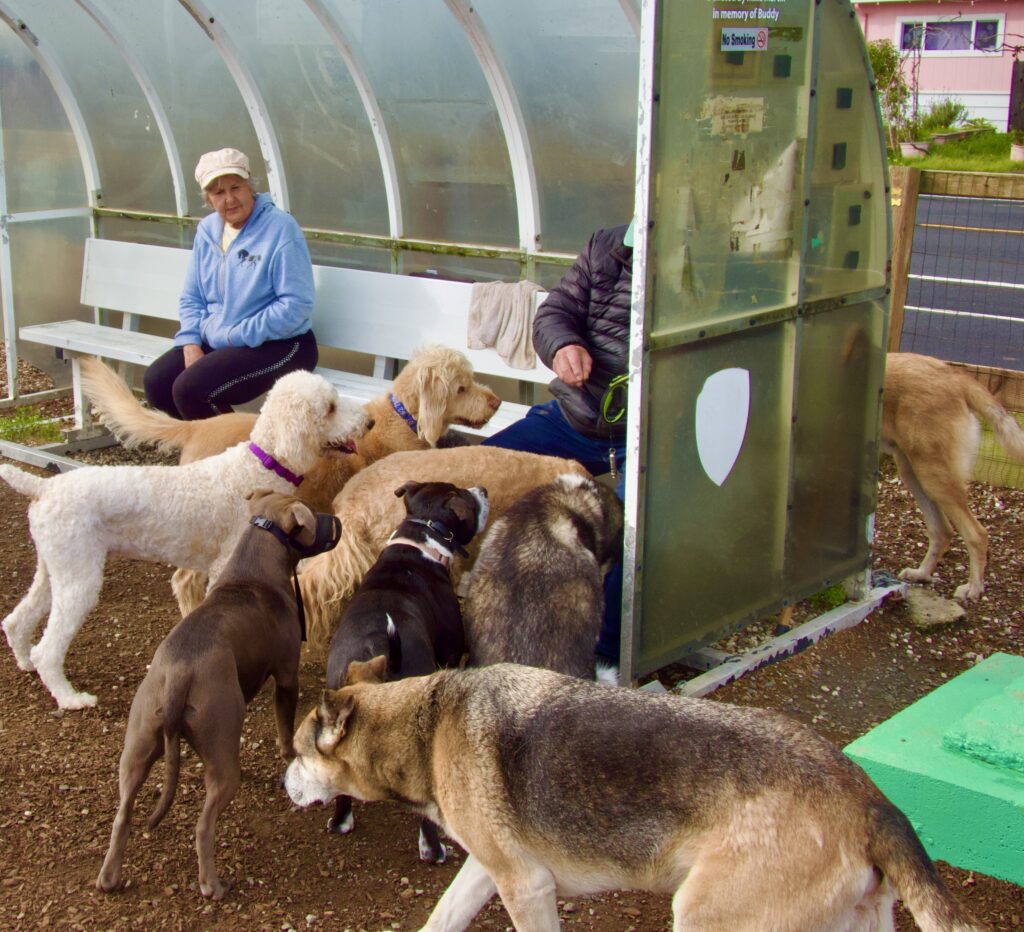
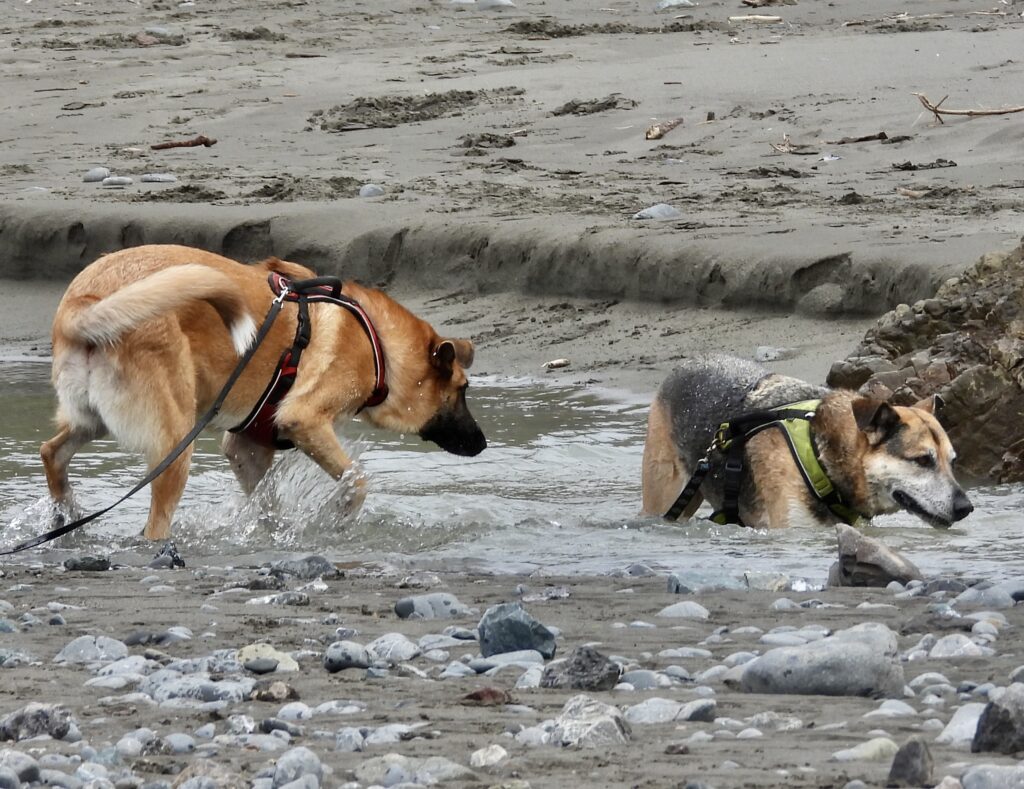
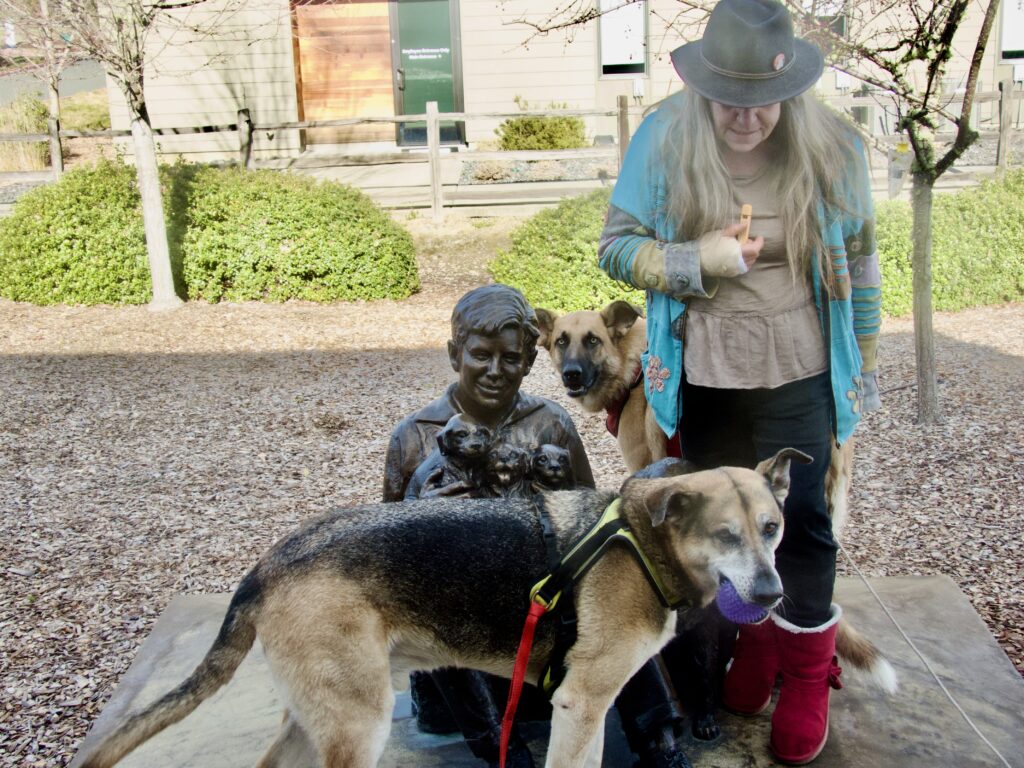
Behind the glass is Caesar, who gets nervous in big crowds and was perfectly content to watch the other dogs gobble
cookies from the safety of the window.
When you really watch birds and animals, you end up amazed by them and baffled by us — by how much of our thinking still resembles the Medieval Catholic Church, and how badly we need modern Galileos to poke holes in the nonsense we’re fed about human superiority. One of the firm “rules” we’re told is that animals don’t use tools. Yet my old GSD, Monk — trained to retrieve keys — once fetched a long stick and tried to fish out a set of keys that had fallen down a stairwell behind a locked tennis‑court gate. We didn’t document it, but another man, fed up with this anthropocentric idiocy, has an entire YouTube channel of animals using tools. My favorite is Veroniika, an elderly cow who picks up sticks to scratch her back and perform a whole repertoire of practical tasks.
Science has to stick to experiments that can be repeated under controlled conditions, and that’s fine as far as it goes. But the side effect is that what we see with our own eyes — every day, in our yards, on fishing boats, in barns, in living rooms — gets dismissed as “unproven,” or worse, filed under urban legend. The bigger problem is the failure of people to actually learn how science works, and the media’s chronic inability to communicate it. That combination is a dangerous one for any civilization. It raises the unsettling question of what happens in the next pandemic, especially if the mortality rate is high and public trust is low. The stakes aren’t theoretical; they’re about whether people understand enough to protect themselves and each other.
We all have stories of astonishing thinking, instinct, or intuition from pets, farm animals, or even some squirrel we “talked” to in the park. Once you start paying attention, you realize these moments aren’t rare at all — they’re everywhere, woven into daily life, quietly contradicting the tidy human narrative about who’s smart and who’s not.
I’ve spent my life observing German Shepherd intelligence, so most of my stories live in that world. But the thing I believe most strongly is that every animal — and every human — is unique. There is no such thing as “the smartest breed,” or even the tidy scientific claim that all ravens are smarter than all chickens. The entire scientific community seems convinced of that one, but it simply isn’t true. The root of the problem goes back to the scientific method we all learned in school: form a hypothesis, do objective testing, repeat it again and again, and eventually your hypothesis becomes a valid theory. It’s a useful tool, but it also traps us into thinking that only what can be measured, repeated, and graphed is real — and everything else, including the intelligence we witness with our own eyes, somehow doesn’t count.
This was a great way to do basic science, but it also led to a new “Man as god” belief system — the very one the Catholic Church forgot, as my modern Catholic teacher liked to say (and if the 1970s still count as modern). We traded one kind of certainty for another: instead of misinterpreted scripture declaring humans the center of everything, we now have data charts doing the same job. The faith changed, but the arrogance stayed put.
God is the center of the universe, not man and his ego. And even if you don’t believe in God, as my teacher liked to add — it’s still a far healthier way to think than the anthropomorphic arrogance that comes from misusing the scientific method. That mindset rules us now. Journalism got caught in it too: the idea that you start from a “neutral” premise, get one quote from one side, another from the other, and voilà — truth. This wasn’t my theory; it was literally imagined by secularists at the first convention of what became the Associated Press and later SPJ. They meant well, but they built a system that treats human opinion as the center of the universe and everything else — animals, ecosystems, intuition, lived experience — as peripheral noise.
So what does this have to do with Brutus and his new game? Lots. If you read the books about German Shepherds, you’ll get a terribly limited view of their abilities. Try it now: do a Google search on the origin of the German Shepherd and you’ll find the nearly universal nonsense that the breed was created by “scientific breeders” in the 20th century. It’s a tidy story, built to fit a tidy worldview — the same worldview that insists intelligence must be standardized, measured, graphed, and ranked. But anyone who has lived with these dogs knows better. Their creativity, their problem‑solving, their humor, their individuality — none of it fits inside the neat little boxes the experts keep drawing.
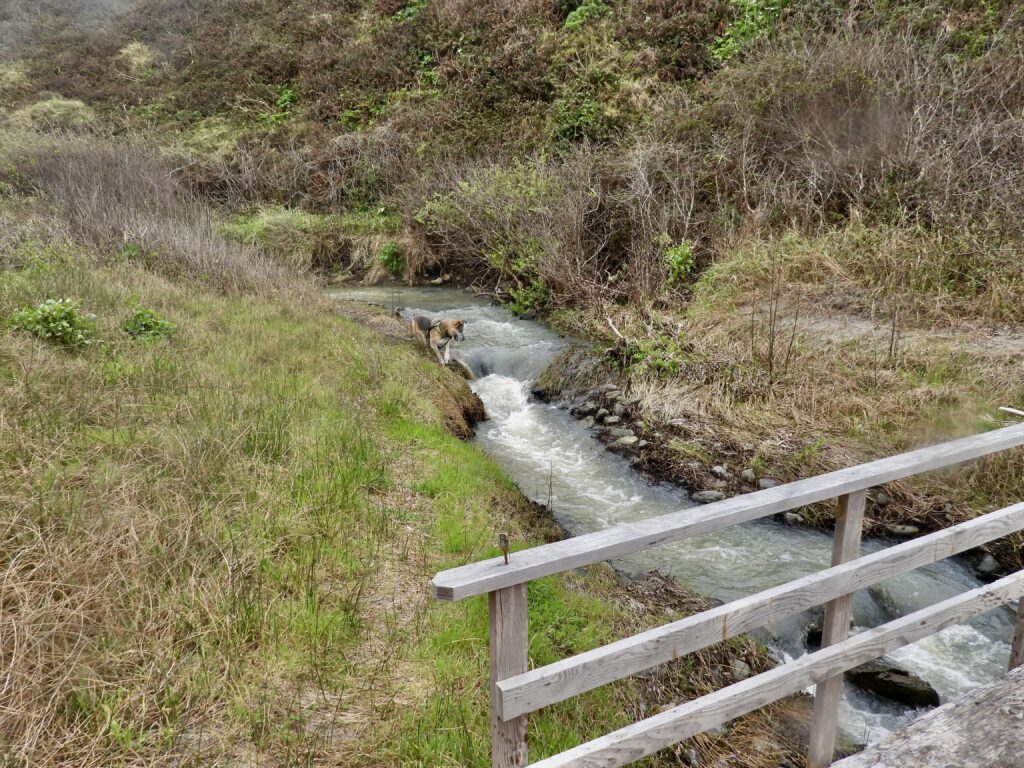
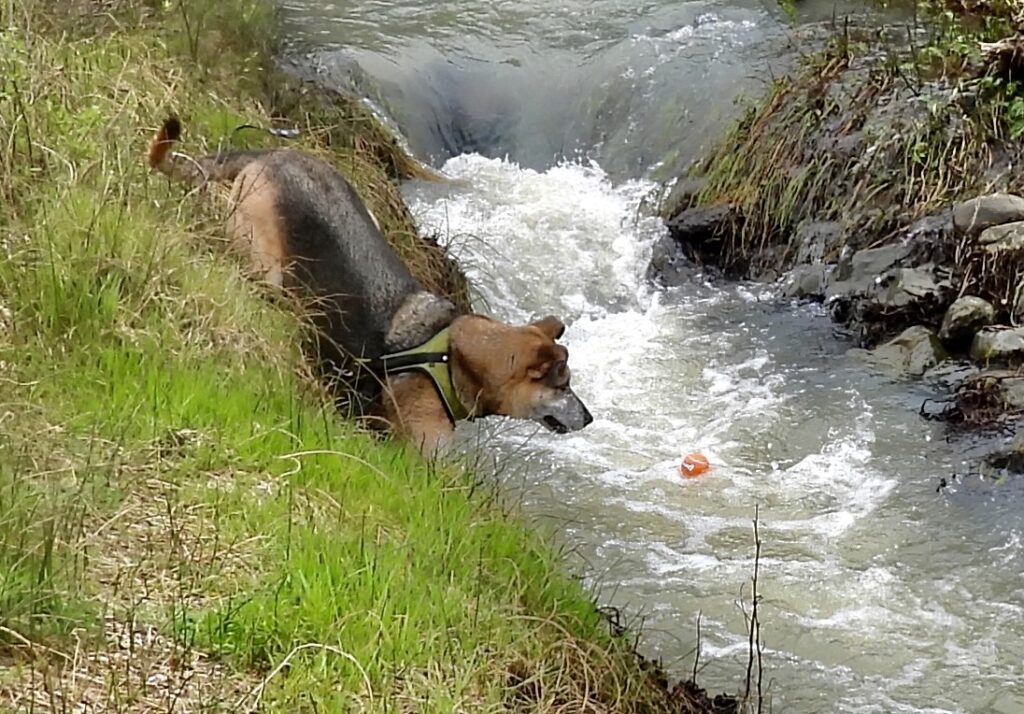
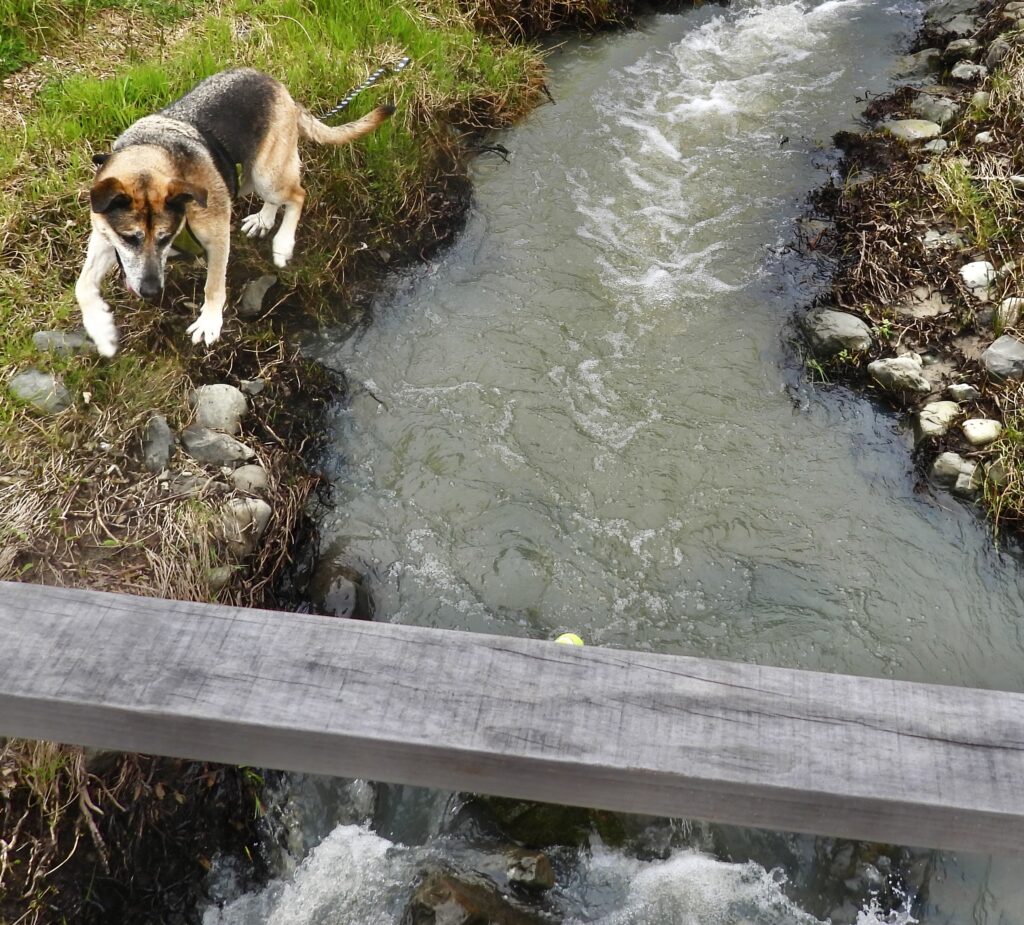
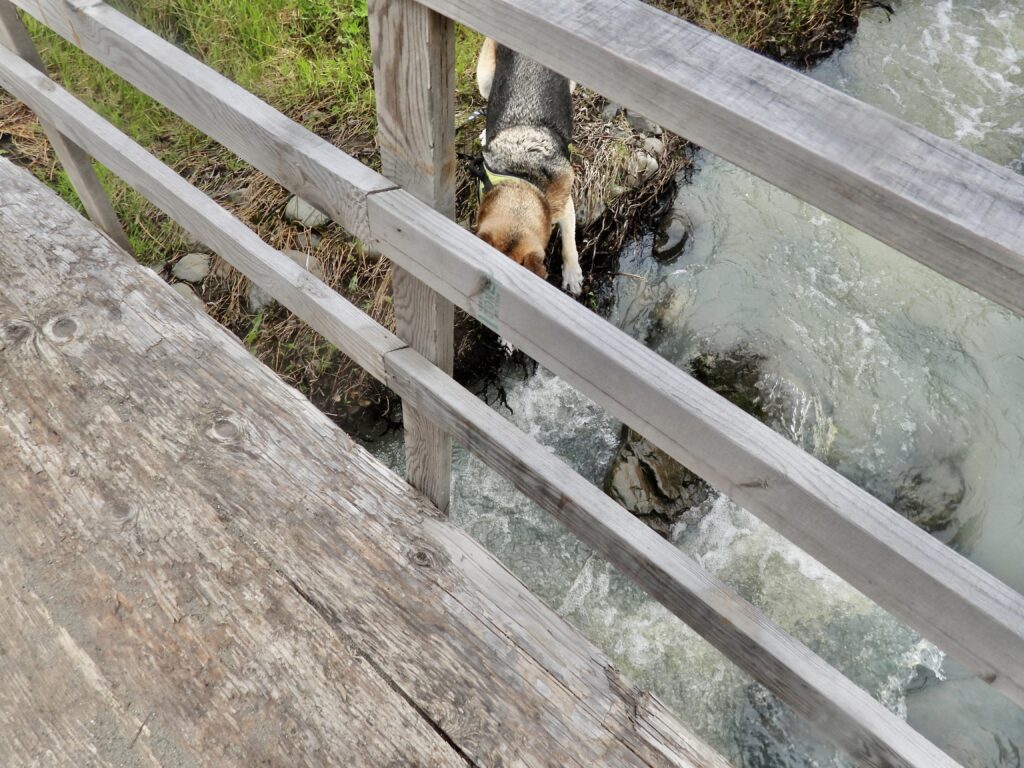
Here is how the new game works!
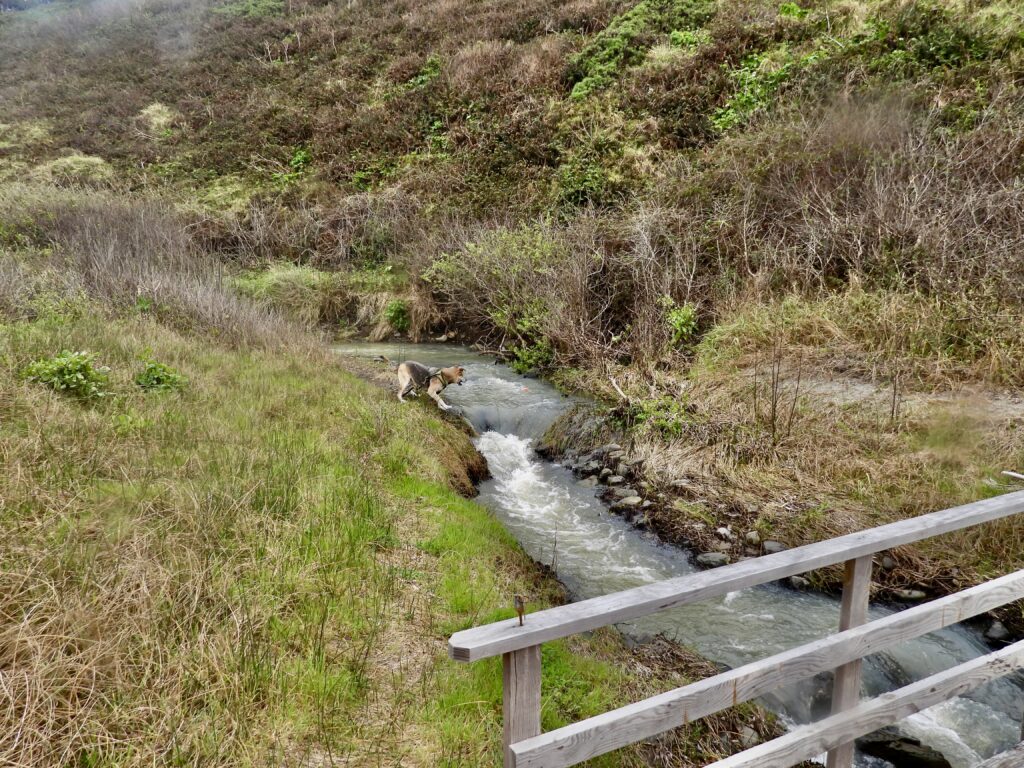
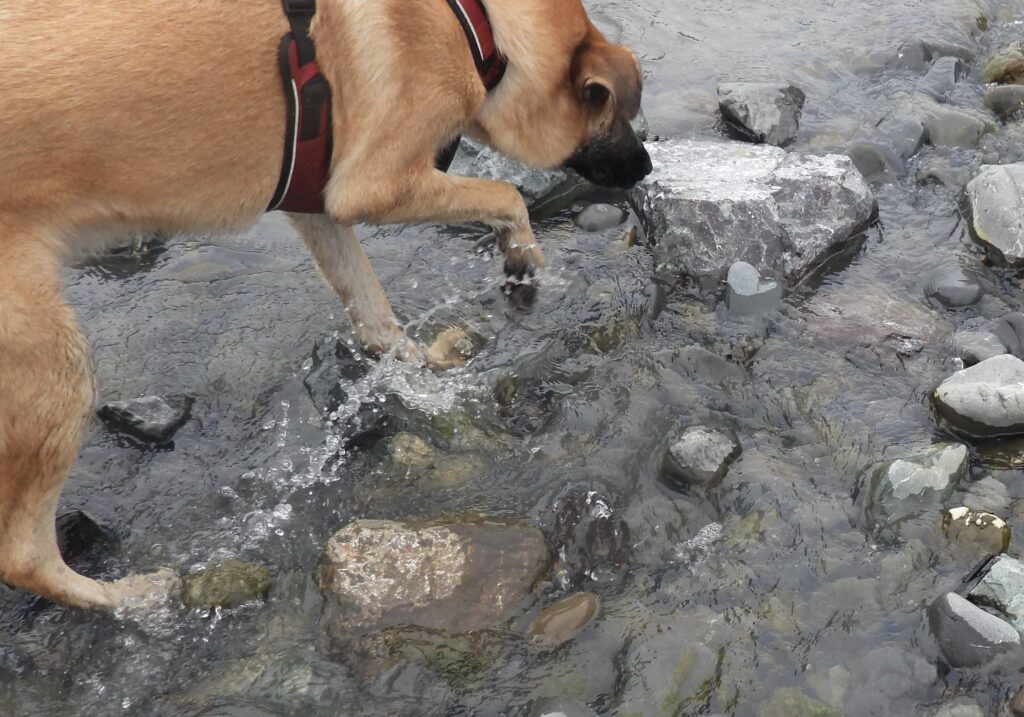
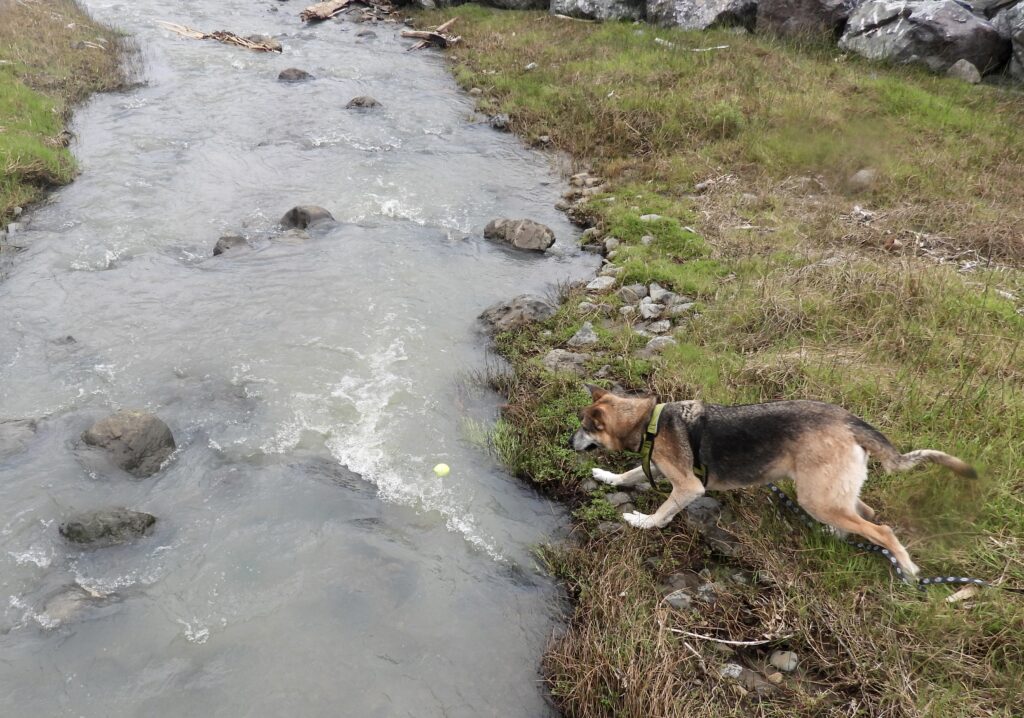
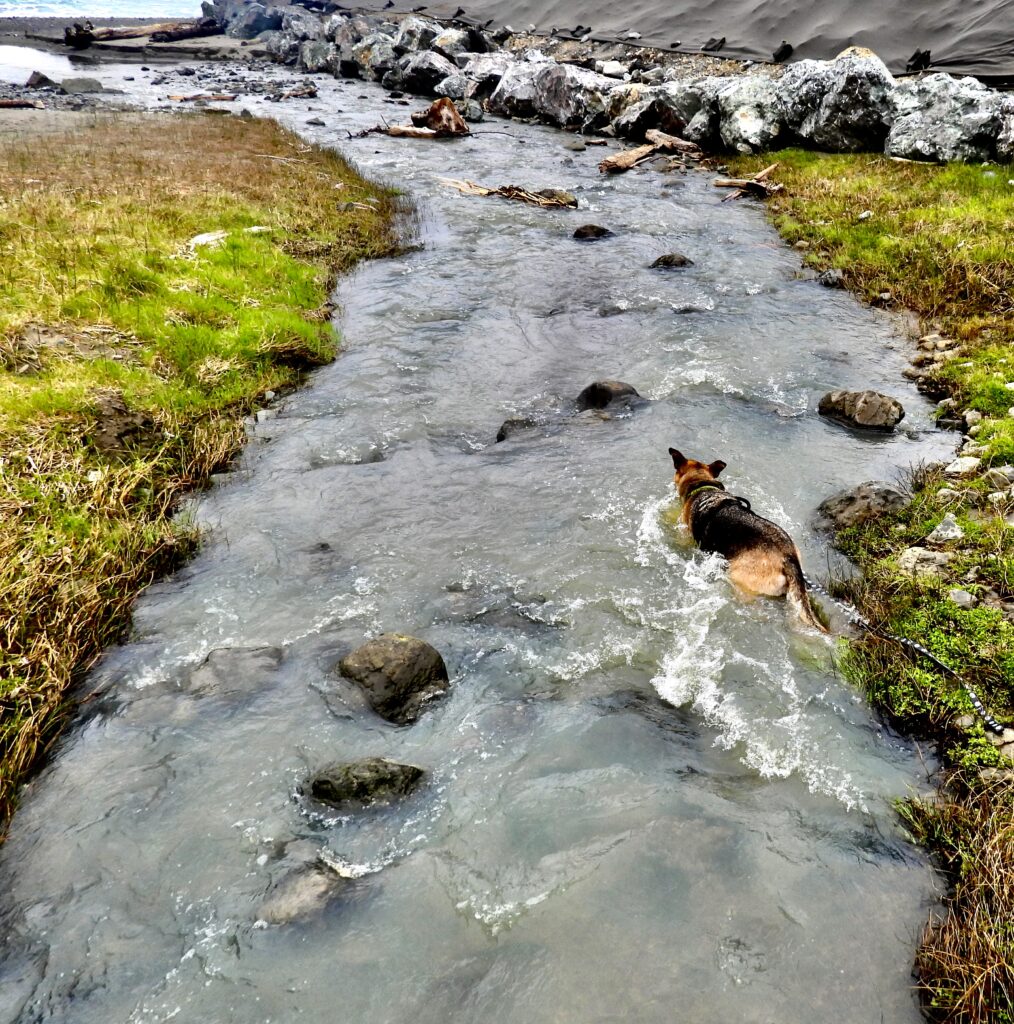
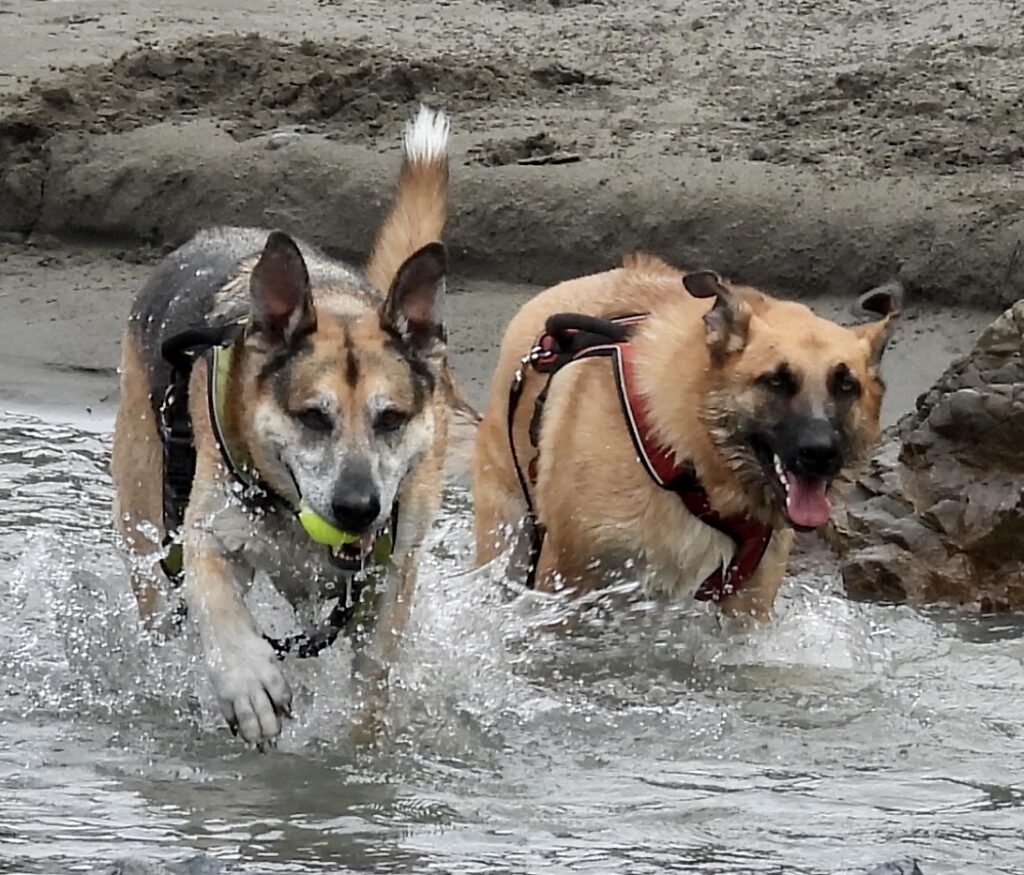
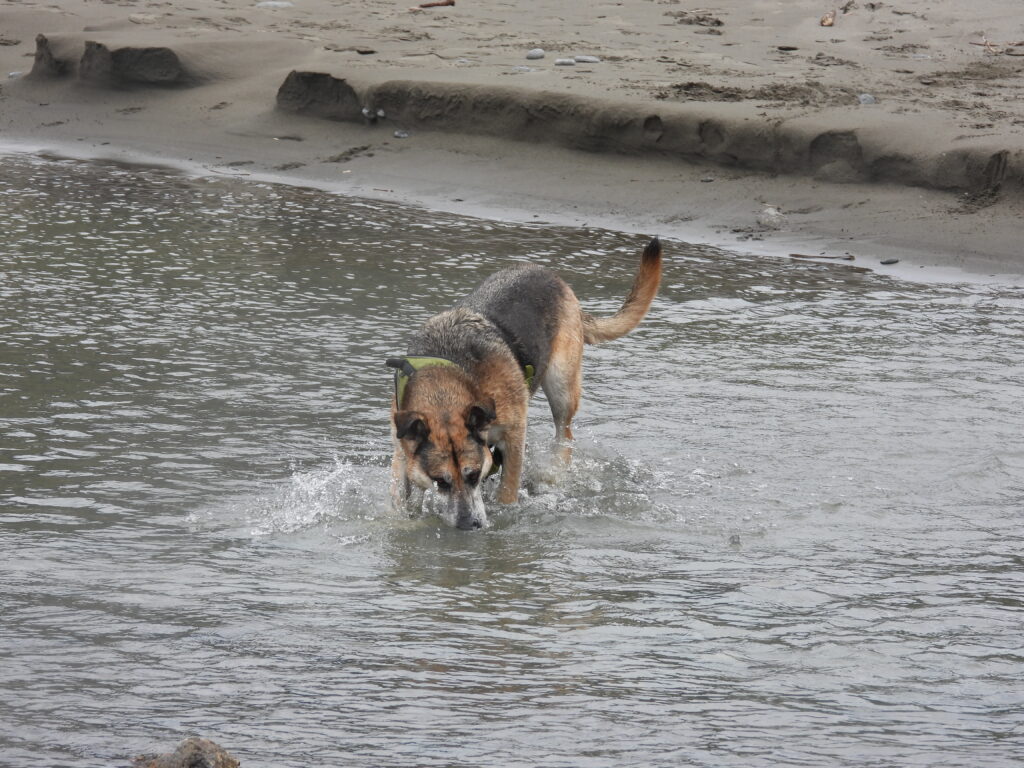
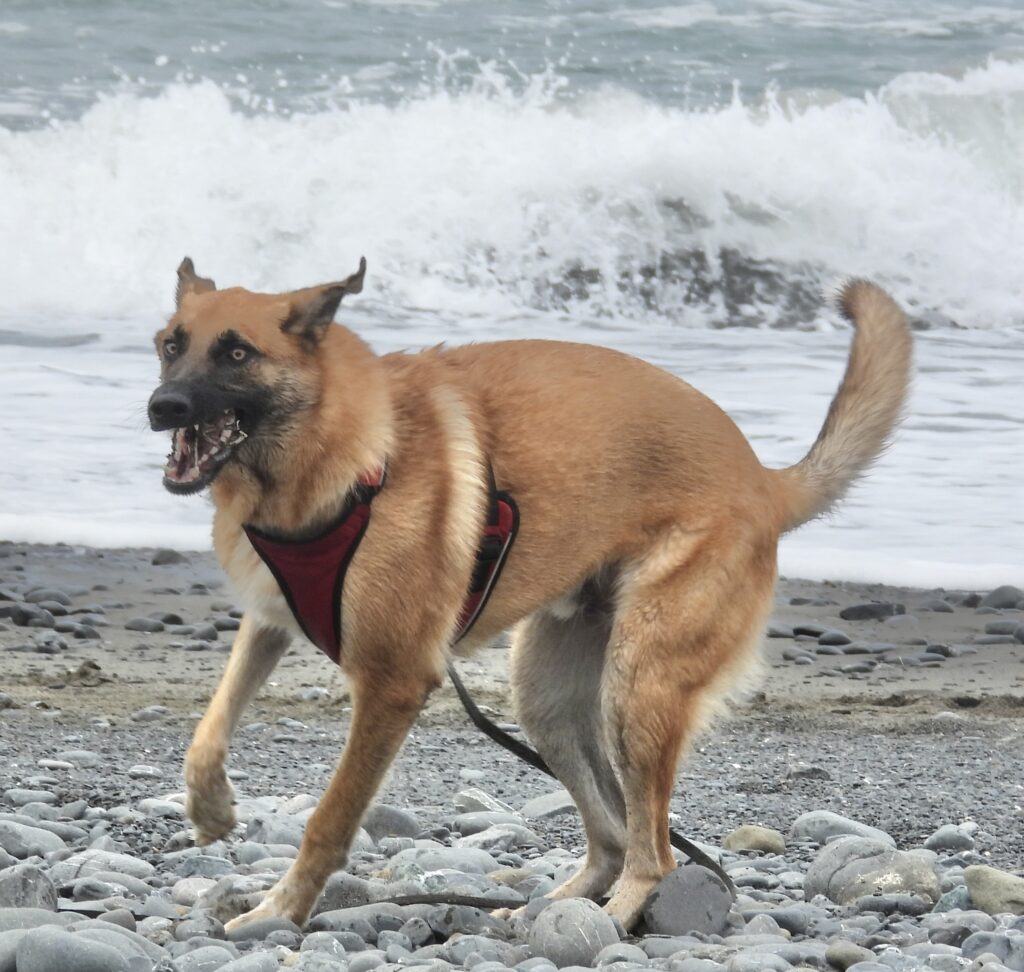
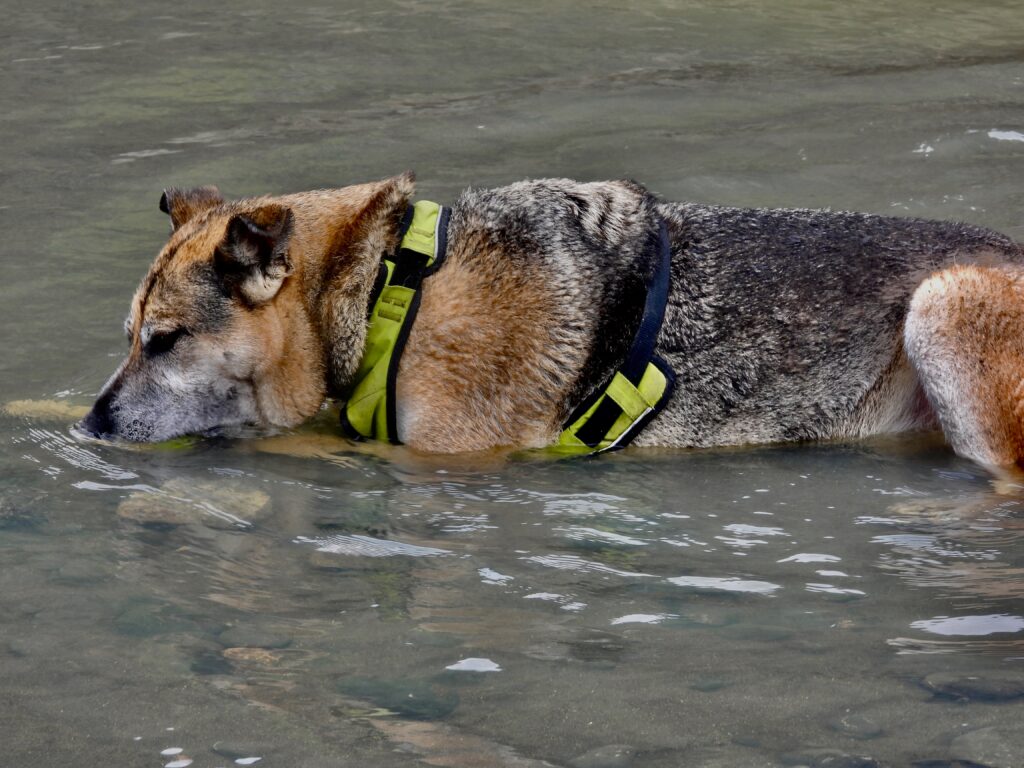
Instead of fetch, it’s a game where he throws the ball in himself. He doesn’t actually try to bring it right back. He runs down the creek, waits and watches it ride the rapids until just the right moment, then he pounces. But even then, he doesn’t bring it back to me. He puts it back in the creek and keeps going, all the way to the ocean. One part of the game I don’t understand is that when he gets the ball each time, he. will hold it underwater, shaking it or even sitting on it. When it gets to the ocean, he usually pulls it out before it heads to Hawaii , although twice during 12 rounds of the new game he let it go out to sea, then ran up and down the shore waiting for it to wash up. It did, by some miracle. Then he brought it back, finally TO ME!!! I got one throw into Chadborne Creek, then he took the ball far up the creek, dropped it in and waited for the pounce moment. Repeat, repeat 12x. He DEMANDED I watch and if I didn’t he would be very irked at me. Caesar watched too, running 20 feet inland, back and forth barking. Sometimes, he would come down to the bank and look at the ball and Brutus would chase him off. That was it! But I think it will be a winner and a big seller anywhere there are rivers or creeks! See the photos below to learn the game for yourself!
Brutus is a Belgian Malinois crossed with a German Shepherd. For thousands of years, dogs like him protected sheep and the barbarian white tribes of the region the Romans dismissively labeled Germania. Every region bred its own working dogs, each distinct, each shaped by the land and the people who depended on them. In Turkey, the Anatolian Shepherd has existed in its current form for roughly 6,000 years, its breeding guarded as a cultural secret. Then, in the 1930s, the U.S. military quietly imported a group of Anatolians, hoping to create the ultimate sheepdog for American ranchers. They planned to cross them with other breeds, but when World War II began, the project collapsed and the illegally imported dogs were sold off. Most of the Anatolians we see in the U.S. today trace back to that strange little experiment.
The Romans admired the sheepdogs of Gaul and Hispania too — dogs that already had the form of Great Pyrenees by 3000 BC. Our dog Caesar is twenty‑five percent Great Pyrenees and sixty‑nine percent German Shepherd, and knowing this history explains why he often feels far more like a sheepdog than a GSD. Breeds that have existed for millennia manifest more strongly; their instincts run deeper than anything a modern breeder can engineer. The Greyhound is mentioned in the Bible as distinctive and very fast. The Hungarian Komondor appears in its current form in a 1544 painting. These dogs weren’t invented in laboratories or kennel clubs — they were shaped by land, weather, predators, and the people who depended on them.
But in Germany, the culture was different. Local villages each had their own version of the German Shepherd, shaped over thousands of years because the Germanic peoples remained hunter‑gatherers far longer than the societies of Turkey or the Mediterranean. A hunting dog that could take down the deer or wolves was as valuable as a sheep guarder in Germany. Their dogs weren’t engineered in a lab or invented by a single breeder; they were the product of landscape, weather, predators, and the daily work of survival. Every valley, every forest edge, every sheep‑trail produced its own distinct type — variations on a theme that had been evolving long before anyone thought to write a breed standard.
Edward Tenner, in his book Constructing the German Shepherd, describes how Germany developed different versions of the dog for different purposes — one for hunting, one for herding, and one simply labeled “home defense.” This was the landscape the so‑called scientific breeders stepped into, armed with Darwin’s theory and a dash of Mary Shelley’s Dr. Frankenstein. None of the ancients kept breeding records, yet they produced powerful, consistent working dogs over thousands of years. But in the scientific age, the demand shifted: everything had to follow an equation. X + Y = Z. The mystery, the intuition, the land‑shaped wisdom of generations — all of it was pushed aside in favor of a formula.
So several German “scientists” set out to create the ultimate dog by selecting what they believed were the smartest specimens. But what, exactly, was this new German Shepherd supposed to do? One thing they promptly forgot was shepherding — too lowbrow, too rural, too old‑world for their grand project. And the result is what we see today: modern German Shepherds who are excellent protectors but essentially worthless as sheep herders. The ancient dogs did the work for thousands of years; the scientific breeders, armed with equations and ego, bred the very job right out of them. But they also gave the GSD permanent hip dysplasia, by doing what labs do and tribesmen would not do- breed in a rush to gain a single result.
It’s no coincidence that all of this unfolded at the same time the notion of “superior races” and genetic hierarchy was gaining traction — especially in Germany. The so‑called scientific fields of phrenology and craniometry, which claimed to “prove” white racial superiority through skull measurements and shapes, were wildly popular. They never survived the tests of common sense or actual scientific rigor, but they fit the cultural mood: a belief that human beings could be ranked, engineered, and perfected the same way the new dog breeders believed they could engineer the “ultimate” German Shepherd. It was the same hubris wearing two different lab coats.
Some of the phony baloney German scientists wanted the racially superior pure dog. Most wanted a good, consistent and handsome pet, or farm dog or hunting dog, or… gosh darn it they could never decide.
A society called the Phalanx Society formed in Germany to standardize the breed, but it dissolved after only three years when the arguments turned physical and the feuds over the “correct” shape of the dog became too contentious for any committee to survive. Still, breeders forged ahead, determined to create the world’s smartest and handsomest dog — and just as determined to market it. German Shepherds became both beloved and feared during World War I, and soldiers from all over the world wanted one when they returned home. By World War II, the Nazis had folded the German Shepherd into their propaganda about German superiority. Hitler was rarely photographed without his dog, Blondi, whom he poisoned before taking his own life so she would not fall into Soviet hands.
This horrifying legacy of Volkswagen Bugs and German Shepherd Dogs didn’t stop either one from becoming part of the great “German invasion” of America in the 1940s and 1950s. The dogs especially took off. Today, German Shepherds are the #2 registered breed in the United States and the #1 breed in many countries. I’ve never had one of those myself — mine have all been some sort of mutt we called German Shepherds. And honestly, mutts are always number one by a huge margin. They’re the real national dog, the ones who slip through the cracks of breed standards and marketing campaigns and just go on being themselves.
Are they as smart as advertised? Sometimes — but never in the simple, packaged way they were sold
Scientific studies say German Shepherds have the logic skills of a 2½‑year‑old child, and if you add smell intelligence, the number shoots higher. But there’s no scientific proof that German Shepherds are smarter than other breeds. The data show huge variation within every breed, and every attempt to rank them produces mixed results. In one study, a single brilliant Australian Kelpie outperformed every dog in the room and skewed the entire curve.
I’ve had German Shepherds all my life, starting with Monk — the one I stole from my sister. Monk was the most intelligent dog I’ve ever seen. He could fetch 26 different items on command — hammer, keys, jacket, whatever you named. Dad and I performed with him at Paul Bunyan Days in the 1980s, where he walked Fifi the poodle and did a tightrope act until he fell, yelped, and we got booed for it, even though the stunt was his idea. On road trips he’d spot a sliding board, bark until we stopped, then run up the ladder and slide down like a kid at recess. He came from the Berkeley pound and was scheduled to be put down the next day. He barked like a maniac — I recognized it as claustrophobia, which he had his whole life. Monk was an all‑black GSD, apparently full, and absolutely one of a kind.
Next came Sturmz, a wolf–GSD mix from the Oakland pound who used his intelligence only when it served his own agenda. Blocked by a fence in Napa, he once went a quarter‑mile down the road, crawled through a tiny Highway 20 drainpipe, climbed a seven‑foot fence, and rendezvoused with a female in heat. He was neutered immediately after that adventure. Tricks weren’t his thing, but he and I could talk in our heads as clearly as day.
After Sturmz came Aspen, a Swiss Mountain Dog–GSD mix from the Lake County pound — deeply empathetic and uninterested in proving anything. She and we adopted Reynard, a beautiful full black street‑urchin pup caught by the dog catcher in Monterey after fending for himself as a tiny puppy. He died young of bone cancer at five. Aspen and Sturmz both lived past fourteen.
Next came Brutus, whom we rescued from people he had completely overwhelmed, with Molly’s help. He was stronger, more intense, and honestly scary when we first got him. Nothing I’d learned from all the dogs before him worked fast enough, so I went to the police‑dog school for help. Linda and I put thousands of hours into him, and by three he was the best‑trained dog we’d ever had. German Shepherds aren’t known for perfect obedience, but once he understood my strongly expressed orders, he followed them from then on. Brutus is the baddest ass USMC TYPE A guy you will ever meet, but also a total goofus for play.
Early on, after raccoons killed some of our chickens, I told him, “YOU get those.” He sniffed, understood, and did — instant termination. Raccoons, a fox, even a bobcat in the chicken house or after the birds — all dispatched. I wished I hadn’t taught him that. Later we learned about his breeding: he’d been meant for military use.
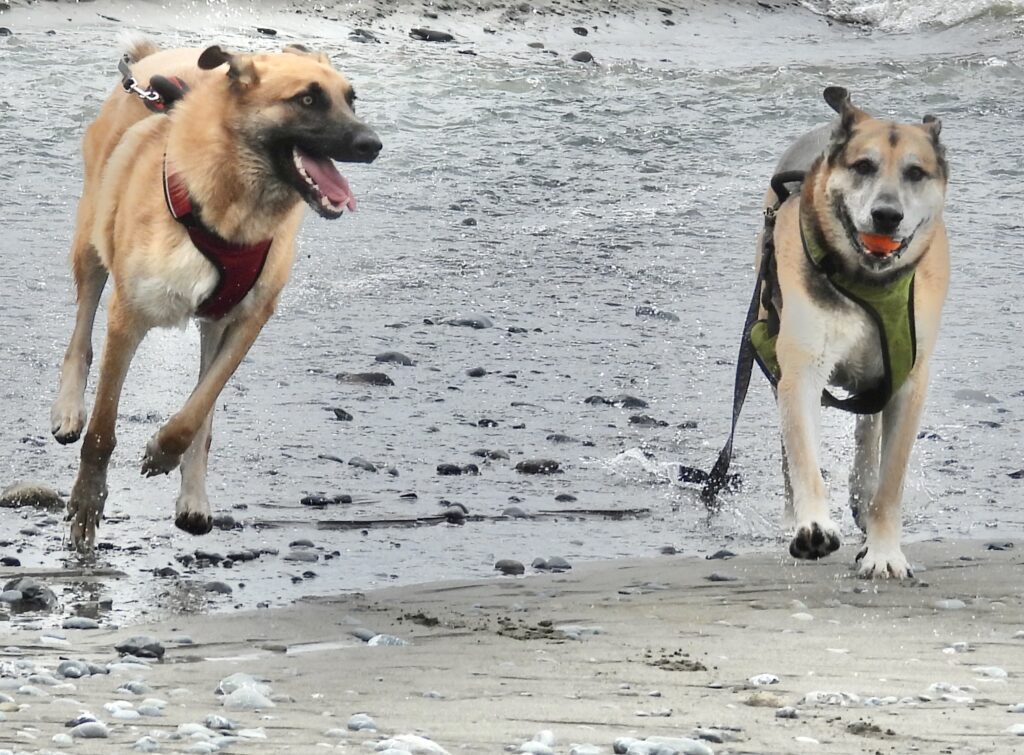
At ten, Brutus is still off‑the‑charts intense, just a little less volcanic than he used to be. His black coat has gone almost entirely gray now. We adopted three‑month‑old Caesar, the most friendly, non‑aggressive, high‑spirited lover imaginable — all heart, no fight — and he worships Brutus. Brutus, in turn, treats him with astonishing gentleness.
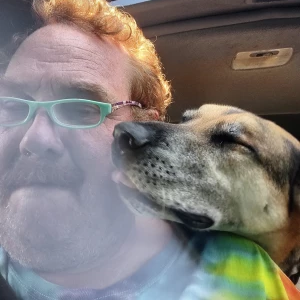
Brutus slept in our bed every night for nine years. When Caesar arrived, Brutus showed the puppy the bed and never came back, refusing even to consider it. It was his gift to the little guy, who is now bigger than he is.
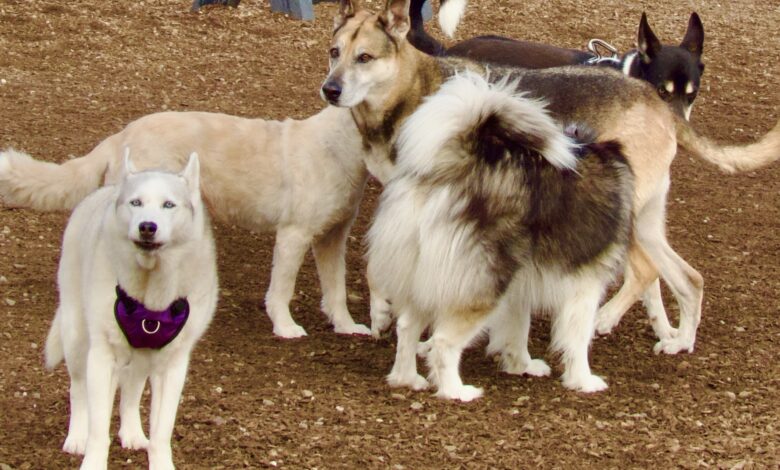
Caesar is sixty‑nine percent German Shepherd and twenty‑five percent Great Pyrenees, another ancient sheepdog breed from Spain. The GSD part is the newcomer; the Pyrenees wins out most days. He’s logical, but always watching with extreme caution- he was bred to watch wolves and watches with trepidation his own wolf, whom he worships. Caesar won’t eat or go outside until Brutus says its time to do so.. Brutus would thoughtlessly charge into Hell and bite the devil on the leg. Caesar once had a pet caterpillar he protected, and he has to watch, sniff, and circle before deciding to proceed — even if the “suspect” is a piece of steak.
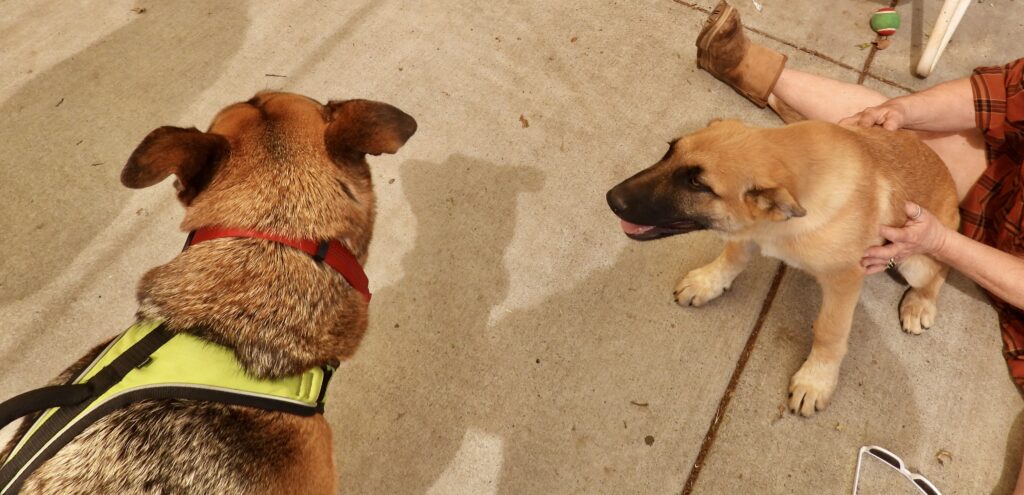
I hadn’t planned a story, but when I watched Brutus invent a new game and then try to teach it to me, I had no choice but to report it. He gets mad when I take photos instead of paying attention, so I didn’t get many. His communication — watch this — is unmistakable. All my GSD crosses have invented games and tried to teach them to me. We both think logically, but those pesky species lines make it hard to speak the same language.
Come along on our photo story and see if you can figure out all the rules.
If we’re going to survive as humans, we have to learn to speak their language again instead of forcing them to be what we want. That’s the lesson Brutus was offering in that split second of watch this — a reminder that the world isn’t built on our commands, our theories, or our tidy ideas of control. It’s built on relationship, attention, and the ancient intelligence still walking beside us on four legs.
We don’t teach them nearly as much as they teach us. And if we’re smart — truly smart — we’ll start listening again.
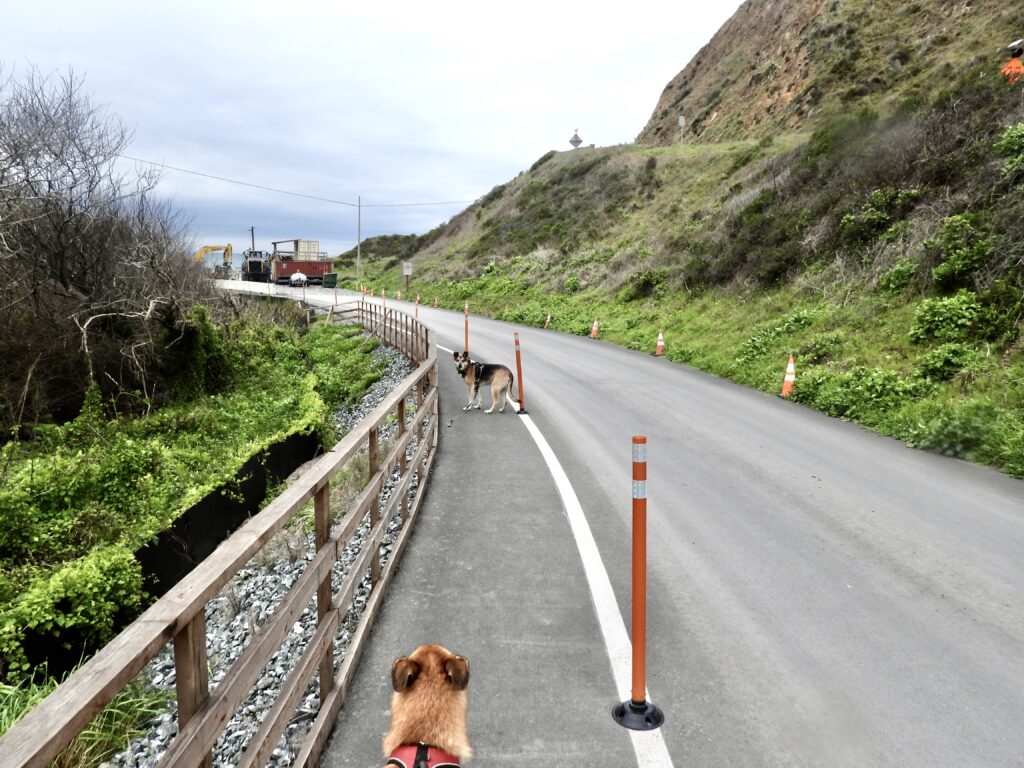
and shout “hurry up” like this.


So what was the game he taught you!?
Its the one I showed photos of. I should give more of an explantion. Instead of fetch, its a game where he throws the ball in and he fetches to himself, only to do it again. He goes all the way down the creek, then gets it out of the ocean and brings it to me, for one throw up creek. Then he goes up and throws the ball in for the ride down the rapids I should put this in the story!