Big shakes at Fort Bragg PD: New Chief today?, Grand Jury Response, Transparency Portal

Three men — two from within the Fort Bragg Police Department and Interim Chief Eric Swift — are vying to become the city’s next chief this week. We expected a decision by Friday but the smoke signals have still not been sent out by Jason, Marcia, Lindy, Tess and Scott. It could be Monday now. All three would be a credit to Fort Bragg, and it’s hard to imagine any of these gentlemen struggling to work together once the decision is made. The two are Capt. Thomas O’Neal and Sgt. Jonathan McLaughlin.
Chief Swift announced the launch of the long‑awaited (Flock Automated License Plate Reader or ALPR) transparency portal .Promised by the city back in late 2024, the portal never materialized until Swift and his team pushed forward after concerns were raised about Flock cameras.
We interviewed Chief Swift shortly after the Flock camera issues surfaced. Unlike other media outlets, we pressed him on the city’s broken promise of a portal. Swift didn’t make the promise himself, but once he committed publicly — including in council session — the portal was delivered quickly.
Check out the portal:
Fort Bragg CA PD Transparency Portal
Swift didn’t make the original promise, but once he told us — and, we believe, the council in open session — that the portal would be delivered, it was completed quickly.
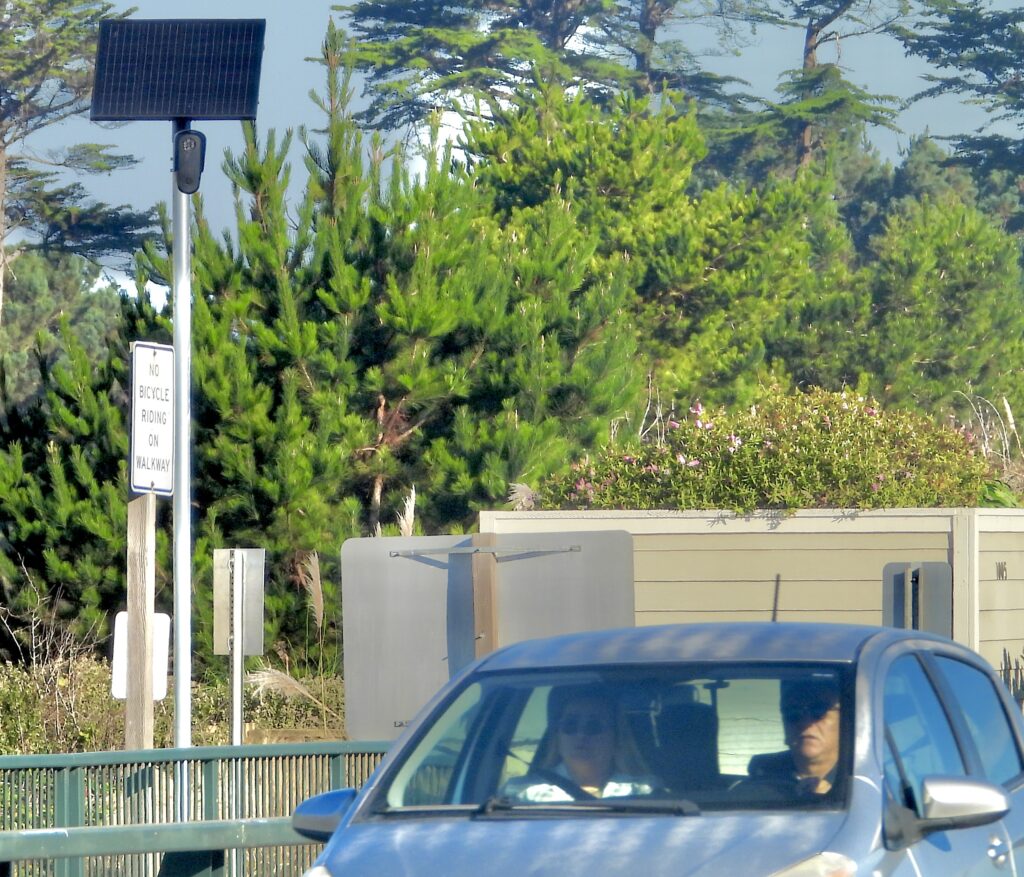
He also objected to calling the Flock devices “surveillance cameras.” In his view, the word carries the connotation of constant monitoring. ALPR cameras only capture still images of vehicles and license plates at a moment. The cameras Fort Bragg uses are narrowly focused:
“It hits on the license plate, not looking at people. … No one is actively using it to track people. It’s just looking at the license plate and the make of the car. When you use the word ‘surveillance,’ I think that gives people the idea it’s being monitored in real time. For example, we’re not looking for DUI drivers. We’re not sitting at the camera, watching. There is a hot sheet, and if a plate on that hot sheet is a hit, it sends out a message.”
Anytime a vehicle is reported stolen, it can be placed on a list called the hot sheet. Other serious felonies tied to a license plate or vehicle can also be flagged and searched for using the Flock system.
We asked if the cameras could be used in an investigation. Swift confirmed that if, for example, a bank were robbed, police could check whether the suspect’s car passed a camera. That creates an audit trail, viewable on the portal. Each use of the system leaves a public record.
Swift emphasized that the data is stored securely and not available to other agencies:
“The data is ours. It cannot be sold by Flock. And once thirty days is up, it’s gone.”
By default, the data is stored for 30 days. Some cities retain data for shorter periods. Swift acknowledged the question but argued that information must be kept long enough to allow retrieving evidence which supports open investigations; immediate deletion would hinder that work.
We also discussed Axon body and car cameras. Swift said their data is likewise not shared and is retained for one month, the same as Flock.
Nationally, Flock cameras are controversial, though other brands — used mostly on officers and patrol cars — have not drawn the same scrutiny. Those cameras record everything they see, including license plates in private lots during calls. Locally, they’ve been in use for eight years, but Swift stressed that FBPD’s ALPR are used to find license plates or vehicles if they are tied to specific calls, felonies and/or on the hot sheets.
He added that Flock data cannot be shared with ICE or other non‑state agencies. Traditional police databases have long contained information on stolen cars or suspects from other states, but Flock data is limited to California departments.
Of course, surveillance technology is not new. During the Bush administration, when Frank worked for the Advocate News, the Coast Guard commander described a “see‑everything” camera at the mouth of the harbor, monitored 24/7. The device can still be seen from the jetty, though later commanders said it became outdated years ago as better technologies emerged.
Swift made clear that for him, transparency is a priority. He wanted the portal up and running quickly, and he believes it can even help prevent crime:
“The very fact that criminals know there are ALPR cameras at all the city entrances is a deterrent. Some might not come here because they know about this, and the added risk isn’t worth it.”
In recent days, controversy over Flock cameras has surfaced again — this time in Oakland.
Oakland police hit with lawsuit for sharing license plate camera data with feds
We previously reported on this issue in this article:
No Public Portal: Flock System Lacks Promised Access by Fort Bragg Police – Mendocino Coast .News
We are continuing to follow national news about Flock cameras, especially the claims raised in one particular video that we covered in this article:
In another item we reported, the city is compiling facts about the Care Response Unit (CRU). This special three‑person team — neither police officers nor social workers — has been credited with helping address homelessness in Fort Bragg. The program has drawn interest from other cities.
At the same time, the city and the Fort Bragg Police Department are responding to questions raised by the Grand Jury about the Care Response Unit (CRU). The Grand Jury spent most of its April report praising the CRU.
2025 Grand Jury report on homelessness
The Grand Jury is seeking more data so that Fort Bragg’s CRU solution can be more useful for expansion.
“The Grand Jury has not received any outcome results, but at the time of this report the CRU program is experiencing much local praise and positive media attention and is now being copied and studied by various cities in California and beyond. The University of California, Los Angeles is evaluating the program for wider implementation,” the Grand Jury reports.
The Grand Jury reported that one flaw of the CRU is that it ends at the city lines and is contributing to homelessness in the areas outside the city.
“A criticism of the CRU program shows that individuals who decline services frequentlyleave the city limits. If an individual does not have an adequate home to which they can return, CRU personnel may transport the individual to outside city limits to join a nearby homeless encampment.
The city has a plan to fix that problem, but for that more stats are needed, not just positive news stories.
“The Fort Bragg Police Department’s plan to counter this criticism is to bring CRU to nearby towns from Cleone to Elk, including Caspar, Mendocino, Little River and Albion. These small towns do not have their own law enforcement agencies and rely on the Sheriff’s Office for support. The Sheriff’s Office covers the coast from Gualala to Rockport, nearly 100 miles, with only two deputies. At the time of this report, Fort Bragg has a successful homeless program in place, “ the Grand Jury reports.
The city is compiling data to answer the Grand Jury’s questions, following its April report. That will be presented at the first City Council meeting in December
The CRU was one element of a broader approach to homelessness inspired by controversial consultant Robert Marbut and led by then‑Mayor Bernie Norvell along with the council, including Lindy Peters. That strategy combined multiple efforts: building homes for the homeless through the Plateau project, using the CRU to spearhead a winter shelter, and moving people from out of town along after one night in the shelter or as quickly as possible.
Frank writing in the Mendocino Voice
Fort Bragg’s new housing project creates neighborhood of seniors, families and homeless
And:
Fort Bragg’s new crisis team gets thumbs-up from controversial homeless expert • The Mendocino Voice
The Public Safety Committee meeting this week, where the Grand Jury report was expected to be discussed, lasted only twenty minutes. The matter will now return on the December city council agenda.
The only substantive discussion came when Committee Chair Lindy Peters said Police Capt. Thomas O’Neal had not been given enough credit for the Care Response Unit (CRU). Former Chief Neil Cervenka had led discussions on the issue, but when we asked questions, those questions were were often referred to O’Neal.
“It was Thomas O’Neal that brought this to the Public Safety Committee meeting. There are some other people who seem to be wanting to take a lot of credit for this program, but he’s the one that brought it to us. We’re the ones that moved it forward. And you know, if you hadn’t showed up that day with that particular report, who knows where we’d be right now with our homeless situation. I think it’s been very effective, and I know your staff report that comes out on the statistics is going to prove that. But I just want to commend you for bringing it forward. The first time it was your idea, and then you let it go. And it seems like some others are taking more credit than they should for something you brought forward. So I want to thank you personally and on behalf of the city for doing that,” Peters said.
O’Neal responded:
“I deeply appreciate that, but I will absolutely say I have one of the most amazing teams I have ever worked with in my current CRU team. And I’ve also been lucky to have chiefs who have given me free rein to do some crazy stuff.”
Peters added:
“So thank you. And remember, it’s grant‑funded for the most part, and we have to go out and find the money when we do this. Sometimes it’s not easy, and you’ve been very helpful with that as well.”
Fort Bragg now stands at a crossroads: choosing its next chief while proving that transparency and accountability are more than words. The new portal is a step forward, but the CRU debate shows how vital facts and follow‑through remain.
Leadership, technology, and community trust are converging. The measure of success will not be in promises, but in whether residents feel safer, better served, and fully informed.
We have tried unsuccessfully to steer the debate away from just Flock cameras to all the brands and the massive surveillance state we now live in, created by everybody having cameras everywhere. We will be demanding not just a portal but more information on the security and storage of all the vendors used by all the governments in the county going forward. Stay tuned!
I don’t support the decision to install the Flock cameras in this town or in any public place. A review of the many lawsuits and news stories about the Flock company suggest that:
The cameras and data has been hacked quite easily.
The company does not delete the images and data as represented.
My understanding is that Flock owns the cameras, the images and data generated and controls the system, except perhaps when it gets hacked.
The company may collect and interpret the data generated for commercial and other purposes.
The “studies” that Flock uses to promote and sell their services were done by the company and not by independent parties. These “studies” have been demonstrated to be unreliable, biased and misleading.
It appears that the residents and visitors to Fort Bragg are sacrificing their privacy for a false sense of security.
-Dave